CONSUMER CONTRACTS DON'T MATTER WHEN APPELLATE COURTS CREATE CASELAW TO ALLOW CIRCUMVENTION
Much of the discussion about the state of American consumer law, including the ongoing controversy over the Restatement of the Law of Consumer Contracts, and its reliance on quantitative surveys of caselaw of questionable quality, center on issues surrounding consumer contracts at the front end:
Questions such as the manner in which a contract is formed in the first instance, and how terms are later modified; whether the specific terms applicable to the transaction are disclosed to the consumer in a meaningful and understandable manner; and whether they are excessively one-sided, oppressive, or unconscionable.
CONSUMERS AS CLAIMANTS (PLAINTIFFS)
One major underlying concern is that consumers’ ability to bring claims against businesses may be jeopardized, that the scope of rights a consumer has under such a contract may be unduly limited, such as through mandatory arbitration and class-action waiver clauses, and that consumers may be prevented from vindicating their rights—including statutory rights that come into play based on the nature of the transaction--in an effective manner.
A related issue is whether consumer contracts are drafted to effectively preclude relief that could otherwise be obtained through class actions. This is obviously of great importance in instances of large-scale wrongful business conduct where the value of each claim any single consumer might have is too small to make it economically feasible to bring such claim in an individual action.
Questions such as the manner in which a contract is formed in the first instance, and how terms are later modified; whether the specific terms applicable to the transaction are disclosed to the consumer in a meaningful and understandable manner; and whether they are excessively one-sided, oppressive, or unconscionable.
CONSUMERS AS CLAIMANTS (PLAINTIFFS)
One major underlying concern is that consumers’ ability to bring claims against businesses may be jeopardized, that the scope of rights a consumer has under such a contract may be unduly limited, such as through mandatory arbitration and class-action waiver clauses, and that consumers may be prevented from vindicating their rights—including statutory rights that come into play based on the nature of the transaction--in an effective manner.
A related issue is whether consumer contracts are drafted to effectively preclude relief that could otherwise be obtained through class actions. This is obviously of great importance in instances of large-scale wrongful business conduct where the value of each claim any single consumer might have is too small to make it economically feasible to bring such claim in an individual action.
CONSUMER CONTRACTS
AT THE BACK END – WHEN CONSUMERS BECOME LAWSUIT TARGETS
Much more, however, is at stake for individuals at the back-end,
when the business has a claim against a consumer, and takes the consumer to court.
And that’s where consumer contracts matter too. At least in theory.
And that’s where consumer contracts matter too. At least in theory.
A debt collection claim is, in essence, a breach of contract
claim because the creditor’s complaint is that the consumer has defaulted, i.e.
has not made periodic payments as promised, which takes two basic forms: (1) a failure
to make regular installment payments as they become due under the amortization
schedule of a retail installment contract or (2) a failure to make monthly
minimum payments computed based on a formula contained an agreement governing open-end
credit such as a credit card account. In the latter case, the minimum payment will
typically consist of a percentage of the revolving balance and current finance
charges, which may include other charges (such as a late fee or over-limit fee)
in addition to the newly accrued interest and any past-due amount.
To prove such a breach-of-contract claim under Texas common
law, a plaintiff must adduce sufficient evidence on a several essential
elements: (1) a valid contract, (2) performance by the plaintiff or tender of
performance, (3) breach by the defendant, and (4) damages caused by breach.
In order to obtain a judgment against a consumer, a creditor
would, under long-standing caselaw, have to produce competent evidence on each
element. If the creditor fails to do so, or if the proffered evidence is of
questionable quality and therefore subject to evidentiary objections and
exclusion, the consumer may have a viable defense to the lawsuit.
The reality, however, is different. At least in Texas, appellate
courts have made it much easier for creditors to obtain judgments against
former customers by relaxing conventional proof requirements in debt collection
cases, and by allowing creditors to avoid the proof requirements applicable to a breach-of-contract
claim altogether, thus rendering the contract, and whatever terms it may contain,
immaterial.
CIRCUMVENTION OF
PROOF REQUIREMENTS APPLICABLE TO BREACH OF CONTRACT
Starting in 2008 with an opinion issued by the Dallas
Court of Appeals, Texas courts have allowed creditors to circumvent the proof
requirements of a breach-of-contract claim by bringing the collection action as
a common-law “account stated” claim instead, or in the alternative. See Dulong v. Citibank (South Dakota),
N.A., 261 S.W.3d 890, 893 (Tex.App.-Dallas 2008, no pet.).
"ACCOUNT STATED" ADAPTED FOR CREDIT CARD
DEBT COLLECTION IN TEXAS
When a creditor proceeds on an account-stated theory, it no
longer has to provide even a copy of a boilerplate credit card agreement. Credit
card statements alone will do.
See à The Account Stated Theory and the lowering of proof requirements in credit card debt collection cases; --> Resurrection of account-stated for credit card debt collection in Texas.

See à The Account Stated Theory and the lowering of proof requirements in credit card debt collection cases; --> Resurrection of account-stated for credit card debt collection in Texas.

Also see: Emanuel J. Turnbull, Account Stated Resurrected: The Fiction of Implied Assent in Consumer Debt Collection, 38 VT. L. REV. 339, 340 (2013)
Several other courts of appeals have jumped on the bandwagon
without re-examining the validity of the suit-on-account theory for collection
of a bank debt that does not involve sale of goods or services, thus lowering the
proof requirements for credit card debt plaintiffs, and depriving the
defendants of any benefits that might accrue from the existence of a written
contract. See, e.g., McFarland v. Citibank (S.D.), N.A., 293 S.W.3d 759, 764
(Tex. App.-Waco 2009, no pet.) ("Thus, we join our sister courts in
holding that account stated, and not a suit on a sworn account, is a proper
cause of action for a credit card collection suit because no title to personal
property or services passes from the bank to the credit card holder."); Jaramillo v. Portfolio Acquisitions, LLC, No. 14-08-00939-CV, 2010 WL 1197669, at *7 (Tex.App.-Houston [14th Dist.] Mar. 30, 2010, no pet. h.) (mem. op.); Butler v. Hudson & Keyse, L.L.C., No. 14-07-00534-CV, 2009 WL 402329, at *3 (Tex.App.-Houston [14th Dist.] Feb. 19, 2009, no pet.) (mem. op.); also see Houle v. Capital One Bank (USA), NA., No. 08-16-00234-CV (Tex.App.- El Paso, 2018, pet. filed) (affirming summary judgment for credit card bank on two theories).
 |
| McFarland v. Citibank (South Dakota), N.A., 293 S.W.3d 759 (Tex.App.-Waco 2009, no pet.) |
QUANTUM MERUIT REMEDY ALSO MIS-APPROPRIATED FOR CONSUMER DEBT COLLECTION - FOR THE BENEFIT OF A VULTURE FUND, NO LESS
One Texas court of appeals has gone so far as to bless quantum meruit as an alternative theory for the collection of a bank debt, even though quantum meruit is an equitable theory and is generally precluded when a contract governs the parties’ relationship because a suit to enforce the contract provides an adequate legal remedy.
In 2008, the Fourteenth Court of Appeals jumped on quantum meruit to accommodate a debt-buyer entity that was at that time a prolific litigant in court all around Texas, but had not adduced sufficient evidence from the original creditor to prevail on its breach-of-contract claim in the case that came before the court. See McElroy v. Unifund CCR Partners, No. 14-07-00661-CV, 2008 WL 4355276 (Tex. App.-Houston [14th Dist.] Aug. 26, 2008, no pet.) (mem. op.).
Quantum meruit generally applies only to
claims based on the sale of goods or provision of services not paid for. A bank does not
sell goods or services. Instead, it makes its money by charging interest on the
extension of credit and on fees paid by merchants that accept their cards. Interest
is not compensation of services, and the goods or services charged on a credit
card are provided by third parties. These purchases are financed by the bank, rather
than the bank acting as seller. The only component of a balance on a credit
card account that arguably constitutes compensation for a service provided by
the bank to its customer would be an annual membership fee or monthly service
charge. But even that is debatable, at least under federal law governing
consumer credit, including the federal definition of what constitutes finance charges.
A memorandum opinion issued by the same Houston-based appellate court in a subsequent credit card collection case brought by a bank (rather than a debt buyer) likened the case to McElroy in that it was undisputed that “there was a credit-card agreement of some kind,” but did not take issue with the blessing of the quantum meruit doctrine for credit card debt collection. See Ayers v. Target Nat'l Bank, No. 14-11-00574-CV, 2012 WL 3043043 (Tex. App.-Houston [14th Dist.] July 26, 2012, no pet.) (mem. op.) (reversing summary judgment granted in favor of bank on breach-of-contract theory).
Ayers’ discussion of McElroy solidifies the conclusion that the quantum meruit claim had been permitted even though the breach-of-contract cause of action was available, and could have been pursued with proper evidence. By affirming the judgment for the creditor in McElrod despite the creditor’s failure to prove up the terms of the underlying credit card agreement, the Fourteenth Court of Appeals essentially condoned and excused the debt buyer’s failure to adduce the requisite type and amount of proof. It blessed the circumvention of those proof requirements through an alternative theory that had--at least until then--been inapposite and unavailable because quantum meruit is an equitable remedy incompatible with the existence of a contract governing the parties’ relationship.
But once a court of appeals makes an error of law, the same court can then defend and repeat the error by treating it as a prior ruling with the force of precedent.
That has not happened with McElroy, but it did happen with the Dulong precedent from Dallas, which has been cited and relied upon numerous times by appellate courts since. Account Stated is routinely pleaded by some creditors in mass litigation in the trial courts. Very few such cases reach the courts of appeals these days. Some banks have also embraced the new opportunity.
Wells Fargo, for example, now pleads an account-stated count in addition to their cause of action for breach of contract.
RELAXATION OF PROOF
REQUIREMENTS FOR BREACH OF CONTRACT ITSELF
In addition to providing a work-around when a creditor cannot find a contract as a predicate for a breach-of-contract claim, Texas courts have also lowered the standards that generally apply in contract cases to accommodate credit card issuers and purchasers of charged-off accounts. There is now, in effect, a special interest jurisprudence for the benefit of creditors that has carved out its custom exceptions from general rules of law and procedure.
Many courts no longer hold plaintiffs to the burden of actually having to prove that a boilerplate agreement attached to a summary judgment affidavit
is the agreement that was provided to the customer and subsequently accepted by
card use. Instead, they consider conclusory affidavit testimony to the effect that
“Exhibit A is a true and correct copy of the applicable agreement” sufficient. See, e.g., Houle v. Capital One Bank (USA),
NA. No. 08-16-00234-CV (Tex.App.- El Paso, 2018, pet. filed).
One court saw no problem with the fact that the date printed
on the generic agreement did not match the date referenced by the affiant as
the date of contract-formation by card use, reasoning that the bank had the
right to change the terms (as shown on the face of the challenged agreement)
and that the defendant accepted the more recent version by continued card use.
See Wakefield v. Wells Fargo Bank, N.A., No. 14-12-00686-CV, 2013 Tex. App.
LEXIS 14018 (Tex. App.-Houston [14th Dist.]. Nov. 14, 2013, no pet.) (mem. op.).
Although, with the appellate court's help, Wells Fargo defeated the pro se appeal, the bank subsequently changed its affidavit template, which no longer includes the date of card use as a relevant contract-formation fact. See excerpt from a more recent case below:
 |
| Affidavit excerpt from Wakefield: Approximate Contract-formation Date |
Although, with the appellate court's help, Wells Fargo defeated the pro se appeal, the bank subsequently changed its affidavit template, which no longer includes the date of card use as a relevant contract-formation fact. See excerpt from a more recent case below:
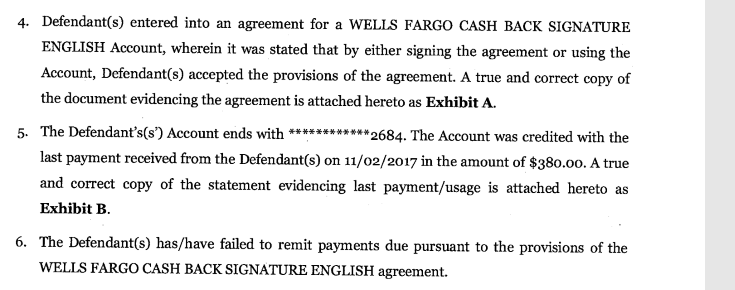 |
| Excerpt from Wells Fargo affidavit in a recent filing: Date of last payment reported, but no date for contract formation by card use |
CONTRACT-FORMATION PROOF IN DISPUTES OVER ARBITRATION
Interestingly, the contract-formation analysis with respect
to notice of terms is much more refined when it comes to acceptance of an arbitration
agreements by an employee (by continuing to work after notice) and when the which-version-is-the-controlling-contract
issue surfaces in other types of litigation involving banks and their customers.
As for formation of an agreement to arbitrate in the employment context, see Kmart Stores of Tex., L.L.C. v. Ramirez, 510 S.W.3d 559, 565 (Tex.App.-El Paso 2016, pet. denied) (where employer provided evidence that employee had logged on to computer and received notice of arbitration agreement, employee bore burden of raising a fact issue contesting formation, which she met by filing a sworn denial of notice); Stagg Restaurants, LLC v.. Serra, No. 04-18-00527-CV (Tex.App.- San Antonio, Feb. 13, 2019, no pet.) (trial court's denial of motion to compel arbitration affirmed in interlocutory appeal where employer failed to prove notice of arbitration provision in occupational injury plan document to employee who later brought work-related injury suit).
As for different sorts of bank-customer litigation, see In Re Comerica, No. 14-16-00418-CV (Tex.App.-
Houston [14th Dist.] Jun. 30,
2016)(concluding that “Comerica has not established that the trial court
clearly abused its discretion by ordering Comerica to withdraw its application
to arbitrate the claim against it with JAMS because the record contains no
evidence that Comerica mailed written notice of the amended Contract and its
text to [customers] or that [customers] by some other means agreed to the
amended Contract with the arbitration provision.”).
As for formation of an agreement to arbitrate in the employment context, see Kmart Stores of Tex., L.L.C. v. Ramirez, 510 S.W.3d 559, 565 (Tex.App.-El Paso 2016, pet. denied) (where employer provided evidence that employee had logged on to computer and received notice of arbitration agreement, employee bore burden of raising a fact issue contesting formation, which she met by filing a sworn denial of notice); Stagg Restaurants, LLC v.. Serra, No. 04-18-00527-CV (Tex.App.- San Antonio, Feb. 13, 2019, no pet.) (trial court's denial of motion to compel arbitration affirmed in interlocutory appeal where employer failed to prove notice of arbitration provision in occupational injury plan document to employee who later brought work-related injury suit).
 |
| Stagg Restaurants, LLC v. Serra, No. 04-18-00527-CV (Tex.App.- San Antonio, Feb. 13, 2019, no pet.) (holding that employer's motion to compel arbitration was properly denied because employer failed to prove that employee was given notice of arbitration provisions within occupational injury plan, and employee swore he had no notice) |
![In Re Comerica, No. 14-16-00418-CV. (Tex.App.- Houston [14th Dist.] Jun. 30, 2016) (agreement on arbitration not proven)](https://blogger.googleusercontent.com/img/b/R29vZ2xl/AVvXsEhEduWjrR_q6ugm1xgnLO2e14JWS7TZAjthBmMqrNElpR66y8UUtGoJ6G2sGpiJZfIWu3yQB3qal-inEdYj8dpYm2TeKkHH51m_iG60CgkEmKWKMyQzLkESUjZZmA5nH0NZZL5W8PxhkXMF/s1600/Arb+caselaw+-+In+Re+Comerica+Bank+%2528Tex.App.-Houston+2016%2529.JPG "In Re Comerica, No. 14-16-00418-CV. (Tex.App.- Houston [14th Dist.] Jun. 30, 2016) (agreement on arbitration not proven)") |
| In Re Comerica, No. 14-16-00418-CV (Tex.App.- Houston [14th Dist.] Jun. 30, 2016) (agreement on arbitration not proven) |
THIS IS THE CONTRACT THAT APPLIES TO THE DEFENDANT; TAKE MY WORD FOR IT
There are significant differences among major credit card
issues on whether the credit card agreement offered as evidence in a collection
suit contains any indicia that link it to a specific account or the specific account
holder.
American Express used to rely generic agreements like other
major card issuers, but years ago switched to a practice of issuing cardholder
agreements that are dated, and also contain the name of the account holder
(including the name of the business for business cards), the account ending
digits, and the type of account. The unique identifying information is printed
in the top section of the first page of the cardmember agreement, which
consists of two parts. One part sets forth the account-specific pricing terms
while the other part contains the standard (invariant) terms that also apply to
other cardholders within the same customer segment. Those terms include a Utah
choice of law clause and regularly also encompass some form of an arbitration
agreement.
Discover Bank’s customer agreements do not contain
information identifying accounts by numbers or customers by name, but
references the version of the agreement (called “Terms Level”) within the body
of the affidavit of its servicer, which is a variable data field in the
template along with other case-specific data such as name of cardholder and
amount of the outstanding balance for which the Bank seeks judgment.
The Customer Agreements attached by Wells Fargo Bank, by
contrast, do not contain any account or customer-specific particulars. Nor does
Wells Fargo even attach the “Important Terms of Your Account” document that sets
forth the account-specific cost-of-credit disclosures required under the Truth
in Lending Act. A number of appellate cases, even from otherwise creditor-friendly
courts of appeal, hold that the creditor must prove the cost terms because they
are essential contract terms, but adherence to this long-standing rule of law
is also eroding.
Texas court of appeals cases that found that proof of credit terms (or derivation of balance, which requires proof of interest) was lacking or insufficient:
Uribe v. Pharia, LLC, No. 13-13-00551-CV, 2014 WL 3555529 (Tex.App.-Corpus
Christi July 17, 2014) (mem. op.) (collecting cases).
- Williams v. Unifund CCR Partners Assignee of Citibank, 264 S.W.3d 231, 236 (Tex. App.-Houston [1st Dist.] 2008, no pet.)(holding evidence was insufficient to establish the terms of a valid contract as a matter of law where creditor failed to produce actual credit-card agreement or any other document that established the agreed terms, including the applicable interest rate or method for determining finance charges);
- Tully v. Citibank (S.D.), N.A., 173 S.W.3d 212, 216-17 (Tex. App.-Texarkana 2005, no pet.) (holding evidence insufficient to show interest rate charged was agreed on where the only evidence was the rates specified in monthly statements);
- Hooper v. Generations Community Federal Credit Union, No. 04-12-00080-CV, 2013 WL 2645111, at *3 (Tex. App.-San Antonio June 12, 2013, no pet.) (mem. op.) (reversing judgment for creditor where cardholder agreement was not offered into evidence and there was no evidence establishing debtor's specific obligations under an agreement);
- Colvin v. Tex. Dow Employees Credit Union, No. 01-11-00342-CV, 2012 WL 5544950, at *6 (Tex. App.-Houston [1st Dist.] Nov. 15, 2012, no pet.) (mem. op.) (reversing summary judgment for creditor where creditor failed to offer the original agreement, monthly statements, or other evidence establishing how it calculated its alleged damages);
- Martin v. Federated Capital Corp., No. 01-12-00116-CV, 2012 WL 4857835, at **2-3 (Tex. App.-Houston [1st Dist.] Oct. 11, 2012, no pet.) (mem. op.) (reversing summary judgment for creditor where creditor's evidence failed to explain how it calculated its damages);
- Ayers v. Target National Bank, No. 14-11-00574-CV, 2012 WL 3043043, at **2-4 (Tex. App.-Houston [14th Dist.] July 26, 2012, no pet.) (mem. op.) (reversing summary judgment for creditor where creditor failed to present cardholder agreement and a portion of the form language on the credit-card application was illegible and form language was in Spanish);
- Wande v. Pharia, No. 01-10-00481-CV, 2011 WL 3820774, at *5 (Tex. App.-Houston [1st Dist.] Aug. 25, 2011, no pet.) (mem. op.) (reversing summary judgment for creditor where creditor presented the cardholder agreement but important portions of the agreement were illegible, including a section entitled "Finance Charges," and creditor presented no evidence regarding the calculations it used to arrive at claimed outstanding balance);
- Jaramillo v. Portfolio Acquisitions, LLC, No. 14-08-00939-CV, 2010 WL 1197669, at **5-6 (Tex. App.-Houston [14th Dist.] March 30, 2010, no pet.) (mem. op.) (holding evidence insufficient to establish a valid contract where card member agreement was entered into evidence, but many of its material terms were missing; "This court and its sister court have drawn a distinction between cases where a card member agreement is entered into evidence and where there is no card member agreement.")
FUTURE POST: THE LOWERING OF
EVIDENTIARY STANDARDS IN CONSUMER DEBT COLLECTION CASES
[ forthcoming ]
