Showing posts with label debt-collection-suit. Show all posts

Thursday, May 2, 2019

Consumer Contracts at the Back-End: A Different Perspective on the (draft) Restatement of Consumer Law from Texas

CONSUMER CONTRACTS DON'T MATTER WHEN APPELLATE COURTS CREATE  CASELAW TO ALLOW CIRCUMVENTION 

Much of the discussion about the state of American consumer law, including the ongoing controversy over the Restatement of the Law of Consumer Contracts, and its reliance on quantitative surveys of caselaw of questionable quality, center on issues surrounding consumer contracts at the front end:

Questions such as the manner in which a contract is formed in the first instance, and how terms are later modified; whether the specific terms applicable to the transaction are disclosed to the consumer in a meaningful and understandable manner; and whether they are excessively one-sided, oppressive, or unconscionable.

CONSUMERS AS CLAIMANTS (PLAINTIFFS)

One major underlying concern is that consumers’ ability to bring claims against businesses may be jeopardized, that the scope of rights a consumer has under such a contract may be unduly limited, such as through mandatory arbitration and class-action waiver clauses, and that consumers may be prevented from vindicating their rights—including statutory rights that come into play based on the nature of the transaction--in an effective manner.

A related issue is whether consumer contracts are drafted to effectively preclude relief that could otherwise be obtained through class actions. This is obviously of great importance in instances of large-scale wrongful business conduct where the value of each claim any single consumer might have is too small to make it economically feasible to bring such claim in an individual action.

CONSUMER CONTRACTS AT THE BACK END – WHEN CONSUMERS BECOME LAWSUIT TARGETS 

Much more, however, is at stake for individuals at the back-end, when the business has a claim against a consumer, and takes the consumer to court.

And that’s where consumer contracts matter too. At least in theory.

A debt collection claim is, in essence, a breach of contract claim because the creditor’s complaint is that the consumer has defaulted, i.e. has not made periodic payments as promised, which takes two basic forms: (1) a failure to make regular installment payments as they become due under the amortization schedule of a retail installment contract or (2) a failure to make monthly minimum payments computed based on a formula contained an agreement governing open-end credit such as a credit card account. In the latter case, the minimum payment will typically consist of a percentage of the revolving balance and current finance charges, which may include other charges (such as a late fee or over-limit fee) in addition to the newly accrued interest and any past-due amount.

To prove such a breach-of-contract claim under Texas common law, a plaintiff must adduce sufficient evidence on a several essential elements: (1) a valid contract, (2) performance by the plaintiff or tender of performance, (3) breach by the defendant, and (4) damages caused by breach.

In order to obtain a judgment against a consumer, a creditor would, under long-standing caselaw, have to produce competent evidence on each element. If the creditor fails to do so, or if the proffered evidence is of questionable quality and therefore subject to evidentiary objections and exclusion, the consumer may have a viable defense to the lawsuit.

The reality, however, is different. At least in Texas, appellate courts have made it much easier for creditors to obtain judgments against former customers by relaxing conventional proof requirements in debt collection cases, and by allowing creditors to avoid the proof requirements applicable to a  breach-of-contract claim altogether, thus rendering the contract, and whatever terms it may contain, immaterial. 

CIRCUMVENTION OF PROOF REQUIREMENTS APPLICABLE TO BREACH OF CONTRACT

Starting in 2008 with an opinion issued by the Dallas Court of Appeals, Texas courts have allowed creditors to circumvent the proof requirements of a breach-of-contract claim by bringing the collection action as a common-law “account stated” claim instead, or in the alternative. See Dulong v. Citibank (South Dakota), N.A., 261 S.W.3d 890, 893 (Tex.App.-Dallas 2008, no pet.).  

"ACCOUNT STATED" ADAPTED FOR CREDIT CARD DEBT COLLECTION IN TEXAS 
  
When a creditor proceeds on an account-stated theory, it no longer has to provide even a copy of a boilerplate credit card agreement. Credit card statements alone will do.
See à The Account Stated Theory and the lowering of proof requirements in credit card debt collection cases; -->  Resurrection of account-stated for credit card debt collection in Texas.


Emanuel J. Turnbull, Account Stated Resurrected: The Fiction of Implied Assent in Consumer Debt Collection, 38 VT. L. REV. 339, 340 (2013)
Also see: Emanuel J. Turnbull, Account Stated Resurrected: The Fiction of Implied Assent in Consumer Debt Collection, 38 VT. L. REV. 339, 340 (2013) 

Several other courts of appeals have jumped on the bandwagon without re-examining the validity of the suit-on-account theory for collection of a bank debt that does not involve sale of goods or services, thus lowering the proof requirements for credit card debt plaintiffs, and depriving the defendants of any benefits that might accrue from the existence of a written contract. See, e.g., McFarland v. Citibank (S.D.), N.A., 293 S.W.3d 759, 764 (Tex. App.-Waco 2009, no pet.) ("Thus, we join our sister courts in holding that account stated, and not a suit on a sworn account, is a proper cause of action for a credit card collection suit because no title to personal property or services passes from the bank to the credit card holder."); Jaramillo v. Portfolio Acquisitions, LLC, No. 14-08-00939-CV, 2010 WL 1197669, at *7 (Tex.App.-Houston [14th Dist.] Mar. 30, 2010, no pet. h.) (mem. op.); Butler v. Hudson & Keyse, L.L.C., No. 14-07-00534-CV, 2009 WL 402329, at *3 (Tex.App.-Houston [14th Dist.] Feb. 19, 2009, no pet.) (mem. op.); also see Houle v. Capital One Bank (USA), NA., No. 08-16-00234-CV (Tex.App.- El Paso, 2018, pet. filed) (affirming summary judgment for credit card bank on two theories).

McFarland v. Citibank (South Dakota), N.A., 293 S.W.3d 759 (Tex.App.-Waco 2009, no pet.) 
  
QUANTUM MERUIT REMEDY ALSO MIS-APPROPRIATED FOR CONSUMER DEBT COLLECTION - FOR THE BENEFIT OF A VULTURE FUND, NO LESS  

One Texas court of appeals has gone so far as to bless quantum meruit as an alternative theory for the collection of a bank debt, even though quantum meruit is an equitable theory and is generally precluded when a contract governs the parties’ relationship because a suit to enforce the contract provides an adequate legal remedy.

In 2008, the Fourteenth Court of Appeals jumped on quantum meruit to accommodate a debt-buyer entity that was at that time a prolific litigant in court all around Texas, but had not adduced sufficient evidence from the original creditor to prevail on its breach-of-contract claim in the case that came before the court. See McElroy v. Unifund CCR Partners, No. 14-07-00661-CV, 2008 WL 4355276 (Tex. App.-Houston [14th Dist.] Aug. 26, 2008, no pet.) (mem. op.).

Quantum meruit generally applies only to claims based on the sale of goods or provision of services not paid for. A bank does not sell goods or services. Instead, it makes its money by charging interest on the extension of credit and on fees paid by merchants that accept their cards. Interest is not compensation of services, and the goods or services charged on a credit card are provided by third parties. These purchases are financed by the bank, rather than the bank acting as seller. The only component of a balance on a credit card account that arguably constitutes compensation for a service provided by the bank to its customer would be an annual membership fee or monthly service charge. But even that is debatable, at least under federal law governing consumer credit, including the federal definition of what constitutes finance charges.  

A memorandum opinion issued by the same Houston-based appellate court in a subsequent credit card collection case brought by a bank (rather than a debt buyer) likened the case to McElroy in that it was undisputed that “there was a credit-card agreement of some kind,” but did not take issue with the blessing of the quantum meruit doctrine for credit card debt collection. See Ayers v. Target Nat'l Bank, No. 14-11-00574-CV, 2012 WL 3043043 (Tex. App.-Houston [14th Dist.] July 26, 2012, no pet.) (mem. op.) (reversing summary judgment granted in favor of bank on breach-of-contract theory).

Ayers’ discussion of McElroy solidifies the conclusion that the quantum meruit claim had been permitted even though the breach-of-contract cause of action was available, and could have been pursued with proper evidence. By affirming the judgment for the creditor in McElrod despite the creditor’s failure to prove up the terms of the underlying credit card agreement, the Fourteenth Court of Appeals essentially condoned and excused the debt buyer’s failure to adduce the requisite type and amount of proof. It blessed the circumvention of those proof requirements through an alternative theory that had--at least until then--been inapposite and unavailable because quantum meruit is an equitable remedy incompatible with the existence of a contract governing the parties’ relationship.

But once a court of appeals makes an error of law, the same court can then defend and repeat the error by treating it as a prior ruling with the force of precedent.

That has not happened with McElroy, but it did happen with the Dulong precedent from Dallas, which has been cited and relied upon numerous times by appellate courts since. Account Stated is routinely pleaded by some creditors in mass litigation in the trial courts. Very few such cases reach the courts of appeals these days. Some banks have also embraced the new opportunity.
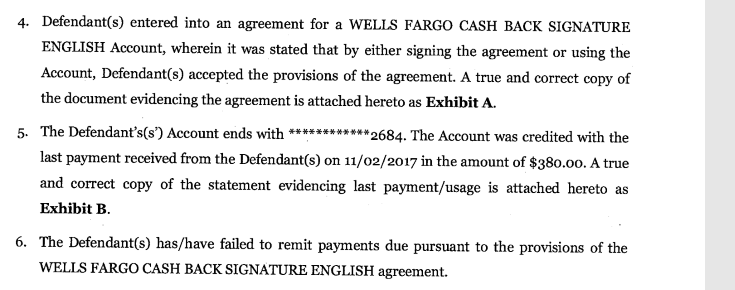
Wells Fargo, for example, now pleads an account-stated count in addition to their cause of action for breach of contract.
  
RELAXATION OF PROOF REQUIREMENTS FOR BREACH OF CONTRACT ITSELF 

In addition to providing a work-around when a creditor cannot find a contract as a predicate for a breach-of-contract claim, Texas courts have also lowered the standards that generally apply in contract cases to accommodate credit card issuers and purchasers of charged-off accounts. There is now, in effect, a special interest jurisprudence for the benefit of creditors that has carved out its custom exceptions from general rules of law and procedure.

Many courts no longer hold plaintiffs to the burden of actually having to prove that a boilerplate agreement attached to a summary judgment affidavit is the agreement that was provided to the customer and subsequently accepted by card use. Instead, they consider conclusory affidavit testimony to the effect that “Exhibit A is a true and correct copy of the applicable agreement” sufficient. See, e.g., Houle v. Capital One Bank (USA), NA. No. 08-16-00234-CV (Tex.App.- El Paso, 2018, pet. filed).

One court saw no problem with the fact that the date printed on the generic agreement did not match the date referenced by the affiant as the date of contract-formation by card use, reasoning that the bank had the right to change the terms (as shown on the face of the challenged agreement) and that the defendant accepted the more recent version by continued card use. See Wakefield v. Wells Fargo Bank, N.A., No. 14-12-00686-CV, 2013 Tex. App. LEXIS 14018 (Tex. App.-Houston [14th Dist.]. Nov. 14, 2013, no pet.) (mem. op.).

Affidavit excerpt from Wakefield: Approximate Contract-formation Date 

Although, with the appellate court's help, Wells Fargo defeated the pro se appeal, the bank subsequently changed its affidavit template, which no longer includes the date of card use as a relevant contract-formation fact. See excerpt from a more recent case below:


Excerpt from Wells Fargo affidavit in a recent filing: Date of last payment reported,
but no date for contract formation by card use

CONTRACT-FORMATION PROOF IN DISPUTES OVER ARBITRATION

Interestingly, the contract-formation analysis with respect to notice of terms is much more refined when it comes to acceptance of an arbitration agreements by an employee (by continuing to work after notice) and when the which-version-is-the-controlling-contract issue surfaces in other types of  litigation involving banks and their customers. 

As for formation of an agreement to arbitrate in the employment context, see Kmart Stores of Tex., L.L.C. v. Ramirez, 510 S.W.3d 559, 565 (Tex.App.-El Paso 2016, pet. denied) (where employer provided evidence that employee had logged on to computer and received notice of arbitration agreement, employee bore burden of raising a fact issue contesting formation, which she met by filing a sworn denial of notice); Stagg Restaurants, LLC v.. Serra, No. 04-18-00527-CV (Tex.App.- San Antonio, Feb. 13, 2019, no pet.) (trial court's denial of motion to compel arbitration affirmed in interlocutory appeal where employer failed to prove notice of arbitration provision in occupational injury plan document to employee who later brought work-related injury suit).

Stagg Restaurants, LLC v. Serra, No. 04-18-00527-CV (Tex.App.- San Antonio, Feb. 13, 2019, no pet.)
Stagg Restaurants, LLC v. Serra, No. 04-18-00527-CV (Tex.App.- San Antonio, Feb. 13, 2019, no pet.) (holding that employer's motion to compel arbitration was properly denied because employer failed to prove that employee was given notice of arbitration provisions within occupational injury plan, and employee swore he had no notice) 
As for different sorts of bank-customer litigation, see In Re Comerica, No. 14-16-00418-CV  (Tex.App.- Houston [14th Dist.]  Jun. 30, 2016)(concluding that “Comerica has not established that the trial court clearly abused its discretion by ordering Comerica to withdraw its application to arbitrate the claim against it with JAMS because the record contains no evidence that Comerica mailed written notice of the amended Contract and its text to [customers] or that [customers] by some other means agreed to the amended Contract with the arbitration provision.”).

In Re Comerica, No. 14-16-00418-CV. (Tex.App.- Houston [14th Dist.]  Jun. 30, 2016) (agreement on arbitration not proven)
In Re Comerica, No. 14-16-00418-CV  (Tex.App.- Houston [14th Dist.]  Jun. 30, 2016)
(agreement on arbitration not proven)
THIS IS THE CONTRACT THAT APPLIES TO THE DEFENDANT; TAKE MY WORD FOR IT

There are significant differences among major credit card issues on whether the credit card agreement offered as evidence in a collection suit contains any indicia that link it to a specific account or the specific account holder.

American Express used to rely generic agreements like other major card issuers, but years ago switched to a practice of issuing cardholder agreements that are dated, and also contain the name of the account holder (including the name of the business for business cards), the account ending digits, and the type of account. The unique identifying information is printed in the top section of the first page of the cardmember agreement, which consists of two parts. One part sets forth the account-specific pricing terms while the other part contains the standard (invariant) terms that also apply to other cardholders within the same customer segment. Those terms include a Utah choice of law clause and regularly also encompass some form of an arbitration agreement.

Discover Bank’s customer agreements do not contain information identifying accounts by numbers or customers by name, but references the version of the agreement (called “Terms Level”) within the body of the affidavit of its servicer, which is a variable data field in the template along with other case-specific data such as name of cardholder and amount of the outstanding balance for which the Bank seeks judgment.

The Customer Agreements attached by Wells Fargo Bank, by contrast, do not contain any account or customer-specific particulars. Nor does Wells Fargo even attach the “Important Terms of Your Account” document that sets forth the account-specific cost-of-credit disclosures required under the Truth in Lending Act. A number of appellate cases, even from otherwise creditor-friendly courts of appeal, hold that the creditor must prove the cost terms because they are essential contract terms, but adherence to this long-standing rule of law is also eroding.

Texas court of appeals cases that found that proof of credit terms (or derivation of balance, which requires proof of interest) was lacking or insufficient:  

Uribe v. Pharia, LLC, No. 13-13-00551-CV, 2014 WL 3555529 (Tex.App.-Corpus Christi July 17, 2014) (mem. op.) (collecting cases). 

  • Williams v. Unifund CCR Partners Assignee of Citibank, 264 S.W.3d 231, 236 (Tex. App.-Houston [1st Dist.] 2008, no pet.)(holding evidence was insufficient to establish the terms of a valid contract as a matter of law where creditor failed to produce actual credit-card agreement or any other document that established the agreed terms, including the applicable interest rate or method for determining finance charges); 
  • Tully v. Citibank (S.D.), N.A., 173 S.W.3d 212, 216-17 (Tex. App.-Texarkana 2005, no pet.) (holding evidence insufficient to show interest rate charged was agreed on where the only evidence was the rates specified in monthly statements);  
  • Hooper v. Generations Community Federal Credit Union, No. 04-12-00080-CV, 2013 WL 2645111, at *3 (Tex. App.-San Antonio June 12, 2013, no pet.) (mem. op.) (reversing judgment for creditor where cardholder agreement was not offered into evidence and there was no evidence establishing debtor's specific obligations under an agreement); 
  • Colvin v. Tex. Dow Employees Credit Union, No. 01-11-00342-CV, 2012 WL 5544950, at *6 (Tex. App.-Houston [1st Dist.] Nov. 15, 2012, no pet.) (mem. op.) (reversing summary judgment for creditor where creditor failed to offer the original agreement, monthly statements, or other evidence establishing how it calculated its alleged damages); 
  • Martin v. Federated Capital Corp., No. 01-12-00116-CV, 2012 WL 4857835, at **2-3 (Tex. App.-Houston [1st Dist.] Oct. 11, 2012, no pet.) (mem. op.) (reversing summary judgment for creditor where creditor's evidence failed to explain how it calculated its damages); 
  • Ayers v. Target National Bank, No. 14-11-00574-CV, 2012 WL 3043043, at **2-4 (Tex. App.-Houston [14th Dist.] July 26, 2012, no pet.) (mem. op.) (reversing summary judgment for creditor where creditor failed to present cardholder agreement and a portion of the form language on the credit-card application was illegible and form language was in Spanish); 
  • Wande v. Pharia, No. 01-10-00481-CV, 2011 WL 3820774, at *5 (Tex. App.-Houston [1st Dist.] Aug. 25, 2011, no pet.) (mem. op.) (reversing summary judgment for creditor where creditor presented the cardholder agreement but important portions of the agreement were illegible, including a section entitled "Finance Charges," and creditor presented no evidence regarding the calculations it used to arrive at claimed outstanding balance); 
  • Jaramillo v. Portfolio Acquisitions, LLC, No. 14-08-00939-CV, 2010 WL 1197669, at **5-6 (Tex. App.-Houston [14th Dist.] March 30, 2010, no pet.) (mem. op.) (holding evidence insufficient to establish a valid contract where card member agreement was entered into evidence, but many of its material terms were missing; "This court and its sister court have drawn a distinction between cases where a card member agreement is entered into evidence and where there is no card member agreement.")  
FUTURE POST: THE LOWERING OF EVIDENTIARY STANDARDS IN CONSUMER DEBT COLLECTION CASES 

[ forthcoming ]


Tuesday, October 3, 2017

Collecting from the Collectors: Ken Paxton's Phony Defense of Texas Consumers

HOW TO MAKE MONEY OFF THE VICTIMS OF ABUSIVE DEBT-COLLECTION

Attorney General Ken Paxton's Phony Defense 
of Texas Consumers 

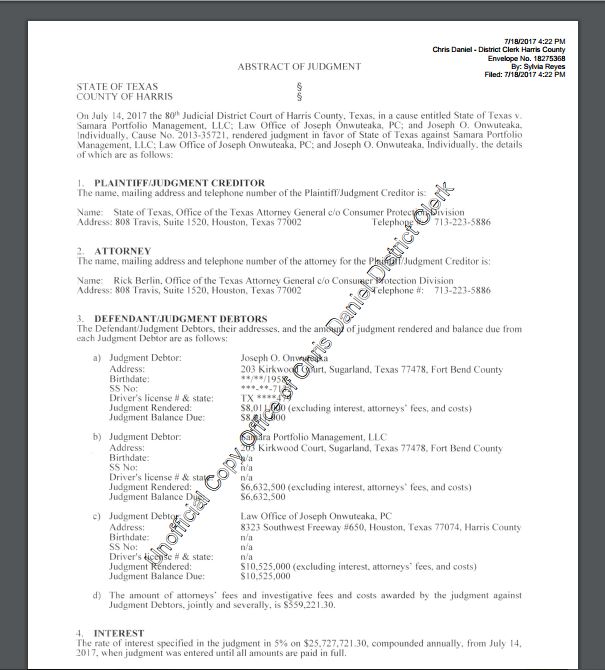
On July 14, 2017 State District Judge Larry Weiman in Houston awarded the State a judgment for more than $25 million based on a verdict delivered by a Harris County jury a few weeks earlier against local attorney Joseph O. Onwuteaka and his company and law firm for code violations committed in the course of collecting consumer debt: Most notably, suing consumers in a distant venue and failing to redact sensitive personal information.

Attorney General Ken Paxton was quick to take credit. 

Not that Paxton had done the work on the enforcement case, which had been dragging on since 2013 and had already made a trip to the 14th Court of Appeals in Houston and the Texas Supreme Court, albeit on ancillary issues. Nor was it even filed under his watch. Ironically, even though the State’s petition was amended during trial, it was still stating that Samara Portfolio Management LLC and the co-defendants were being sued by Greg Abbott, now Texas Governor. 

That didn’t stop Ken Paxton from rising to the occasion. Before the final judgment and permanent injunction was even posted on the Harris County District Clerk’s website for all the world to behold, Paxton issued a press release with a hotlink to an early-bird copy of the signed judgment, gloating about having thrown the books at Joseph Onwuteaka and procured a $25 Million judgment for the State for illegal debt collection. 

Ken Paxton's $25mil press release - Original here 
Onwuteaka is a Houston-area debt collection attorney, who had gotten himself into the business of squeezing dollars form defaulting debtors after buying up charged-off accounts from creditors who had given up on collecting on those account themselves. He put those debts into the name of an LLC owned by him and his wife, and then hired his own lawfirm to collect the stale debts, with himself serving as attorney of record and attorney in charge. 

In 2013, Paxton’s predecessor in office, Greg Abbott, decided to go after Onwuteaka, the debt-purchasing outfit set up by him (Samara Portfolio Management, LLC) and Onwuteaka’s law firm, for suing debtors in a county in which they do not live and where they hadn’t signed the contract that is the basis for the debt claim, -- that county being Harris County (Houston). Abbott sued through the Consumer Protection Division and also alleged violations of the State's privacy law protecting sensitive personal information from disclosure. 

It’s a picture-perfect case of the pot calling the kettle black

Onwutaka would sue scores of people living elsewhere in the State for his own convenience in a JP Court in Downtown Houston and finally got clobbered by the Attorney General after putting up a hell of a fight. 

The irony is that Ken Paxton does the same thing that he brought Onwuteaka to justice for, as it were.

He goes after people owing money on state-sponsored student loans in Travis County courts, just a few blocks from his Downtown Austin office. Also rather convenient. He isn’t personally involved, of course, but everything is done in his name. 

Paxton presides over a well-oiled litigation machine that churns out debt collection lawsuits by the hundreds, in assembly-line fashion. Highly effective, highly efficient. But the cost-savings aren’t passed on to consumers. To the contrary. Debtors are a business opportunity to fatten up the revenue flow, just as they were for Onwuteaka.

Sitting ducks to be milked, if it may please the blawgosphere to mix metaphors.

Onwuteaka is now on the hook for millions in penalties for wrongful treatment of Texans owing debt, but for Paxton it’s legal. How so? It's perfectly okay for Paxton because he is the beneficiary of a special venue law that says that suit on all Texas Higher Education Coordinating Board loans is to be filed in Austin, no matter where the debtor or the parent who co-signed the promissory note might live or may have signed the note. 

Paxton routinely even sues them out-of-state, using the Secretary of State for long-arm service of process. A few lucking ones even get Paxton’s greetings on a debt suit citation while residing abroad. As far away as Japan.


Some missive from home.


Unlike Joe Onwuteaka, the Attorney General cannot be guilty of suing Texas consumers in a distant and inconvenient forum. For he has the blessings of the Texas Legislature. But what difference does it make to those at the receiving end of the citation whether it comes from Houston, thanks to Joseph Onwutaka, or from Austin, on orders of the Attorney General, when they don’t live in either city?

Attorney General Ken Paxton's response to motion to transfer venue in student loan case invoking mandatory venue statute
Paxton won't yield on Austin Venue 
Unlike Onwuteaka, who had to commute to Downtown Houston from Sugarland (at least before the advent of efiling) and is now facing millions of dollars in penalties for wrongful litigation conduct, the Attorney General has his own special-interest law that allows him to sue Texans across the State from the comfort of his high-rise office in Austin, with occasional hearings a few block down the street at the Travis County Courthouse. 
   
But what excuse, not to mention legislative mandate, could the Attorney General conceivably have for any and all of the following:
  • Misrepresenting the amount of the student loan debt by stating a specific dollar amount in the petition, then hitting defendants with 150% or more of that amount when filing a motion for default judgment with accompanying affidavit on damages for the higher amount. 
  • Pleading for no less than $750 or $1,000 in attorney’s fees in the petition served on the defendants, then filing a fee affidavit for twice, thrice, or even five times as much, depending on the number of notes and size of the loan. 
  • Failing to disclose in his petitions how much interest has accrued on the loans, some very old, thanks to another special law that exempts them from the statute of limitations that applies to everyone else, and failing to break down the amounts for each loan when suing on several notes. 
  • Suing student obligor and co-signer separately and getting two judgments for twice the debt amount, and twice the attorney’s fees, instead of only one judgment for the correct amount, with joint and several liability.
  • Intimidating defendants into not fighting or even answering the lawsuit and providing them with a form to waive not only service, but notice of hearing, where they can then be hit with large amounts of interest and bloated claims for attorney’s fees.  
  • Submitting boilerplate affidavits with less than a handful of variable pieces of data: Name of defendant, amount of the debt, interest, and late charges. And no account or loan payment history records ever attached to support the say-so testimony of his collection division’s designated affidavit signer. 
  • Submitting affidavits claiming thousands of dollars in reasonable and necessary attorney’s fees for mass-produced paperwork that takes bare minutes to generate off a computer based document production system, which is then quickly signed and efiled. 
The Attorney General ostensibly went after Joseph Onwuteaka and his companies to protect the public from a notorious financial predator using heavy-handed tactics to collect on high-interest loans.  

Who will protect the public from the Attorney General and his very own questionable and deceptive conduct? 

Onwuteaka enriched himself on the backs of financially weak people. The Attorney General went after him, and now makes off with Onwuteaka’s ill-gotten gains, which are destined for the State’s and the Attorney General’s own coffers. 

State's abstract of Judgment promptly filed after entry of Final Judgment against Onwuteaka et al 
What did the abused consumers get in restitution or damages while the Attorney General rewarded himself for several years of litigation culminating in a jury trial with millions of dollars while supposedly fighting the good fight for financially struggling consumers and for the good of the public? 

-- Nothing. 

Greg Abbott at least pleaded for restitution to consumers: "Disgorgement", legally speaking. Paxton delivered zilch on that plea for affected consumer-debtors. 


The untold story here is one of untempered institutional greed following in the wake of untempered private greed by an entrepreneurial but unethical and much-disciplined member of the State Bar of Texas. 

First a wayward attorney debt collector squeezes hard-earned dollars from strained family budgets with duplicitous tactics, with the help of a local assembly-line JP court letting him have his way with consumers because it’s just business as usual, then the Attorney General sweeps in from Austin, shuts down Onwuteaka’s boiler-room after parrying with him over several years, and then hoovers up the loot.  
  
KEN PAXTON: HELMSMAN OF ASSEMBLY-LINE DECEPTIONS  

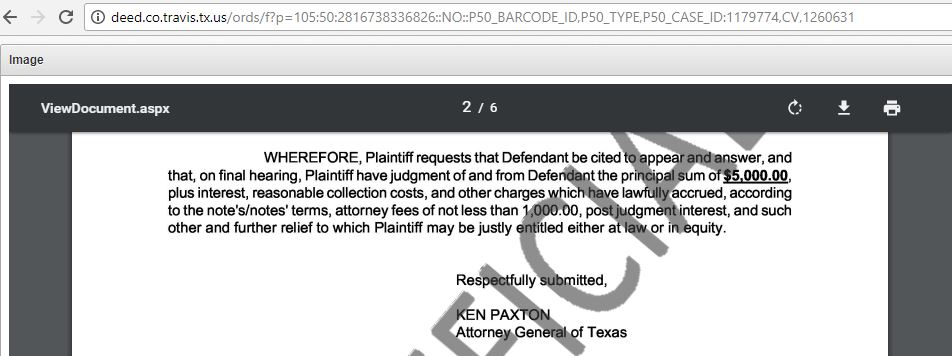
On January 31, 2017, the AG filed a lawsuit against a guy named Don Ray, one of about 100 student loan collection suits filed in Travis County that month, requesting - as he does in hundreds of cases of like kind -- that “Defendant be cited to appear and answer, and that, on final hearing, Plaintiff have judgment of and from Defendant the principal sum of 5,000.00 plus interest, reasonable collection costs, and other charges which have lawfully accrued, according to the note's/notes' terms, attorney fees of not less than 1,000.00, post judgment interest, and such other and further relief to which Plaintiff may be justly entitled either at law or in equity. See Cause No. C-1-CV-17-000942 (link to docket).

According to the process server, Defendant Ray was served February 15, 2017 in Henderson County. He had co-signed the student loan note for his step-child more than twenty years earlier, in 1994, in Palestine, Texas.

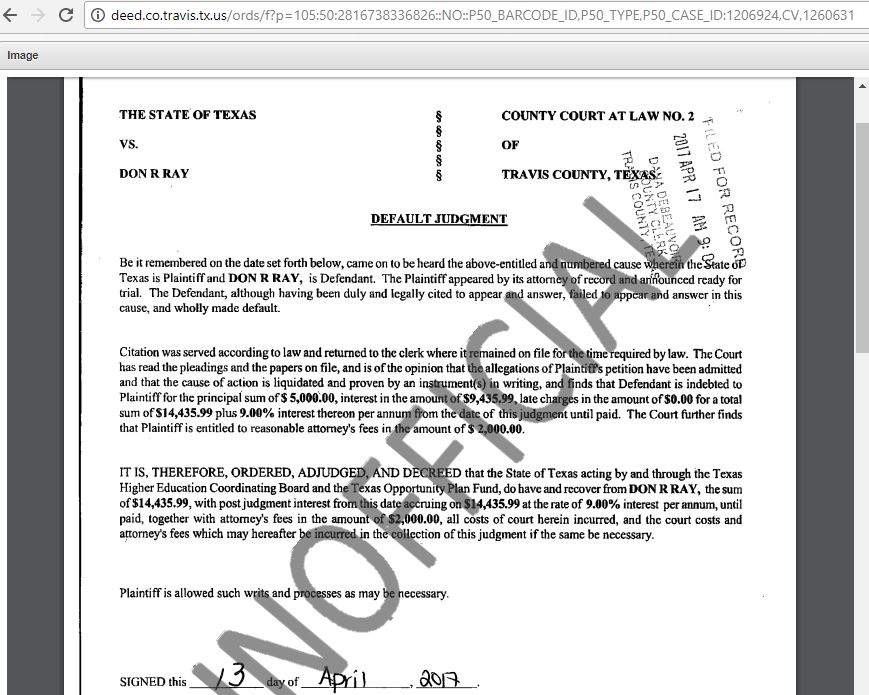
Less than two months later, on April 13, 2017, the Attorney General obtained a default judgment for $14,435.99 on that note and $2,000.00 in attorney's fees.  The default judgment additionally awards interest at the rate of 9% on the $14,435.99 amount that wasn’t disclosed in the petition. (The current judgment interest rate is 5%.)


In the pleading on which the default judgment is based, the principal sum of 5,000.00 was underlined and rendered in bold font. to make it stands out from the text. See below:


Put on the defense, the Attorney General would no doubt argue that - well - the petition accurately states the principal amount of the loan was $5,000.00, which matches the amount shown on the attached promissory note with signed guaranty, and that the word "plus interest" does not rule that the accrued interest may actually be a multiple of the principal. 

Regarding the interest, the Attorney General would point out that the pleading rules do not require disclosure of the rate sought when the lawsuit papers are served. And as for attorney's fees, the petition did not need to state that $2,000.00 would be sought in the default or summary judgment because it stated "not less" than $1,000.00 and therefore left open the possibility that fees might the fees might be higher, - like double or triple. 

And he would be right. The petition was not technically false. It was just deceptive. And in a very clever and calculated way. In a way reminiscent of how Joe Onwuteaka and his ilk operate. 

A person of ordinary intelligence would have looked at the dollar figure - rendered and bold font for emphasis - and thought he was being sued for $5,000.00, rather than for $14,435.99, almost three times as much, and more than three times the amount stated in the petition, including the attorney’s fee award. 

The average co-signing parent or step-parent, now on the receiving end of a lawsuit, may have missed the dollar figure for the attorney's fees altogether because it was not shown in bold digits; but if he read the petition carefully, it would have been reasonable for him to conclude that he was being sued for $1,000.00 in attorney's fees, rather than twice that. 

And he might have thought that if was best just to let the AG have his way, rather than put up a fight. After all, he was just being sued for $6,000.00 and interest. 

Or so he would have thought. -- Wrongly. 
"The Court [...] finds that Defendant is indebted to Plaintiff for the principal sum of $ 5,000.00, interest in the amount of $9,435.99, late charges in the amount of $0.00 for a total sum of $14,435.99 plus 9.00% interest thereon per annum from the date of this judgment until paid.” 
“The Court further finds that Plaintiff is entitled to reasonable attorney's fees in the amount of $2,000.00." 
The Attorney General also has a perfect defense for having doubled up on the attorney's fees, which are grossly overstated given that the assistant attorney general assigned to the case did little more than sign a few papers generated from e-templates on his office’s computer system.

A judge has signed off on the default judgment he submitted and thereby declared the fees to be reasonable. $2,000.00 made in minutes. Profitable indeed. Case closed as of April 13, 2017, date of the judgment.

Gavel or no gavel. Res judicata.

The Travis County Clerk gives student loan suit defendants notice that a judgment was entered for the State, but a copy of the judgment is not attached to the mailing, so the recipient doesn’t even know that he is on the hook for much more than the amount he thought he was being sued for. As much as three times as much, as seen in Case No. C-1-CV-17-000942.

After thirty days, it’s too late to file a motion to set aside the default judgment.

ATTORNEY-GENERAL LITIGATION AS A REVENUE SOURCE 
AND PROFIT CENTER 


ATTORNEY FEE ENHANCEMENT
IN STUDENT LOAN COLLECTION SUITS:
PETITION AMOUNT VS. AMOUNT SOUGHT AND AWARDED IN JUDGMENT 


Sunday, July 23, 2017

Untrustworthy National Collegiate Trusts or untrustworthy NYT Reporting ?

Shoddy loan sharking or just shoddy reporting?

SOME THOUGHTS ON THE KURRENT KERFUFFEL 
ABOUT MISSING PAPERWORK THAT IS NOT EVEN ON PAPER


On July 17, 2017 New York Times broke the next big story on the sub-prime horizon: “As Paperwork Goes Missing, Private Student Loan Debts May Be Wiped Away." 

International News Too - Voila, Free of Debt 

The article cited a few cases in which National Collegiate Student Loan Trusts had sued students-borrowers and had suffered setbacks on appeal. Also see Consumerist story headlined “$5 Billion In Private Student Loans Could Be Wiped Away Because Of Shoddy Record Keeping" and Business Insiders' equally hypy intimation that $5 billion in student loans may be dismissed because the lender lost the paperwork

The referenced appellate court opinions tell a more granulated story. Not as complex as the hard-to-comprehend securitization transactions involving private (i.e. non-federal) student loans themselves, but well worth reading as an antidote to the hype emanating from New York about billions of oustanding student loans and bonds secured by them dissipating into a mirage on the horizon. 

In NTL COLLEGIATE STNDT LN TRUST 2005-1 v. ISAAC OWUSU, 2016 Ohio 259 (2016), an Ohio court of appeals reversed a summary judgment for the Trust because the Trust had not included specific documentation to directly link the pool of debts assigned to NCSLT from  the program lender, Charter One, to the debt Owusu's incurred. 

The appellate opinion does not provide support for the proposition that “the debt was wiped out” and the reviewing court expressly stated that its resolution of Owusu’s appeal and its opinion should not be taken as any indication of the ultimate merits of this case, given that NCSLT may supplement the trial court record upon remand to trial court. NCSLT attempted to add to the record while the appeal was pending, a request that the appellate court denied because the rules of procedure required it to review the summary judgment granted by the court below on the basis of only those documents that were before the trial court at the time the trial court ruled in NCSLT’s favor. NCSLT was not precluded from producing better evidence later on, on remand to the lower court.

In NATIONAL COLLEGIATE STUDENT LOAN TRUST 2003-1 et al v. ADAM BEVERY et al, 2014 Ohio 4346, a different Ohio court of appeals agreed to set aside default judgments entered against lawyerless defendants and to remand both cases to the Huron County Court of Common Pleas for further proceedings. As in the Owusu case, the Court of Appeals did not wipe out the alleged debt, but merely vacated judgments in favor of the Trust (and the trial court’s denial of their motions for relief from judgment), and sent the cases back to the court below for retrial. Unsurprisingly, the defendants had competent attorney representation on appeal, and properly presented their case. The reversal was not a final adjudication on the merits, and did not resolve the matter for good. 

The few appellate cases referenced by the New York Times in its July 17, 2017 article titled “As Paperwork Goes Missing, Private Student Loan Debts May Be Wiped Away“ and other media outlets that followed its lead, do not warrant the conclusion that merely because some lawyers for NCSLT in some cases did not adduce sufficient documentation to prove their case, or did not satisfy the relevant rules of evidence when held to their burden of proof, all such cases are doomed; much less that none of the underlying loan notes are enforceable, thus rendering worthless the entire pool of loans nominally valued in billions.

Indeed, a generalization based on such a tiny and unrepresentative sample of cases that reached the court of appeals, is a logical fallacy, and is therefore properly characterized as hyperbole.

More signs of international propagation: Italy 
The New York Times story nevertheless snowballed, and has apparently already spooked the financial markets, and given rise to even more misconceptions.

On July 18, 2017 - the day after - Business Insider seconded the New York Times with the headline proclaiming that “$5 billion in student loans may be dismissed because the lender lost the paperwork.” 

This headline exemplifies a logical fallacy likewise, because the premise of a dismissal due to missing “paperwork” presupposes that a lawsuit is filed in the first instance that gives a court subject-matter jurisdiction over the defaulted loans, and triggers the applicable burdens of proof, though that burden of proof is very low in the context of default judgments (at least in Texas). 

The various NCSLT Trusts may have been busy filing thousands of collections cases through TSI’s network of attorneys throughout the country, but that is a tiny percentage of all collateralized private student loans under the National Collegiate Trust umbrella. Nor are all loans in default in the first instance so as to provide a legal basis for a collection suit to even be contemplated as a collection tool and as a means to upgrade portfolio performance. 

Finally, NCSLT could simply stop filing lawsuits and rely on other collection methods, and thereby deprive courts of cases, a few of which might be resolved against it. Until the Trust, or the financial gurus behind it, get sued for some sort of grand wrongdoing connected with origination and securitization, the Trust - or whoever is at the helm - is also in control of the litigation machine, and could simply pull the plug, which is unlikely to happen for reasons that will be discussed below.

Hailing from Delaware: National Collegiate Student Loan Master Student Trust
and Progeny of more than a Dozen  

Delaware Department of State: Roster of NCSLT Trusts
Who is currently at the helm of the Trusts is not that clear because the Trusts' governing documents themselves are ambiguous (or at least arguably so, for high-octane lawyers) as to the respective roles of Owners, Owner Trustee, Administrator, Indenture Trustee, and Servicers, and because some of the original players performing these respective roles have been substituted or have otherwise changed. PHEAA, the original loan servicer, is currently embroiled in litigation with the Trusts over who is in charge, and who has the power to set policy on such matters as forbearance agreements and handling of defaulted loans.

Another current issue is the push to unload bad loans onto the secondary market (for bad debt) to realize a cash infusion and eliminate the service costs for loans gone bad payable to PHEAA or other servicers. PHEAA's opponents, speaking for the Trusts, want to audit PHEAA, clip its wings, or replace it altogether with a new servicer, a move PHEAA has been vigorously resisting.

But filing collection lawsuits appears to be part of the business model, and appears to be a key component of the efforts to shore up the shoddy quality of the unsecured loans made to folks with marginal credit at high interest rates, not to mention hefty origination fees added up-front to the applied-for loan amounts, which increased the principal balance ab initio, without any interest yet having accrued. The borrowers never saw the origination fee (which went to the marketers and originators of the loans), except on their Truth in Lending Disclosures. While not labeled interest outright on the loan application, the Origination Fee would, in effect, substantially raise the cost of the loan. And they would eventually have to pay it all back.

Ten years down the road, the loans have entered the repayment period, whether students graduated or not, and whether they got the well-paying jobs they were aspiring to or stayed mired in misery, and borrowers are officially defaulting after their loans have been kept nominally alive for months, if not years, through the grant of hardship deferrals and forbearance agreements, "earning" interest, and then "late charges" only on paper, or rather, on the electronic equivalent thereof, PHEAA's accounting system. Once assigned to litigation, TSI would keep adding interest to the "charge off" balance, based on LIBOR, and would present that additional amount, plus filing fees, to the courts as part of the total damages sought by the particular Trust claiming to own the defaulted account and named as Plaintiff. 

Why there is little reason for NCSLT to stop suing students on defaulted loans 

The majority of student loan collection cases currently prosecuted by NCSLT’s lawyers result in default judgments because Defendants do not hire competent counsel to object to NCSLT’s loan documentation, which is often defective or insufficient because it is prepared by mass-litigation subcontractor in Georgia, Transworld System, Inc. The proof standards for default judgments are minimal. In Texas, failure to answer a lawsuit means that the allegations in the pleadings are admitted, and only damages have to be proven, and such damages are easily proven by affidavit. Which is where TSI comes in. TSI mass-produces such affidavits for default judgments and for summary judgments, or - if the case is contested - for filing prior to trial and use as business records affidavit in lieu of a live witness at trial.

TSI's official designation is "Subservicer" of U.S. Bank National Association, the "Special Servicer" or backup-servicer. U.S. Bank National Association is actually the Indenture Trustee and the only bank that is still involved with the student loans bundled years earlier into Trust assets. The myriad of banks and other lenders that originated the loans are no longer in the picture, and the actual loan servicing is done by AES, which is a trade name for PHEAA, a governmental entity ("Pennsylvania Higher Education Assistance Agency") that services private student loans as a side line.

TSI gets the defaulted accounts. It is highly efficient in churning out affidavits, with copies of documents and loan history reports attached, to support motions for judgment. There is no economic rationale for high quality standards to be imposed upon the production of affidavits and documentary exhibits because it is known by all parties with a stake in the matter, based on a long track record of such litigation whose efficiency can by monitored with simple statistical analysis tools, that the vast majority of Defendants will not contest the lawsuit filed against them. Even if they do, the same documents will suffice in most cases, as long as the Defendants are not legally savvy, and do not or cannot afford to hire a lawyer to make proper objections and hold the Trust's lawyers to their burden of proof in court.

In short, it makes no business sense to produce high-quality work product for the Trusts' lawyers to take to court. These are not tort cases with difficult issues of establishing causal connection between tort and injury, and proving and quantifying personal injury damages. These are run-of-the-mill cases based on a few pieces of look-alike forms and print-outs from an account management system. Even the loan origination document are all identical for particular program lenders, excepts for borrower names, amounts, dates, and such. And interest rates, of course, but those are already in the accounting system and the loan history is generated from the servicer's computer system to which TSI operatives are given access. TSI then calculates additional interest based on the LIBOR rate that has accrued since the account was assigned to them. This additional interest includes interest accruing while the case has been pending in court.

The proposition that litigation costs will put a dent in the Trusts' ability to collect on student loans, and lead to losses, is also a fallacy. 

First, it is common industry practice for collection law firms and solo collection attorneys to be retained based on a contingency fee agreement, which means that they will receive a percentage of the recovery, rather than billing the client by the mushrooming hour. Within that framework, the law firm has every incentive to keep the expenditure of attorney hours low, and the amount of recoveries at the maximum, at the lowest cost. In other professions, the collection law firm’s cut would be called a commission. In still other lines of work, it would be called a bounty. 

Second, the recovery of a lump sum representing the sum of the accelerated principal balance and accrued interest (some of it already capitalized, i.e. added to principal) is always much larger than the sum of missed installment payments for any particular student loan. Each default judgment on which NCSLT is able to collect (whether through wage garnishment, in some states, or writ of garnishment served on a bank at which the judgment debtor has money on deposit, in states such as Texas that do not allow express wage garnishment) will thus improve the cash-flow for the portfolio as a whole because lump sum recovery by judgment will compensate for a multiple of similar defaulted loans on which no installment payments are being made. 

Each successful lawsuit against a student debtor is accordingly a win-win proposition for the Trust and, ultimately, its bondholders because each successful lawsuit will bring in revenue against a bases-line of zilch. By definition, the loans assigned to TSI and passed on to the lawyers for collection are in default. They have not been bringing in any return because no installment payments were being made. 

Like all other creditors and assignees of original creditors, the Trust always seeks judgment for the accelerated loan balance (though it may waive additional interest calculated by TSI and added to the “chargeoff” balance). This allows the Trust to improve the quality of the defaulted notes in toto by precipitously increasing the yield on defaulted student loans that would otherwise – by definition - occasion no yield at all. 

Even allowing for the bounty percentage shared with the collection law firm and even allowing for the fact that many default judgments will be un-collectible, each collected judgment is a windfall because it brings in more money immediately than would be realized if the loan were performing in accordance with the amortization schedule spanning a time period of twenty years, only a portion or half of which has elapsed so far. 

Student loans were collateralized from 2004 through 2007 (typically only a few months after origination), as reflected in the array of suffixes ranging from National Collegiate Student Loan Trust 2004-3 through National Collegiate Student Loan Trust 2007-4 - more than a dozen. None of them would yet have matured by their own terms as of 2017, but many are past the date the deferrals and past multiple hardship or other forbearance extensions, and that's where the part of the business model involving the court systems kicks in.

Why settling for a lot less than amount sued for makes sense for NCSLT 

For the same reasons - the imperative of cash now, rather than later -- it makes perfect sense for the Trusts – or their authorized representative - to settle pending lawsuits and already-granted judgments for 50% or less of their face value when the Defendant contests the claim or hires a lawyer to put up a fight. 

Settlement for a reduced lump sum amounts results in immediate cash-flow because the payment is tendered voluntarily by the debtor at once, and may not otherwise be collectible through coercive means such as execution on nonexempt assets. Many debtors do not have sufficient nonexempt assets, which is why they went into default in the first place. 

In order to obtain a release of a judgment for a substantially discounted amount, however, a debtor may be willing to liquidate assets that would otherwise not be reachable by the judgment-creditor, or might borrow money from family and friends to get the student loan millstone off his neck.

Like TSI, the "sub-servicer" hired to provide litigation support for defaulted student loans that are assigned for litigation, the collection law firms filing the lawsuit against borrowers in the Trust’s name use automated processes and rely on computer-based document production systems to produce pleadings, motions, draft judgments and other litigation documents. Like TSI, they do so very efficiently and at very low cost. There is often no actual court appearance by a lawyer for the Trust because motions for default judgment with attached business records affidavit are merely submitted to the court for processing and a judge’s signature. 

Actual attorney involvement in NCSLT collection suits minimal. The economies of scale and the lawsuit-mill efficiencies serve the bottom line of the collection firm (by keeping labor costs down) as well as the client (through recovery of lump sums either through settlement or collection of judgments). The contingency nature of the retainer contract gives the law firm an incentive to maximize collections in dollar terms, rather than billing for unnecessary legal work at higher hourly rates to improve its own revenue stream.  

It is only in highly contested cases that evidentiary matters, "shoddy paperwork", and missing links in the chain of title even become an issue, and that is also where the labor cost for legal work performed on behalf of the Trust goes up. Those are the cases that have a chance of ending up on appeal and result in published appellate opinions. About a handful of them so far, around the country. A tiny number. These are outlier cases by definition and are unrepresentative of the thousands of cases that predictably result in default or summary judgments in the courts below.

The proposition that the Trust’s collection litigation entails high costs that will choke off the revenue stream for the Trusts and the bondholders is likewise a myth that is easily debunked. 

When NCSLT files a lawsuit, it must pay filing fees, and those costs are added to the loan balance by TSI. But the filing fees are small ($250-$300 in Texas) and they approximate the value of a single installment payment of the average defaulted NCSLT student loan (The monthly installment amount is shown on the Loan Disclosure statement when the loan is disbursed - as an estimate, based on a 20-year repayment period - and on a computer printout from AES, the Trust's loan servicer, that is typically included as proof of account history with the Trusts' court-filed affidavits and attachments). 

While it is true that these filing fees represent out-of-pocket expenses for each lawsuit up front, NCSLT will receive judgment for reimbursement of these out-of-pocket expenses when default or summary judgment is entered in its favor. 

The only filing fees that NCSLT will not collect are those expended on cases that are not resolved in its favor, or result in judgments that are uncollectible because the judgment defendants are destitute or otherwise judgment-proof because they do not possess nonexempt assets. 

Because both the Trust's successful lawsuits and the pending lawsuits and judgments it settles result in lump sum recoveries ranging in the thousands of dollars or tens of thousands of dollars, the expenses incurred for filing unsuccessful ones are easily absorbed. They represent but a small cost of doing business. That business being the conversion of nonperforming private student loans - usually made to high-risk borrowers at high interest rates, compared to federal loans, i.e. unsecured and sub-prime - into performing ones (on the portfolio-wide basis) by taking defaulting former students and their co-signers to court.

The collegiate debtors' day of reckoning has already arrived. The day of reckoning for the wizards behind the Collegiate Trust money-making machine may still be far out on the horizon.


Wednesday, August 14, 2013

Discover Bank - Original Creditor as Plaintiff (profile)


DISCOVER CREDIT CARD COLLECTION SUITS IN TEXAS COURTS

NAME OF CARD ISSUER AND ENTITY TYPE

Discover Bank is a bank operating out of Delaware and a leading issuer of credit cards nationwide. It is not a national bank under the National Banking Act, but it is insured by the FDIC. Discover Bank appears as plaintiff in debt collection suits, but other entities are also involved. 

SERVICERS AND SUBSIDIARIES

March  2015 UPDATE: DB SERVICING CORPORATION DOES NOT EXIST ANY MORE. See image of record from Ohio Secretary of State: 
DB SERVICING CORPORATION DOES NOT EXIST ANY MORE.

The new servicer is DISCOVER PRODUCTS INC, a UTAH corporation. Also see list of Discover Financial Services family of companies (image added to bottom of this post) 

Discover Bank relies on servicers to handle part of its operations. Two affiliated entities' names appear in summary judgment affidavits:  DB Servicing Corporation and DFS Services LLC.

The numerous people who execute summary judgment affidavits for Discover Bank in debt collection suits (see partial list below) are employees of the servicers. Some identify themselves as employee of one servicer on some affidavits, and as employee of the other entity on others. They may be full-time affidavit signers, but their job titles are typically given as “Legal Placement Account Managers” or “Litigation Support Specialist”.

LAWFIRMS AND LAWYERS THAT SUE ON DISCOVER BANK'S CREDIT CARD ACCOUNTS IN TEXAS 

Discover Bank has many customers in Texas and sues on defaulted accounts in its own name. For that purpose, it employs more than one law firm in Texas. The debt collection firms used by Discover include ZWICKER& ASSOCIATESRAUSCH, STURM, ISRAEL, ENERSON & HORNIK, LLC ("RSIEH"); and SCHEINTHAL & KOUTS, L.L.P.

Additionally, Discover Bank debt suits are also brought by WEINSTEIN & RILEY, P.S. a law firm with offices in Seattle, Washington. Because it is a legal requirement, WEINSTEIN utilizes Texas-licensed attorneys to handle cases in Texas court (Josh Harrison, Jason D. Anderson, Cody Moorse).

VOLUME OF LITIGATION 

From August 2012 to August 2013 Discover Bank filed 454 cases in Harris County District Courts. The total for the four civil county courts at law for the same time span was 66.
  
DISCOVER CARD AGREEMENTS

Discover Bank’s form contracts are typically more than two dozen pages long and have a table of content, with page references. The bank’s standard agreements come in many versions, which are identified by Copyright Year and by versions codes consisting of numbers and a letter in the footer of the first page. 

For Example: TL20A.0508 from 2008, and  TL22H.0210 from 2010 
  
The iterations of agreements appear to be consecutively numbered. Assuming Discover Bank started with TL01, there are now more than twenty successive versions, not counting version distinguished by the letter designations ("A" and "H" in the examples above).  

Arbitration Clause 

Like most other CMAs, Discover Bank CardmemberAgreements contain arbitration provisions. The choice of law is Delaware, which reflects its home state and that state’s requirement that all banks located there operate under Delaware law.

Usury Avoidance Clause 

Unlike most other CMAs, Discover card agreements also contain a usury savings clause. That clause is designed to avoid usury liability in the event a variable interest rate exceeds the legal limit in a particular jurisdiction. It provides for a credit for all overcharges resulting from the application of an excessive interest rate.

MONTHLY ACCOUNT STATEMENTS

Finance Charges

Monthly Discover Card statements contain two or three balance categories, depending on whether a balance transfer offer was made and utilized. The standard balance categories are Purchases and Cash Advances. Different interest rates may apply to different balance categories. The interest rate for the balance transfer category will typically be a low rate (e.g  3 for 4 percent) for a limited time.

Interest rates on Discover Card account statements run as high as 29.99%. This is legal under Delaware law, but could be challenged as usurious if the Plaintiff does not invoke Delaware law or other basis for exemption from Texas interest rate limits (-- > usury under Texas law). 

Payment address and address for correspondence 

Discover Bank statements have either one of two addresses printed on payment coupons: a post office box in Phoenix Arizona ZIP Code 85038 or one in Carol Stream, Illinois with ZIP Code 60197.

Interestingly, Discover Bank requests that correspondence be sent to an address in Utah: P.O. Box 30943 Salt Lake City, UT 84130. This is presumably the address where complaints (billing disputes) should also be sent. Implication: If an affiant testifies about no dispute having been received, the affiant should show a connection to the Utah office to be in a position to do so based on personal knowledge and familiarity with mail received and documents created at that location.  

Purported “duplicates” of monthly statements for use in litigation

For litigation purposes, Discover Bank (or an affiliated company) re-generates statements from a database; oftentimes a whole stack of them (but the volume of documentation appears to vary among attorneys). They are not necessarily true and accurate copies of the statements that were actually mailed near the date shown as the billing cycle closing dates. On occasion the statements created for use as litigation exhibits differ from the originals. They may even have a different mailing address on them.  

Additional documentation produced by Discover as Plaintiff in debt collection suits 

Unlike most other credit card issuers, Discover Bank produces (and uses as exhibits) images of checks signed by card members and sent with payments, along with the corresponding payment coupons torn off from the monthly statements and enclosed in the envelope in which the payment is sent. At least in a subset of debt collection cases this type of evidence appears as part of the summary judgment submission. Unlike the re-generated monthly statements, these exhibits appear to be genuine copies (or images) of the originals as indicated by the presence of handwriting on them.  
  
AFFIDAVIT SIGNERS IN RECENT CASES  

Danielle Laughrey, identified as "employee and custodian of records for DB Servicing Corporation, the servicing affiliate for Discover Bank". Her affidavit states that DB Servicing Corporation is a wholly-owned subsidiary of Discover Bank.  Like other affiants, Laughrey also signs affidavits in Franklin County in the State of Ohio. She also acts as a notary for other affiants. 

Patrick Sayers, identified as "Litigation Support Specialist" for DB SERVICING CORPORATION, signs affidavits in Franklin County, Ohio (Notary: Phyllis A. Scholey)

James Ball, Litigation Support Manager for DB Servicing Corporation

Natasha Szcyzgiel, Legal Placement Account Manager, signing affidavits in the State of Ohio, County of Franklin.

Additional affiants whose affidavits have appeared in lawsuits by Discover Bank in Texas courts: 
Heidi Leo, with Abigail Fried as notary
Joshua Frazier, with Bethany Stark as notary 
Janice Dorr, with Schloley as notary
Bethany Stark, Robert Adkins, Stacey Holmes, Stefanie Watkins, Tiffany Adair, Stephen Ball, Erin Marmol
   
WHAT’S UNIQUE OR NOTEWORTHY IN SUITS ON DISCOVER BANK ACCOUNTS?

The usury-avoidance clause that is a feature of all Discover Bank cardmember agreements.

DISCOVER FINANCIAL SERVICES & DISCOVER BANK: RELATED ENTITIES

Discover Financial Services - List of Subsidiaries incl. Discover Bank (2015)
OTHER CARD ISSUERS THAT BRING THEIR OWN LAWSUITS AGAINST CONSUMERS / CARD-HOLDERS

American Express Centurion Bank
American Express Bank, FSB
Bank of America (through FIA Card Services N.A.) 
Capital One Bank
Citibank, N.A.
Target National Bank