Showing posts with label quantum-meruit. Show all posts

Thursday, May 2, 2019

Consumer Contracts at the Back-End: A Different Perspective on the (draft) Restatement of Consumer Law from Texas

CONSUMER CONTRACTS DON'T MATTER WHEN APPELLATE COURTS CREATE  CASELAW TO ALLOW CIRCUMVENTION 

Much of the discussion about the state of American consumer law, including the ongoing controversy over the Restatement of the Law of Consumer Contracts, and its reliance on quantitative surveys of caselaw of questionable quality, center on issues surrounding consumer contracts at the front end:

Questions such as the manner in which a contract is formed in the first instance, and how terms are later modified; whether the specific terms applicable to the transaction are disclosed to the consumer in a meaningful and understandable manner; and whether they are excessively one-sided, oppressive, or unconscionable.

CONSUMERS AS CLAIMANTS (PLAINTIFFS)

One major underlying concern is that consumers’ ability to bring claims against businesses may be jeopardized, that the scope of rights a consumer has under such a contract may be unduly limited, such as through mandatory arbitration and class-action waiver clauses, and that consumers may be prevented from vindicating their rights—including statutory rights that come into play based on the nature of the transaction--in an effective manner.

A related issue is whether consumer contracts are drafted to effectively preclude relief that could otherwise be obtained through class actions. This is obviously of great importance in instances of large-scale wrongful business conduct where the value of each claim any single consumer might have is too small to make it economically feasible to bring such claim in an individual action.

CONSUMER CONTRACTS AT THE BACK END – WHEN CONSUMERS BECOME LAWSUIT TARGETS 

Much more, however, is at stake for individuals at the back-end, when the business has a claim against a consumer, and takes the consumer to court.

And that’s where consumer contracts matter too. At least in theory.

A debt collection claim is, in essence, a breach of contract claim because the creditor’s complaint is that the consumer has defaulted, i.e. has not made periodic payments as promised, which takes two basic forms: (1) a failure to make regular installment payments as they become due under the amortization schedule of a retail installment contract or (2) a failure to make monthly minimum payments computed based on a formula contained an agreement governing open-end credit such as a credit card account. In the latter case, the minimum payment will typically consist of a percentage of the revolving balance and current finance charges, which may include other charges (such as a late fee or over-limit fee) in addition to the newly accrued interest and any past-due amount.

To prove such a breach-of-contract claim under Texas common law, a plaintiff must adduce sufficient evidence on a several essential elements: (1) a valid contract, (2) performance by the plaintiff or tender of performance, (3) breach by the defendant, and (4) damages caused by breach.

In order to obtain a judgment against a consumer, a creditor would, under long-standing caselaw, have to produce competent evidence on each element. If the creditor fails to do so, or if the proffered evidence is of questionable quality and therefore subject to evidentiary objections and exclusion, the consumer may have a viable defense to the lawsuit.

The reality, however, is different. At least in Texas, appellate courts have made it much easier for creditors to obtain judgments against former customers by relaxing conventional proof requirements in debt collection cases, and by allowing creditors to avoid the proof requirements applicable to a  breach-of-contract claim altogether, thus rendering the contract, and whatever terms it may contain, immaterial. 

CIRCUMVENTION OF PROOF REQUIREMENTS APPLICABLE TO BREACH OF CONTRACT

Starting in 2008 with an opinion issued by the Dallas Court of Appeals, Texas courts have allowed creditors to circumvent the proof requirements of a breach-of-contract claim by bringing the collection action as a common-law “account stated” claim instead, or in the alternative. See Dulong v. Citibank (South Dakota), N.A., 261 S.W.3d 890, 893 (Tex.App.-Dallas 2008, no pet.).  

"ACCOUNT STATED" ADAPTED FOR CREDIT CARD DEBT COLLECTION IN TEXAS 
  
When a creditor proceeds on an account-stated theory, it no longer has to provide even a copy of a boilerplate credit card agreement. Credit card statements alone will do.
See à The Account Stated Theory and the lowering of proof requirements in credit card debt collection cases; -->  Resurrection of account-stated for credit card debt collection in Texas.


Emanuel J. Turnbull, Account Stated Resurrected: The Fiction of Implied Assent in Consumer Debt Collection, 38 VT. L. REV. 339, 340 (2013)
Also see: Emanuel J. Turnbull, Account Stated Resurrected: The Fiction of Implied Assent in Consumer Debt Collection, 38 VT. L. REV. 339, 340 (2013) 

Several other courts of appeals have jumped on the bandwagon without re-examining the validity of the suit-on-account theory for collection of a bank debt that does not involve sale of goods or services, thus lowering the proof requirements for credit card debt plaintiffs, and depriving the defendants of any benefits that might accrue from the existence of a written contract. See, e.g., McFarland v. Citibank (S.D.), N.A., 293 S.W.3d 759, 764 (Tex. App.-Waco 2009, no pet.) ("Thus, we join our sister courts in holding that account stated, and not a suit on a sworn account, is a proper cause of action for a credit card collection suit because no title to personal property or services passes from the bank to the credit card holder."); Jaramillo v. Portfolio Acquisitions, LLC, No. 14-08-00939-CV, 2010 WL 1197669, at *7 (Tex.App.-Houston [14th Dist.] Mar. 30, 2010, no pet. h.) (mem. op.); Butler v. Hudson & Keyse, L.L.C., No. 14-07-00534-CV, 2009 WL 402329, at *3 (Tex.App.-Houston [14th Dist.] Feb. 19, 2009, no pet.) (mem. op.); also see Houle v. Capital One Bank (USA), NA., No. 08-16-00234-CV (Tex.App.- El Paso, 2018, pet. filed) (affirming summary judgment for credit card bank on two theories).

McFarland v. Citibank (South Dakota), N.A., 293 S.W.3d 759 (Tex.App.-Waco 2009, no pet.) 
  
QUANTUM MERUIT REMEDY ALSO MIS-APPROPRIATED FOR CONSUMER DEBT COLLECTION - FOR THE BENEFIT OF A VULTURE FUND, NO LESS  

One Texas court of appeals has gone so far as to bless quantum meruit as an alternative theory for the collection of a bank debt, even though quantum meruit is an equitable theory and is generally precluded when a contract governs the parties’ relationship because a suit to enforce the contract provides an adequate legal remedy.

In 2008, the Fourteenth Court of Appeals jumped on quantum meruit to accommodate a debt-buyer entity that was at that time a prolific litigant in court all around Texas, but had not adduced sufficient evidence from the original creditor to prevail on its breach-of-contract claim in the case that came before the court. See McElroy v. Unifund CCR Partners, No. 14-07-00661-CV, 2008 WL 4355276 (Tex. App.-Houston [14th Dist.] Aug. 26, 2008, no pet.) (mem. op.).

Quantum meruit generally applies only to claims based on the sale of goods or provision of services not paid for. A bank does not sell goods or services. Instead, it makes its money by charging interest on the extension of credit and on fees paid by merchants that accept their cards. Interest is not compensation of services, and the goods or services charged on a credit card are provided by third parties. These purchases are financed by the bank, rather than the bank acting as seller. The only component of a balance on a credit card account that arguably constitutes compensation for a service provided by the bank to its customer would be an annual membership fee or monthly service charge. But even that is debatable, at least under federal law governing consumer credit, including the federal definition of what constitutes finance charges.  

A memorandum opinion issued by the same Houston-based appellate court in a subsequent credit card collection case brought by a bank (rather than a debt buyer) likened the case to McElroy in that it was undisputed that “there was a credit-card agreement of some kind,” but did not take issue with the blessing of the quantum meruit doctrine for credit card debt collection. See Ayers v. Target Nat'l Bank, No. 14-11-00574-CV, 2012 WL 3043043 (Tex. App.-Houston [14th Dist.] July 26, 2012, no pet.) (mem. op.) (reversing summary judgment granted in favor of bank on breach-of-contract theory).

Ayers’ discussion of McElroy solidifies the conclusion that the quantum meruit claim had been permitted even though the breach-of-contract cause of action was available, and could have been pursued with proper evidence. By affirming the judgment for the creditor in McElrod despite the creditor’s failure to prove up the terms of the underlying credit card agreement, the Fourteenth Court of Appeals essentially condoned and excused the debt buyer’s failure to adduce the requisite type and amount of proof. It blessed the circumvention of those proof requirements through an alternative theory that had--at least until then--been inapposite and unavailable because quantum meruit is an equitable remedy incompatible with the existence of a contract governing the parties’ relationship.

But once a court of appeals makes an error of law, the same court can then defend and repeat the error by treating it as a prior ruling with the force of precedent.

That has not happened with McElroy, but it did happen with the Dulong precedent from Dallas, which has been cited and relied upon numerous times by appellate courts since. Account Stated is routinely pleaded by some creditors in mass litigation in the trial courts. Very few such cases reach the courts of appeals these days. Some banks have also embraced the new opportunity.
Wells Fargo, for example, now pleads an account-stated count in addition to their cause of action for breach of contract.
  
RELAXATION OF PROOF REQUIREMENTS FOR BREACH OF CONTRACT ITSELF 

In addition to providing a work-around when a creditor cannot find a contract as a predicate for a breach-of-contract claim, Texas courts have also lowered the standards that generally apply in contract cases to accommodate credit card issuers and purchasers of charged-off accounts. There is now, in effect, a special interest jurisprudence for the benefit of creditors that has carved out its custom exceptions from general rules of law and procedure.

Many courts no longer hold plaintiffs to the burden of actually having to prove that a boilerplate agreement attached to a summary judgment affidavit is the agreement that was provided to the customer and subsequently accepted by card use. Instead, they consider conclusory affidavit testimony to the effect that “Exhibit A is a true and correct copy of the applicable agreement” sufficient. See, e.g., Houle v. Capital One Bank (USA), NA. No. 08-16-00234-CV (Tex.App.- El Paso, 2018, pet. filed).

One court saw no problem with the fact that the date printed on the generic agreement did not match the date referenced by the affiant as the date of contract-formation by card use, reasoning that the bank had the right to change the terms (as shown on the face of the challenged agreement) and that the defendant accepted the more recent version by continued card use. See Wakefield v. Wells Fargo Bank, N.A., No. 14-12-00686-CV, 2013 Tex. App. LEXIS 14018 (Tex. App.-Houston [14th Dist.]. Nov. 14, 2013, no pet.) (mem. op.).

Affidavit excerpt from Wakefield: Approximate Contract-formation Date 

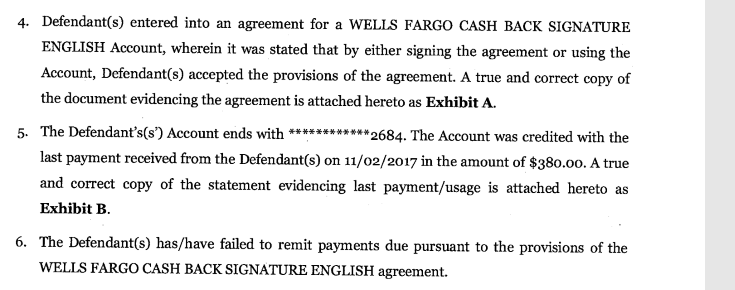
Although, with the appellate court's help, Wells Fargo defeated the pro se appeal, the bank subsequently changed its affidavit template, which no longer includes the date of card use as a relevant contract-formation fact. See excerpt from a more recent case below:


Excerpt from Wells Fargo affidavit in a recent filing: Date of last payment reported,
but no date for contract formation by card use

CONTRACT-FORMATION PROOF IN DISPUTES OVER ARBITRATION

Interestingly, the contract-formation analysis with respect to notice of terms is much more refined when it comes to acceptance of an arbitration agreements by an employee (by continuing to work after notice) and when the which-version-is-the-controlling-contract issue surfaces in other types of  litigation involving banks and their customers. 

As for formation of an agreement to arbitrate in the employment context, see Kmart Stores of Tex., L.L.C. v. Ramirez, 510 S.W.3d 559, 565 (Tex.App.-El Paso 2016, pet. denied) (where employer provided evidence that employee had logged on to computer and received notice of arbitration agreement, employee bore burden of raising a fact issue contesting formation, which she met by filing a sworn denial of notice); Stagg Restaurants, LLC v.. Serra, No. 04-18-00527-CV (Tex.App.- San Antonio, Feb. 13, 2019, no pet.) (trial court's denial of motion to compel arbitration affirmed in interlocutory appeal where employer failed to prove notice of arbitration provision in occupational injury plan document to employee who later brought work-related injury suit).

Stagg Restaurants, LLC v. Serra, No. 04-18-00527-CV (Tex.App.- San Antonio, Feb. 13, 2019, no pet.)
Stagg Restaurants, LLC v. Serra, No. 04-18-00527-CV (Tex.App.- San Antonio, Feb. 13, 2019, no pet.) (holding that employer's motion to compel arbitration was properly denied because employer failed to prove that employee was given notice of arbitration provisions within occupational injury plan, and employee swore he had no notice) 
As for different sorts of bank-customer litigation, see In Re Comerica, No. 14-16-00418-CV  (Tex.App.- Houston [14th Dist.]  Jun. 30, 2016)(concluding that “Comerica has not established that the trial court clearly abused its discretion by ordering Comerica to withdraw its application to arbitrate the claim against it with JAMS because the record contains no evidence that Comerica mailed written notice of the amended Contract and its text to [customers] or that [customers] by some other means agreed to the amended Contract with the arbitration provision.”).

In Re Comerica, No. 14-16-00418-CV. (Tex.App.- Houston [14th Dist.]  Jun. 30, 2016) (agreement on arbitration not proven)
In Re Comerica, No. 14-16-00418-CV  (Tex.App.- Houston [14th Dist.]  Jun. 30, 2016)
(agreement on arbitration not proven)
THIS IS THE CONTRACT THAT APPLIES TO THE DEFENDANT; TAKE MY WORD FOR IT

There are significant differences among major credit card issues on whether the credit card agreement offered as evidence in a collection suit contains any indicia that link it to a specific account or the specific account holder.

American Express used to rely generic agreements like other major card issuers, but years ago switched to a practice of issuing cardholder agreements that are dated, and also contain the name of the account holder (including the name of the business for business cards), the account ending digits, and the type of account. The unique identifying information is printed in the top section of the first page of the cardmember agreement, which consists of two parts. One part sets forth the account-specific pricing terms while the other part contains the standard (invariant) terms that also apply to other cardholders within the same customer segment. Those terms include a Utah choice of law clause and regularly also encompass some form of an arbitration agreement.

Discover Bank’s customer agreements do not contain information identifying accounts by numbers or customers by name, but references the version of the agreement (called “Terms Level”) within the body of the affidavit of its servicer, which is a variable data field in the template along with other case-specific data such as name of cardholder and amount of the outstanding balance for which the Bank seeks judgment.

The Customer Agreements attached by Wells Fargo Bank, by contrast, do not contain any account or customer-specific particulars. Nor does Wells Fargo even attach the “Important Terms of Your Account” document that sets forth the account-specific cost-of-credit disclosures required under the Truth in Lending Act. A number of appellate cases, even from otherwise creditor-friendly courts of appeal, hold that the creditor must prove the cost terms because they are essential contract terms, but adherence to this long-standing rule of law is also eroding.

Texas court of appeals cases that found that proof of credit terms (or derivation of balance, which requires proof of interest) was lacking or insufficient:  

Uribe v. Pharia, LLC, No. 13-13-00551-CV, 2014 WL 3555529 (Tex.App.-Corpus Christi July 17, 2014) (mem. op.) (collecting cases). 

  • Williams v. Unifund CCR Partners Assignee of Citibank, 264 S.W.3d 231, 236 (Tex. App.-Houston [1st Dist.] 2008, no pet.)(holding evidence was insufficient to establish the terms of a valid contract as a matter of law where creditor failed to produce actual credit-card agreement or any other document that established the agreed terms, including the applicable interest rate or method for determining finance charges); 
  • Tully v. Citibank (S.D.), N.A., 173 S.W.3d 212, 216-17 (Tex. App.-Texarkana 2005, no pet.) (holding evidence insufficient to show interest rate charged was agreed on where the only evidence was the rates specified in monthly statements);  
  • Hooper v. Generations Community Federal Credit Union, No. 04-12-00080-CV, 2013 WL 2645111, at *3 (Tex. App.-San Antonio June 12, 2013, no pet.) (mem. op.) (reversing judgment for creditor where cardholder agreement was not offered into evidence and there was no evidence establishing debtor's specific obligations under an agreement); 
  • Colvin v. Tex. Dow Employees Credit Union, No. 01-11-00342-CV, 2012 WL 5544950, at *6 (Tex. App.-Houston [1st Dist.] Nov. 15, 2012, no pet.) (mem. op.) (reversing summary judgment for creditor where creditor failed to offer the original agreement, monthly statements, or other evidence establishing how it calculated its alleged damages); 
  • Martin v. Federated Capital Corp., No. 01-12-00116-CV, 2012 WL 4857835, at **2-3 (Tex. App.-Houston [1st Dist.] Oct. 11, 2012, no pet.) (mem. op.) (reversing summary judgment for creditor where creditor's evidence failed to explain how it calculated its damages); 
  • Ayers v. Target National Bank, No. 14-11-00574-CV, 2012 WL 3043043, at **2-4 (Tex. App.-Houston [14th Dist.] July 26, 2012, no pet.) (mem. op.) (reversing summary judgment for creditor where creditor failed to present cardholder agreement and a portion of the form language on the credit-card application was illegible and form language was in Spanish); 
  • Wande v. Pharia, No. 01-10-00481-CV, 2011 WL 3820774, at *5 (Tex. App.-Houston [1st Dist.] Aug. 25, 2011, no pet.) (mem. op.) (reversing summary judgment for creditor where creditor presented the cardholder agreement but important portions of the agreement were illegible, including a section entitled "Finance Charges," and creditor presented no evidence regarding the calculations it used to arrive at claimed outstanding balance); 
  • Jaramillo v. Portfolio Acquisitions, LLC, No. 14-08-00939-CV, 2010 WL 1197669, at **5-6 (Tex. App.-Houston [14th Dist.] March 30, 2010, no pet.) (mem. op.) (holding evidence insufficient to establish a valid contract where card member agreement was entered into evidence, but many of its material terms were missing; "This court and its sister court have drawn a distinction between cases where a card member agreement is entered into evidence and where there is no card member agreement.")  
FUTURE POST: THE LOWERING OF EVIDENTIARY STANDARDS IN CONSUMER DEBT COLLECTION CASES 

[ forthcoming ]


Tuesday, October 10, 2017

Quantum Non Meruit: To the Honorable Texas Supreme Court IN RE reasonable attorney fee of $48,000 per hour in Shamoun & Norman LLP v Hill, Albert G, Jr.


No. 16-0107

IN THE SUPREME COURT OF TEXAS
---------------------------------------------------------
Albert G. Hill, Jr.
v.
Shamoun & Norman, LLP
---------------------------------------------------------
On Petition for Review
From the Fifth Court of Appeals, Dallas, Texas (No. 05-13-01634-CV)
---------------------------------------------------------
AMICUS CURIAE BRIEF
SUBMITTED IN SUPPORT OF PETITIONER ALBERT G. HILL, JR.
AND ATTORNEY FEE OBLIGORS NOT SIMILARLY SITUATED
 --------------------------------------------------------

TO THE HONORABLE MEMBERS OF THE TEXAS SUPREME COURT

--------------------------------------------------------

TABLE OF CONTENTS
Index of Authorities ……………………………………………………………………………………  4
Issues Presented ..…………….…………………………………………………..  1

  • I.                    The Shamoun-Hill dispute is as atypical as it can get, factually speaking, but this Court’s resolution thereof will likely impact the vast majority of cases in which the amount in controversy is less than $50,000, and the market-based attorney’s fees are in the range of $150 - $500 per hour.  
  • II.                 The implications of the issues in this case go far beyond the statute of frauds governing contingent fee contracts and the reasonableness of an hourly fee of $48,000.00, whether imputed or part of an express lodestar calculation.
  • III.               The briefing of the distinguished legal practitioners on behalf of the parties and the amici in this case fails to address the wider ramifications of the Court’s anticipated ruling on the availability of quantum meruit recovery for attorney work not expressly contracted for.
  • IV.              If the Court were to rule for Shamoun, it would encourage other attorneys to deceive their clients about the scope of representation, would encourage them to turn the tables on their own clients, and would reward them for colluding with opposing counsel to proffer favorable testimony about their “formidable-foe” status to exaggerate the alleged value of settlements to the former client and the quantum of compensation to be awarded on the quantum meruit claim asserted against the former client.
  • V.                 This Court should address the matter of how attorney’s fees are properly “priced” in the context of fee-shifting and in the absence of a contractual agreement across the full spectrum of cases, including those involving small or moderate amounts in controversy, which would never make it to the Supreme Court by petition for review or mandamus, and do not therefore provide the High Court with an opportunity to address the attorney-fee issue for the judicial system as a whole and the bulk of the caseload.
  • VI.              The methodology for judicial determination of the value of legal work in Texas courts should be revisited and revamped to take into account advances in technology. 

A.    The lodestar approach incentivizes inefficient busywork and bill bloating, but it also imposes some accountability because it is based on quantifiable measures and requires factual particulars. It thus promotes reasonableness in amounts requested and awarded, transparency, and predictability. As such, it facilitates rational assessments on both sides and settlement. It also enables trial courts to engage in a meaningful review of the necessity of discrete task performed in cases litigated to trial, and the reasonableness of the amount of time spent on them.  

B.     The Andersen laundry-list is nebulous, unempirical, and outmoded.

C.     Neither the Lodestar nor the Andersen approach is satisfactory for computer-driven mass litigation that is largely automated and
requires minimal attorney time

D.    While not squarely before this Court, the issue of how attorney fee claims are properly handled in small-value cases at the “retail level”, and how excessive ones are to be curbed, cries out for high-court attention. 

Issues Argued …………………………………………………………… 4

A.    The Shamoun-Hill dispute is as atypical as it can get on the facts,
but the issues are not sui generis. ………………………..…… 4
B.     The implications of the issues raised in this case go far beyond the statute of frauds and the $85,000.00 per-hour-equivalent fee…..…          5
C.     The ample briefing fails to address the collateral consequences
of a ruling on viability of quantum meruit recovery for attorney
work not covered by contract……………………………………………………….. 7
D.    Ethical attorneys and law firms would suffer a competitive
disadvantage …………………………………………………. 8
E.     Lawyers are in a privileged position to know the law
and obtain consent ……………………………..…………… 10
F.      The Court should address the “pricing issue” in the absence of an attorney-client contract and in the fee-shifting context ……………….   13
G.    Scenario I: Computer-driven flat-fee mass litigation………….. 15
H.    Scenario II: Computer-driven percentage-based mass litigation 17

Conclusion …...………………………………………….…………….. 22
Amicus Curiae Statement of Interest ..…………………………'……… 23
Certificate of Service……………………………………………………. 23
Certificate of Word Count ……………………………………………… 23

INDEX OF AUTHORITIES

Arthur Andersen & Co. v. Perry Equip. Corp., 945 S.W.2d 812 (Tex. 1997) …… 18

City of Laredo v. Montano, 414 S.W.3d 731 (Tex. 2013) (per curiam)………..… 19      

El Apple I, Ltd. v. Olivas, 370 S.W.3d 757 (Tex. 2012) ……………………...… 18

Long v. Griffin, 442 S.W.3d 253 (Tex. 2014) (per curiam)…………………...… 19

Shamoun & Norman, LLP v. Hill,
483 S.W.3d 767 (Tex. App.-Dallas 2016, pet. granted)………………….. 9

ISSUES ARGUED

A.    The Shamoun-Hill dispute is as atypical as it can get, but this Court’s resolution thereof will likely impact the vast majority of cases in which the amount in controversy is less than $50,000 and the market-based hourly fee rate would be in the $150-$500 range. 

Attorney fees are the bread-and-butter issue for the legal profession.
The Court has already had the benefit of the briefing of a total of more than a dozen high-caliber members of the profession, not to mention the distinguished jurists in the courts below. This critical mass of legal talent and wisdom no doubt enhances the quality of the decision-making process, but it also skews the lop-sided consensus.
To be sure, Petitioner Hill is a client and not an attorney, but Mr. Hill is a client who can afford to send a bevy of lawyers into a peripheral fee skirmish, and with a judgment to the tune of $7,250,000 already entered against him, the cost-benefit calculus in retaining high-powered appellate talent surely runs in his favor.
But that is not so for the rest of the populace, washed or otherwise.
What about the vast majority of consumers of legal services; -- the entire population of clients of Texas attorneys? What about those Texans who cannot afford a lawyer at all, and yet find themselves at the receiving end of fee-shifting?  
When the State’s highest court ponders the weighty matter of whether a contract is required to entitle an attorney to an enforceable fee, and how the reasonableness of the fees is to be measured and determined, the average Lone State denizen’s interest are very much at stake too. Because one day, he or she may be forced to pay attorney’s fees quantified in the manner ordained by this Court’s precedent, whether or not they ever sought legal counsel. Whether or not asked for it. Whether or not indeed they ever had heard the name of the attorney whose fees they are required to pay.
The kind of lodestar, if any, that guides the High Court in matters of legal fees has rather important implications for the vast majority of Texas who are not adept at navigating the byzantine Texas court system, particularly when they do not have the benefit of any steering by a pilot with the requisite license. They still stand a good chance of ending up liable for the fees payable to an attorney whose assistance or advice -- unlike Mr. Hill -- they have never sought for anything. All they may have in common with a man of Mr. Hill’s luck and means may be complex family dynamics, -- a rather ubiquitous phenomenon.

B.     The implications of the issues raised in this case go far beyond the statute of frauds governing contingency fee contracts and the reasonableness of an hourly fee of $85,000.00, whether imputed or part of an express lodestar calculation.

As commonly understood, a contingent fee agreement is one between a lawyer/law firm that signs up a client as plaintiff, and the higher-than-otherwise “cut” for the lawyer/law firm constitutes compensation for the latter’s assumption of the risk that the case will yield no recovery at all, in which case any and all efforts expended by the law firm (other than costs, for which the client may be liable, depending on the specifics of the contract) are for naught. That risk, however, is voluntarily incurred by the lawyer/law firm and not imposed. The law does -- as it should -- permit contingent fee contracts, because they promote access to the justice system by folks who would not otherwise have the means to do so, and it promotes discipline and quality control on the part of the lawyers and law firms that pursue such cases because efforts expended on ultimately non-viable cases would entail a loss in attorney time and law firm resources.
For cases that turn out to be of marginal merit, the same dynamic encourages early settlement or a well-considered decision to not pursue the claim at all.
But Shamoun’s case does not fit the general pattern. Based on the fact recitations of the parties and the Dallas Court of Appeals, the contingency here involves the avoidance of losses (and control of inherited family assets) along with non-monetary issues (perjury liability, for example) rather than the procurement of a monetary recovery for personal injury or similar compensatory damages, whether by judgment or settlement.
This is an important distinction for public policy and jurisprudential purposes because access to justice is not an issue for a well-heeled litigant such as Mr. Hill, who undisputedly had the ability to pay, and did pay, all invoices sent by Shamoun for legal services rendered totaling over $900,000.[1]
Mr. Hill did not need to be made whole. He already was. By middle-class, lower-class, and underclass standards, if not by the standards that might imbue the thinking of the top 1 percent. And to the extent Mr. Hill incurred perjury liability under the federal court sanctions regime, it would seem to have been of his own doing and hardly deserving of judicial sympathy and equitable outreach.
To all appearances, Mr. Hill can also afford to pay the $7,250,000 meant to be awarded by the jury, reviewing courts on several levels of the judicial hierarchy permitting. But how many Texans could? How many members of the middle class? How many Texas attorneys even? Whether Shamoun ultimately recovers $7,250,000 from Hill is of no moment to people of Texas, or to the State, for that matter (except for the tax revenue consequences, if any, perhaps).
But the import of the jurisprudential principles relied upon by the Court in resolving this case is an entirely different matter. It will likely have far more sweeping ramifications.
Whichever way this Court rules, its opinion should provide a basis for distinction in subsequent cases that likewise implicate the question of whether a percentage-based quantum meruit recovery should be permitted as an exception to the statute of frauds governing contingent fee contracts. And, more broadly speaking, it should address whether a quantum meruit recovery should be permitted at all when it comes on top of fees earned, billed, and paid under a fee agreement involving the same legal services provider and the same client (as opposed to a situation where there is no written attorney-client contract of any kind).

C.     The ample briefing of the distinguished legal practitioners on behalf of the parties and the contributions of the three amici at the PFR-application stage fail to address the wider ramifications of the Court’s anticipated ruling on the availability of quantum meruit recovery for attorney work not expressly contracted for.

Mr. Hill’s legal team urged in their petition that this case should be resolved in a per curiam opinion while those for the Defendant law firm insisted in their response that no high court involvement was called for at all. This Court has nevertheless requested full briefing and set the case for oral argument on October 10, 2017. All this portends an ultimate High Court opinion that will do more than write the last chapter of a drawn-out family feud involving billions of dollars in assets that were – to all appearances -- not earned by any of the family members doing battle over them.
Former Chief Jefferson, in his brief for the Shamoun, says that all three amici do no more than parrot Hill’s argument. While it may be tempting to add one more chirp (not tweet) to the chorus of the parrots, the full aviary of birds – rare, odd, or merely common -- should not be excluded from the theater. A few discordant notes might beneficially accentuate how the member of the legal profession marshalled for a battle of wits in this high-stakes case nevertheless chime rather in unison.
The undersigned odd-bird amicus will therefore take the want of novelty diagnosed by ex-Chief Jefferson as a high bar, and attempt to address it at least in part, in addition to expressing the hope that the statute of frauds as it applies to contingent windfalls to be raked in by Texas attorneys will survive the instant petition for review.

D.    Ethical attorneys and law firms would suffer a competitive disadvantage in the marketplace for legal services

If this Court were to rule in Shamoun’s favor, it would give other Texas attorneys an incentive to put their own interest before those of clients even before the legal matter that is the subject of the representation is concluded. Or before the attorney-client relationship is even formed, for that matter.
Crafty members of the Bar might decide to offer their services at a discounted hourly rate and insert limitation-of-engagement fine-print in the retainer contract, banking on their ability to sue their former clients in quantum meruit later, and thereby hope to make up for the up-front discount on the hourly rate. It would make economic sense.
And the opportunity to generate additional fees from prosecution of the follow-on quantum-meruit suit itself, as already illustrated by the Dallas Court of Appeals opinion in this very case,[2] would provide an additional incentive for such deceptive conduct as part and parcel of the law firm’s business model. At least with respect to the client segment composed of high-asset individuals.
But clients of moderate means with rare lawsuit exposure would not be spared either. An enterprising family law practitioner, for example, might elect to pursue a quantum meruit claim for having to deal with ”complex family dynamics” beyond the spousal relationship at issue in the divorce, or might decide to capitalize on some other peripheral case-specific circumstance that would not be expressly contemplated by the engagement letter or retainer agreement. In fact, there would be an incentive to draft the retainer agreement as narrowly as possible so as to amplify the opportunity to later advance QM claims for extra exertions that do not fall within its scope.
A crafty practitioner could just wait until the final decree of divorce is entered and the division of property effectuated. A quantum meruit claim predicated on some unique constellation of facts in the particular case would then allow him to tap the client’s freshly-received assets to capture at least a share of the Splittsville spoils, if not their entirety.
Suffice it to point out the obvious: That this Court’s blessing of quantum merit recovery on top of charges billed and paid for based on either a contract or on open account would be bad public policy because it would incentivize bad apple behavior and would distort fair competition in the marketplace for legal services, a market that is not very transparent for the average consumer of legal services to begin with.  
This Court should decline the invitation to tilt the scales in favor of those short of scruples who would seek to gain an unfair edge over their peers by discounting their hourly fee in the client-acquisition phase, only to turn the tables on their retained clients later, after settlement or final judgment. The Court should not create incentive for suing clients for additional compensation on a quantum-meruit theory for carved-out services, not to mention allowing them to compound the windfall through additional fees incurred in the second lawsuit and shifting those, too, to their former clients.
E.     Lawyers are in a privileged position to know the law and obtain prior consent
The general public is charged with knowledge of the law. Ignorance of the law does not generally provide an excuse for failing to abide by it. The same should apply, with even greater force, to attorneys, who are presumed to know the law better than laymen, and are therefore in an even more advantageous position to comport their conduct with it.
Shamoun must have been fully aware of the need to not only reduce a contingent fee agreement to writing, but to obtain the client’s express consent to it. And he obviously could not force the client to sign the agreement he desired or may already have drafted himself of by an agent.
Nor was Hill under an obligation to sign the proposed “bonus” agreement submitted to him. Individuals are free to contract as they see fit, or decline to do so. And they are surely entitled to say No.  
Regardless of whether written consent was required by a statue of frauds, the client would have to agree to the terms of the contact proposed by the lawyer. The client’s refusal to sign would seem an indication not only of the lack of an agreement to the extravagant compensation terms that Shamoun subsequently sought to have imposed by a court by force, but of their rejection. Shamoun then sought to pass off the rejected terms as the proper measure of value under the theory of quantum meruit. The re-cloaking was not even particularly artful. It consisted of nothing more than slapping a different label on the same squiggly global services product that could not even be pinned to any one lawsuit, and was not therefore subject to ongoing judicial oversight and discipline within the context of a lawsuit governed by the particular set of rules and standards of conduct in the relevant forum.
Shamoun could not have reasonably relied on the expectation that the client would pay on the excessively generous terms that the client expressly refused to consent to. Which might explain why promissory estoppel was (apparently) not even pleaded in the district court below.
As told in the briefs, the record in this case demonstrates not merely the absence of evidence (or absence of sufficient evidence) of an enforceable agreement for the “monumental” bonus payment, but establishes the contrary proposition as a matter of law: Hill’s refusal to agree to the proposed terms set forth in the proposed statute-of-fraud-compliant fee agreement. That alone should preclude any recovery on an alternative theory as a matter of law, rather than as a matter of facts to be delved into and resolved by a jury. If Judge Jim Jordan is to be faulted at all, he is to be faulted for not dismissing the quantum meruit claim before it went to the jury (assuming he was presented with a proper motion that would have allowed him to do so).
Even if no express refusal of proposed bonus-terms were supported by the record, any and all alternative non-contract theories should be held precluded under these circumstances because a contract was required under the statute of frauds, and the required contract would preclude recovery on equitable theories because the parties to that required contract would have an adequate remedy at law. Shamoun’s invocation of quantum meruit after failing to secure a client contract on the terms desired by him is nothing more than an effort to circumvent the statute of frauds and render it impotent. It amounts to an effort to take advantage of the client after having been told No.
Alternatively, the Court should hold that whatever tasks Shamoun performed under the rubric of “global settlement services” he provided either on the known risk of not getting paid the desired bonus or reward, or pro bono. The law shouldn’t provide a remedy for every risk willingly taken.
While Shamoun suggests in his brief that he was duty-bound to continue to serve his client, he was not the attorney of record in most of the cases within the “spiderweb” and was not therefore required to obtain leave of court to withdraw. In any event, nonpayment of fees (or client’s failure to sign a contingent fee agreement in the alternative) would certainly constitute sufficient good grounds or just cause for most courts to grant permission to withdraw.
Shamoun was free to refrain from providing any “global settlement services” in the absence client consent and payment agreement in writing, and he could have posed the choice to Hill to either sign another engagement letter or forego his services. He could also have offered his client more reasonable terms, perhaps an hourly rate of $750, reflecting a premium for having to deal with “complex family dynamics” and “rapport development and cultivation” and telephonic “unified voice” overtures directed to opposing counsel in a context where others had allegedly fallen short.    
Shamoun was under no obligation to render services not covered by pre-existing fee contracts, and courts should not therefore aid his efforts to coerce payment for services not properly contracted for. If this Court were to hold otherwise, it would lower the standards for the Bar as a whole, and would encourage sloppy practices in managing client-relationships by others. It would also encourage attorneys to sue their clients when they would not do otherwise, which would further erode the public esteem for the legal profession and its practitioners. Finally, it would encourage attorneys to collude with opposing counsel so the later will help them with favorable testimony once they are ready to turn the tables on their own clients and sue them.

F.     This Court should address the matter of how attorney’s fees are properly “priced” in the context of fee-shifting and in the absence of a contractual agreement across the full spectrum of cases, including those involving small or moderate amounts in controversy, which would never make it to the Supreme Court by petition for review or mandamus, and do not therefore provide the Court with an opportunity to address the attorney-fee issue for the judicial system and across the entire caseload as a whole.

Shamoun claims to have rendered exceptional services and to have realized “monumental” benefits for this (former) client worth a $7,250,000 fee.[3]
That rather eye-popping amount is said to constitute but a small fraction of the total value proposition as told by Shamoun.
Regardless of how much of that volume is to be deflated to correct for self-serving puffing, Shamoun has – no doubt – done more than those at the opposite end of the continuum of quantity and quality of effort, and an exceptional hourly rate of $750.00 may very well be defensible in an exceptional case of this nature.
At the opposite end of the spectrum, however, are attorneys who spend minimal amounts to time and effort on a single case because they preside over the contemporary equivalent of a well-oil litigation mill. They, too, claim attorney’s fees vastly out of proportion with the amount of time actually spent on a case, and shift their fees to the opposing parties, most of whom do not have a lawyers of Shamoun’s caliber to defend them. Not to mention defend them in the courts of appeals when cases go awry in the trial courts.
Indeed, most of these defendants do not have a lawyer at all. 
One such litigation-machine attorney is a state employee: Assistant Attorney General John C. Adams, who collects on student loans made the Texas Higher Education Coordinating Board (“THECB”). Another one is Deanna L. Longo, an attorney with LINEBARGER GOGGAN BLAIR & SAMPSON, LLP (“LINEBARGER”), which has a contract with the Harris County for toll road collection work.[4] 

G.    Scenario I: Computer-driven Flat Fee Mass Litigation:
$5,000 for 5-10 minutes of attorney work

Assistant AG John C. Adams regularly swears that his efforts on Texas Higher Education Coordinating Board (THECB) student loan collection lawsuits are worth between $1,500 and $5,000 apiece even though every single one of them is produced with a document production system using electronic forms (i.e. boilerplate), and even though most of them result in default judgments, and do not even involve an in-person court appearance.
In the rare event when a hearing is necessary -- typically in a case in which the defendant obtains a lawyer -- Adams budgets 5 minutes of county court time for it.[5] For a rare trial involving a represented defendant, the amount may be 10-20 minutes.
As the beneficiary of a special venue rule, the Attorney General sues all student loan obligors in Austin, TX, regardless of where they reside, whether in-state, out-of-state, or even in foreign countries. The metric for AAG Adam’s travel to court is therefore city blocks, not miles and overnight stays.  The proper metric under the Lodestar would be minutes, rather than hours.
Under Attorney General Paxton stewardship, the OAG also engages in double-dipping. It sues the student-borrower and his or her co-signer separately on the same debt, and charges the flat-fee attorney’s fees twice, even though one suit is a copy-cat of the other, the only difference being the identifying information for the Defendant(s). The pleadings and motion templates do not even distinguish between debtor and guarantor.
The vast majority of THECB student loan defendants do not have legal representation. They are cash cows ready to be milked. And the private attorneys that agree to take on such cases are loath to challenge the sworn fee testimony of another attorney, not to mention an attorney for the State.
If this Court continues to treat uncontroverted attorney testimony as reasonable ipse dixit, this class of litigants and other in the same boat will continue to be liable for fees measuring thousands of dollars for legal work measured in minutes. Close to de minimis.
And they will have these fees shifted against them, with virtually no judicial oversight as to the quantum that is merited, at least not with respect to the vast majority of cases that either end in default or an agreed judgment, or cases in which the defendant is unrepresented and is in no position to challenge a fee affidavit because he or she is not qualified to opine on what is reasonable. Nor would the majority of defendants even be aware that the lawsuit papers are the output of a largely automated production system, i.e., a lawsuit mill.  
On the other hand, if it is acceptable for the State to set up and run a one-lawyer lawsuit machine as a profit center, and as a revenue source to cross-subsidize other activities of the executive branch, the Court should explore the pros and cons of whether only the State should be permitted to reap the windfalls of automatization of the litigation process, and whether private law firms should be able to do the same. Charge for minutes of attorney attention at hourly rates, or even more.
Mr. Hill’s appeal to this court is relevant in this regard because it involves more than just the statute of frauds for contingent fees. It very much implicates the larger question of how legal services are to be “priced” when they are not subject to market-place price-setting, and have not been contracted for.  
In Shamoun’s case, there was no agreement on the price to be paid for the much-touted “global settlement services.” In the case of THECB student loan collection, there is not even a market at all. The Texas Attorney General has a statutorily granted monopoly. See Tex. Edu. Code §52.39 (“Suit for the remaining sum shall be instituted by the attorney general”).
Assistant AG Adams at least signs pleadings, motions, and fee affidavits. In the second example of dubious attorney-fee claims on an industrial scale in small-value cases, Linebarger’s designated toll suit attorney cannot be troubled to do even that. The firm uses an image of the Rule 8 attorney’s signature not only on its mass-produced pleadings and motions for default and summary judgment, but on its attorney fee affidavits as well. It is the current state-of-the art in robo-litigation. Highly efficient. A single attorney suffices to oversee a litigation docket comprising hundreds of contemporaneously pending cases, but the attorney’s reasonable work hours are not pro-rated over the entire docket.
Anything but.

G.    Scenario II: Computer-driven percentage-based mass litigation:
                Up to $6,000 in reasonable attorney’s fees in cases of no
                (or only contingent) attorney involvement 

LINEBARGER GOGGAN BLAIR & SAMPSON, LLP handles collection of unpaid tolls for the Harris County Toll Road Authority, including collection by litigation. Deanna L. Longo’s name appears on its pleadings as the attorney in charge.
Unlike the Texas Attorney General through Assistant AG Adams, Linebarger does not assert its attorney fee claim on a flat-fee basis. Instead, the County’s private collection firm quantifies and demands its attorney’s fees as a percentage of the sum comprising unpaid tolls, administrative charges, penalties and fees. The dollar amounts obtained through default and summary judgments accordingly vary much more across the caseload than in the THECB student loan cases, but the percentage is consistent. 20% of the total of tolls and charges in County Civil Court at Law No. 2; 30% in the three other county civil courts at law.
But the story is the same. Like THECB student loan obligors and their parents (or other co-signers), toll-suit defendants are held liable for hundreds, if not thousands of dollars of unearned attorney’s fees that are shifted to them as a matter of course by trial courts granting default judgments in assembly-line fashion.
The consideration of Andersen fee factors does not even come into play. One of the four county judges will grant only 20% of the total claim amount in fees, but which defendants are ordered to pay 20% as opposed to 30% is like a lottery, because cases are assigned randomly to one of the four county courts at law sharing the caseload.
Of course, the fees routinely awarded in high-volume litigation are properly denounced as “unearned” only under traditional approaches for valuing attorney work in terms of quantity of time and qualify of effort, whether under the Arthur Andersen[6] or the lodestar approach used by the federal courts and endorsed by this court -- at least in a limited number of contexts -- in El Apple.[7]
This Court has previously condemned "generalities about tasks performed" and specifically said that, "without any evidence of the time spent on specific tasks," the trial court does not have sufficient information to meaningfully review the fee application. Long v. Griffin, 442 S.W.3d 253, 255-56 (Tex. 2014) (per curiam); accord City of Laredo v. Montano, 414 S.W.3d 731, 736-37 (Tex. 2013) (per curiam).
In mass litigation cases such as those by the likes of John C. Adams (delinquent THECB loans) and Deanna L. Longo (unpaid tolls and fines) as attorneys in charge, the evidence of litigation effort before the Court takes the form of cookie-cutter pleadings, motions, and affidavits, including fee affidavits. The case dockets typically comprise no more than a few lines.
Trial judge rarely even get to see a flesh-and-blood attorney, or a wet-ink attorney signature, for that matter. Motions for default judgment do not require a live court appearance, and even motions for summary judgment are “heard” by submission in Harris County.[8]
As contemporaries in the computer age, trial court judges are in the position to take judicial notice that attorney involvement (and indeed human involvement) per case is minimal. They have meaningful information available to them to gauge attorney effort and quality, as well as the ability to spot if something unique cooking on the boilerplates. Unlike individual defendants, county court judges know from handling their own dockets that these cases vary only in a few specifics, such as identifying information for the defendant and amount claimed.
And yet, in the absence of direction from the High Court, attorney’s fees are routinely awarded in these run-of-the-litigation-mill cases in amounts that raise the very same concerns as the $48,000.00 hourly fee equivalent in this case, once the median personal or household income and net worth of the litigants is taken into consideration.
Notwithstanding their numerosity, none of the mass litigation cases involving excessive fee awards for legal work actually performed by computers and automated processes will ever reach this Court.
Unfortunately, this Court is placed in the position to render its doctrinal decisions in the most aberrant of cases, such as this one, involving a member of a family worth billions. Alas. The impact will be suffered -- or enjoyed, as the case might be -- by a much larger population of litigants, none of whom have much in common with Mr. Hill. Certainly not his deep pockets, and the wherewithal to retain top-notch attorneys to do his bidding, or even an expert witness to challenge an attorney fee affidavit, no matter how incredulous it may be as to the amount of hours and dollars attested to as reasonable and necessary, and deemed true in the absence of a qualified rebuttal by another member of the Bar willing to testify contrariwise.
Most of the vastly more common litigants in Texas courts affected by the valuation of attorney’s fees have no one to advocate on their behalf, and no ability to counter an ipse dixit affidavit of a Texas-licensed attorney opining on the reasonableness of charges for documents churned out by the litigation mills they oversee, passing off self-serving fee demands as expert witness testimony that trial courts are bound to credit, based on existing decisional authority, merely because it is un-contradicted.  
This Court should take the moral high ground and resist the understandable urge to do what lawyers want. Natural because, day in – day out, the Court only hears from lawyers and through lawyers.
This Court should affirm that the role of the judiciary involves more than making the system work for attorneys.
Such role includes acknowledging what is self-evident for all but a tiny minority of interested parties, albeit a tiny minority led by a former chief of this Court: That a fee of $48,000.00 per hour is not only not reasonable, but exorbitant. An affront to all who earn and make do with no more with what a still-sitting Texas district court judge earns, and many others who earn less.
What Shamoun is looking for in this case is a Category 5 windfall.
Whether he has it coming his way will not concern the rest of Texas. What will matter is what this Court’s opinion in Hill v Shamoun will stand for, and will be cited and relied for in the tens of thousands of cases thereafter.  
The High Court’s unique role in shaping the jurisprudence of this State and the setting the rules for processing of cases in all of its courts should encompass setting some limits on what lawyers may swear is reasonable to them without incurring sanctions or perjury liability, particularly in cases in which the defendant is categorically prejudiced because he or she is deemed inherently incompetent to contradict an attorney’s professional opinion that a few minutes of his or her time spent on a transactional court case are worth $1,500, $2,500, or even $5,000 apiece.
Those fee claims and awards, too “profoundly disturb notions of fair play and equity.” Albeit at the retail level. One or two standard deviations left and right from the mean, where most Texans are in terms of income, assets, and litigation-proneness.
CONCLUSION
  The amount of money implicated in the underlying dispute is staggering, as is the amount of the fee at issue in the attorney-on-client follow-up litigation that it spawned. The unusual factual particulars, and the fact that the Court hears only from high-powered attorneys, have the potential of distorting the decision-process and culminating in a resolution that might make the attorney fee jurisprudence of the State worse, rather than better and more just. To avoid such a result, the High Court should consider the implications for the vast majority of cases that have no chance of reaching this level within the judicial hierarchy and would therefore not present the Court with the opportunity the reshape the common law to suit the typical case -- and the entire caseload statewide -- as opposed to the rare billion-dollar dispute that attracts some of the best (or at last best known) appellate advocates on both sides of the docket, and is marked by idiosyncratic circumstances, rather than typical ones.


[1] Amicus did not have access to the record in this case. The facts are therefore taken either from the Court of Appeals opinion or from the parties’ briefs.
[2] Shamoun & Norman, LLP v. Hill, 483 S.W.3d 767 (Tex. App.-Dallas 2016, pet. granted) (reversing trial court's judgment on zero-dollar jury award for prosecution of law firm’s quantum meruit claim against former client).
[3] Amount found by the jury. Shamoun actually sent a demand letter for much more.
[4] The Court may frown on having these attorneys called out by name, but that is unavoidable because they are the ones that swear to and sign the fee affidavits.
[5] Travis County Local Rules require time estimates for settings, which are shown on the e-docket.
[6] Arthur Andersen & Co. v. Perry Equip. Corp., 945 S.W.2d 812 (Tex. 1997)
[7] El Apple I, Ltd. v. Olivas, 370 S.W.3d 757 (Tex. 2012).
[8] Oral hearings are optional and may be requested by either party.