Showing posts with label consumer-protection. Show all posts

Tuesday, October 3, 2017

Collecting from the Collectors: Ken Paxton's Phony Defense of Texas Consumers

HOW TO MAKE MONEY OFF THE VICTIMS OF ABUSIVE DEBT-COLLECTION

Attorney General Ken Paxton's Phony Defense 
of Texas Consumers 

On July 14, 2017 State District Judge Larry Weiman in Houston awarded the State a judgment for more than $25 million based on a verdict delivered by a Harris County jury a few weeks earlier against local attorney Joseph O. Onwuteaka and his company and law firm for code violations committed in the course of collecting consumer debt: Most notably, suing consumers in a distant venue and failing to redact sensitive personal information.

Attorney General Ken Paxton was quick to take credit. 

Not that Paxton had done the work on the enforcement case, which had been dragging on since 2013 and had already made a trip to the 14th Court of Appeals in Houston and the Texas Supreme Court, albeit on ancillary issues. Nor was it even filed under his watch. Ironically, even though the State’s petition was amended during trial, it was still stating that Samara Portfolio Management LLC and the co-defendants were being sued by Greg Abbott, now Texas Governor. 

That didn’t stop Ken Paxton from rising to the occasion. Before the final judgment and permanent injunction was even posted on the Harris County District Clerk’s website for all the world to behold, Paxton issued a press release with a hotlink to an early-bird copy of the signed judgment, gloating about having thrown the books at Joseph Onwuteaka and procured a $25 Million judgment for the State for illegal debt collection. 

Ken Paxton's $25mil press release - Original here 
Onwuteaka is a Houston-area debt collection attorney, who had gotten himself into the business of squeezing dollars form defaulting debtors after buying up charged-off accounts from creditors who had given up on collecting on those account themselves. He put those debts into the name of an LLC owned by him and his wife, and then hired his own lawfirm to collect the stale debts, with himself serving as attorney of record and attorney in charge. 

In 2013, Paxton’s predecessor in office, Greg Abbott, decided to go after Onwuteaka, the debt-purchasing outfit set up by him (Samara Portfolio Management, LLC) and Onwuteaka’s law firm, for suing debtors in a county in which they do not live and where they hadn’t signed the contract that is the basis for the debt claim, -- that county being Harris County (Houston). Abbott sued through the Consumer Protection Division and also alleged violations of the State's privacy law protecting sensitive personal information from disclosure. 

It’s a picture-perfect case of the pot calling the kettle black

Onwutaka would sue scores of people living elsewhere in the State for his own convenience in a JP Court in Downtown Houston and finally got clobbered by the Attorney General after putting up a hell of a fight. 

The irony is that Ken Paxton does the same thing that he brought Onwuteaka to justice for, as it were.

He goes after people owing money on state-sponsored student loans in Travis County courts, just a few blocks from his Downtown Austin office. Also rather convenient. He isn’t personally involved, of course, but everything is done in his name. 

Paxton presides over a well-oiled litigation machine that churns out debt collection lawsuits by the hundreds, in assembly-line fashion. Highly effective, highly efficient. But the cost-savings aren’t passed on to consumers. To the contrary. Debtors are a business opportunity to fatten up the revenue flow, just as they were for Onwuteaka.

Sitting ducks to be milked, if it may please the blawgosphere to mix metaphors.

Onwuteaka is now on the hook for millions in penalties for wrongful treatment of Texans owing debt, but for Paxton it’s legal. How so? It's perfectly okay for Paxton because he is the beneficiary of a special venue law that says that suit on all Texas Higher Education Coordinating Board loans is to be filed in Austin, no matter where the debtor or the parent who co-signed the promissory note might live or may have signed the note. 

Paxton routinely even sues them out-of-state, using the Secretary of State for long-arm service of process. A few lucking ones even get Paxton’s greetings on a debt suit citation while residing abroad. As far away as Japan.


Some missive from home.


Unlike Joe Onwuteaka, the Attorney General cannot be guilty of suing Texas consumers in a distant and inconvenient forum. For he has the blessings of the Texas Legislature. But what difference does it make to those at the receiving end of the citation whether it comes from Houston, thanks to Joseph Onwutaka, or from Austin, on orders of the Attorney General, when they don’t live in either city?

Attorney General Ken Paxton's response to motion to transfer venue in student loan case invoking mandatory venue statute
Paxton won't yield on Austin Venue 
Unlike Onwuteaka, who had to commute to Downtown Houston from Sugarland (at least before the advent of efiling) and is now facing millions of dollars in penalties for wrongful litigation conduct, the Attorney General has his own special-interest law that allows him to sue Texans across the State from the comfort of his high-rise office in Austin, with occasional hearings a few block down the street at the Travis County Courthouse. 
   
But what excuse, not to mention legislative mandate, could the Attorney General conceivably have for any and all of the following:
  • Misrepresenting the amount of the student loan debt by stating a specific dollar amount in the petition, then hitting defendants with 150% or more of that amount when filing a motion for default judgment with accompanying affidavit on damages for the higher amount. 
  • Pleading for no less than $750 or $1,000 in attorney’s fees in the petition served on the defendants, then filing a fee affidavit for twice, thrice, or even five times as much, depending on the number of notes and size of the loan. 
  • Failing to disclose in his petitions how much interest has accrued on the loans, some very old, thanks to another special law that exempts them from the statute of limitations that applies to everyone else, and failing to break down the amounts for each loan when suing on several notes. 
  • Suing student obligor and co-signer separately and getting two judgments for twice the debt amount, and twice the attorney’s fees, instead of only one judgment for the correct amount, with joint and several liability.
  • Intimidating defendants into not fighting or even answering the lawsuit and providing them with a form to waive not only service, but notice of hearing, where they can then be hit with large amounts of interest and bloated claims for attorney’s fees.  
  • Submitting boilerplate affidavits with less than a handful of variable pieces of data: Name of defendant, amount of the debt, interest, and late charges. And no account or loan payment history records ever attached to support the say-so testimony of his collection division’s designated affidavit signer. 
  • Submitting affidavits claiming thousands of dollars in reasonable and necessary attorney’s fees for mass-produced paperwork that takes bare minutes to generate off a computer based document production system, which is then quickly signed and efiled. 
The Attorney General ostensibly went after Joseph Onwuteaka and his companies to protect the public from a notorious financial predator using heavy-handed tactics to collect on high-interest loans.  

Who will protect the public from the Attorney General and his very own questionable and deceptive conduct? 

Onwuteaka enriched himself on the backs of financially weak people. The Attorney General went after him, and now makes off with Onwuteaka’s ill-gotten gains, which are destined for the State’s and the Attorney General’s own coffers. 
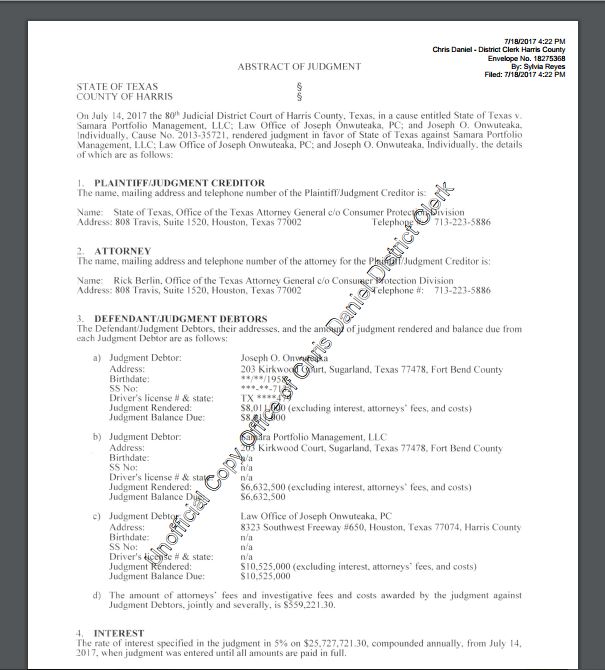
State's abstract of Judgment promptly filed after entry of Final Judgment against Onwuteaka et al 
What did the abused consumers get in restitution or damages while the Attorney General rewarded himself for several years of litigation culminating in a jury trial with millions of dollars while supposedly fighting the good fight for financially struggling consumers and for the good of the public? 

-- Nothing. 

Greg Abbott at least pleaded for restitution to consumers: "Disgorgement", legally speaking. Paxton delivered zilch on that plea for affected consumer-debtors. 


The untold story here is one of untempered institutional greed following in the wake of untempered private greed by an entrepreneurial but unethical and much-disciplined member of the State Bar of Texas. 

First a wayward attorney debt collector squeezes hard-earned dollars from strained family budgets with duplicitous tactics, with the help of a local assembly-line JP court letting him have his way with consumers because it’s just business as usual, then the Attorney General sweeps in from Austin, shuts down Onwuteaka’s boiler-room after parrying with him over several years, and then hoovers up the loot.  
  
KEN PAXTON: HELMSMAN OF ASSEMBLY-LINE DECEPTIONS  

On January 31, 2017, the AG filed a lawsuit against a guy named Don Ray, one of about 100 student loan collection suits filed in Travis County that month, requesting - as he does in hundreds of cases of like kind -- that “Defendant be cited to appear and answer, and that, on final hearing, Plaintiff have judgment of and from Defendant the principal sum of 5,000.00 plus interest, reasonable collection costs, and other charges which have lawfully accrued, according to the note's/notes' terms, attorney fees of not less than 1,000.00, post judgment interest, and such other and further relief to which Plaintiff may be justly entitled either at law or in equity. See Cause No. C-1-CV-17-000942 (link to docket).

According to the process server, Defendant Ray was served February 15, 2017 in Henderson County. He had co-signed the student loan note for his step-child more than twenty years earlier, in 1994, in Palestine, Texas.

Less than two months later, on April 13, 2017, the Attorney General obtained a default judgment for $14,435.99 on that note and $2,000.00 in attorney's fees.  The default judgment additionally awards interest at the rate of 9% on the $14,435.99 amount that wasn’t disclosed in the petition. (The current judgment interest rate is 5%.)
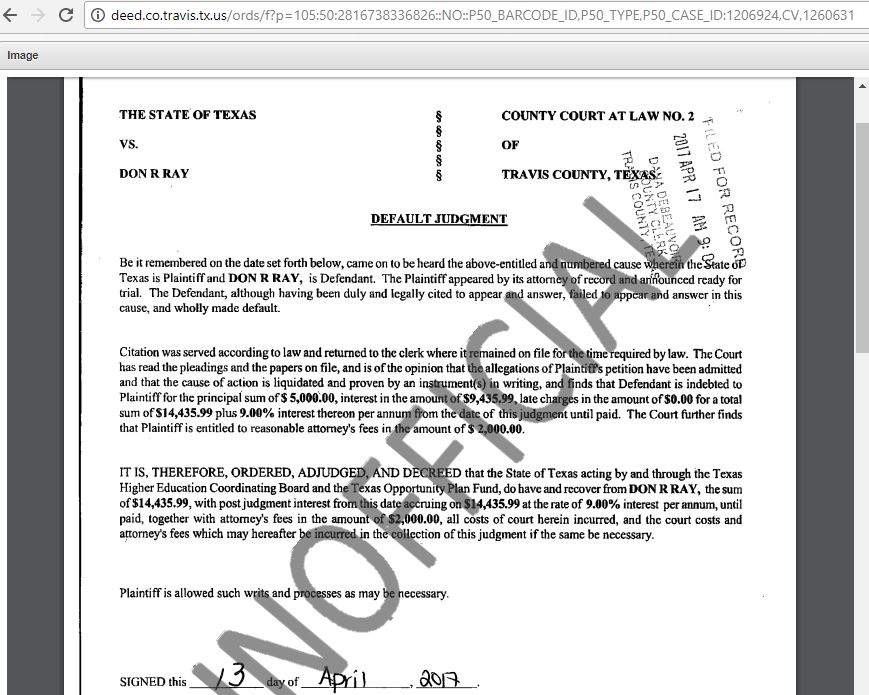
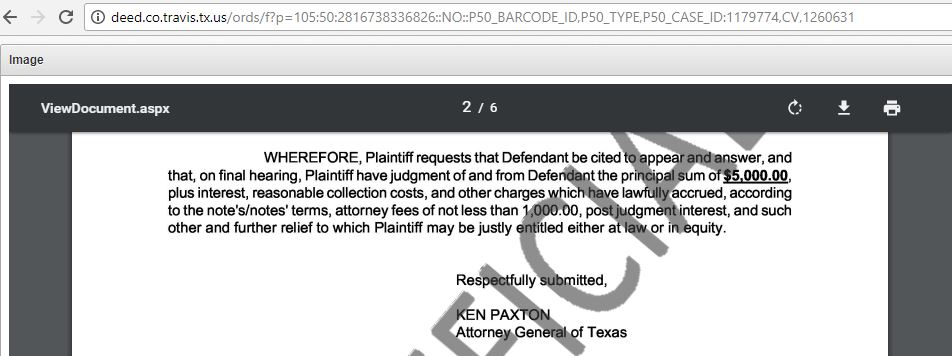
In the pleading on which the default judgment is based, the principal sum of 5,000.00 was underlined and rendered in bold font. to make it stands out from the text. See below:


Put on the defense, the Attorney General would no doubt argue that - well - the petition accurately states the principal amount of the loan was $5,000.00, which matches the amount shown on the attached promissory note with signed guaranty, and that the word "plus interest" does not rule that the accrued interest may actually be a multiple of the principal. 

Regarding the interest, the Attorney General would point out that the pleading rules do not require disclosure of the rate sought when the lawsuit papers are served. And as for attorney's fees, the petition did not need to state that $2,000.00 would be sought in the default or summary judgment because it stated "not less" than $1,000.00 and therefore left open the possibility that fees might the fees might be higher, - like double or triple. 

And he would be right. The petition was not technically false. It was just deceptive. And in a very clever and calculated way. In a way reminiscent of how Joe Onwuteaka and his ilk operate. 

A person of ordinary intelligence would have looked at the dollar figure - rendered and bold font for emphasis - and thought he was being sued for $5,000.00, rather than for $14,435.99, almost three times as much, and more than three times the amount stated in the petition, including the attorney’s fee award. 

The average co-signing parent or step-parent, now on the receiving end of a lawsuit, may have missed the dollar figure for the attorney's fees altogether because it was not shown in bold digits; but if he read the petition carefully, it would have been reasonable for him to conclude that he was being sued for $1,000.00 in attorney's fees, rather than twice that. 

And he might have thought that if was best just to let the AG have his way, rather than put up a fight. After all, he was just being sued for $6,000.00 and interest. 

Or so he would have thought. -- Wrongly. 
"The Court [...] finds that Defendant is indebted to Plaintiff for the principal sum of $ 5,000.00, interest in the amount of $9,435.99, late charges in the amount of $0.00 for a total sum of $14,435.99 plus 9.00% interest thereon per annum from the date of this judgment until paid.” 
“The Court further finds that Plaintiff is entitled to reasonable attorney's fees in the amount of $2,000.00." 
The Attorney General also has a perfect defense for having doubled up on the attorney's fees, which are grossly overstated given that the assistant attorney general assigned to the case did little more than sign a few papers generated from e-templates on his office’s computer system.

A judge has signed off on the default judgment he submitted and thereby declared the fees to be reasonable. $2,000.00 made in minutes. Profitable indeed. Case closed as of April 13, 2017, date of the judgment.

Gavel or no gavel. Res judicata.

The Travis County Clerk gives student loan suit defendants notice that a judgment was entered for the State, but a copy of the judgment is not attached to the mailing, so the recipient doesn’t even know that he is on the hook for much more than the amount he thought he was being sued for. As much as three times as much, as seen in Case No. C-1-CV-17-000942.

After thirty days, it’s too late to file a motion to set aside the default judgment.

ATTORNEY-GENERAL LITIGATION AS A REVENUE SOURCE 
AND PROFIT CENTER 


ATTORNEY FEE ENHANCEMENT
IN STUDENT LOAN COLLECTION SUITS:
PETITION AMOUNT VS. AMOUNT SOUGHT AND AWARDED IN JUDGMENT 


Wednesday, February 8, 2017

CFPB releases summary of consumer complaints, total tally now above 1 million


CFPB RELEASE DATE: February 8, 2017

CONSUMER FINANCIAL PROTECTION BUREAU MONTHLY SNAPSHOT SPOTLIGHTS MORTGAGE COMPLAINTS


Report Also Looks at Consumer Complaints from Tennessee
WASHINGTON, D.C. – Today the Consumer Financial Protection Bureau (CFPB) released a monthly complaint snapshot highlighting consumer complaints about mortgages. The snapshot shows that consumers continue to report experiencing problems with mortgage servicers. This month’s report also highlights trends seen in complaints coming from Tennessee. As of Jan. 1, 2017, the Bureau handled approximately 1,080,700 consumer complaints across all products nationwide.  
“Today’s snapshot shows that consumers continue to report running into issues when making payments on their mortgages or when trying to overcome obstacles to keep themselves in their homes,” said CFPB Director Richard Cordray. “The Bureau will continue to work to ensure that mortgage servicers give consumers the timely and effective assistance they deserve.” 
Category Spotlight: MortgagesWith a value of over $10 trillion, the U.S. mortgage market is the largest consumer financial market in the world. Over the past three years, the Bureau has created new protections for consumers such as requiring lenders to determine that consumers can afford to repay their mortgages. The Bureau has also introduced new consumer-friendly forms to help people shop for mortgages and avoid unexpected issues at the closing table. As of Jan. 1, 2017, the Bureau handled approximately 260,500 mortgage-related complaints. Some of the findings in the snapshot include: 
  • Consumers continue to report problems with mortgage servicing: More than 80 percent of mortgage-related complaints submitted to the Bureau had to do with issues consumers report running into when they were making payments, or when they were unable to pay their mortgage. 
  • Consumers complain about funds being misapplied: Consumers complained that when they paid for identified shortages in their escrow accounts, the money they paid was not applied accurately and resulted in an increase in their monthly payments. Additionally, consumers complained that electronic monthly mortgage payments made via bill pay services through their financial institutions were not properly credited to their loan accounts.   
  • Consumers report issues dealing with servicers when trying to resolve loan problems: A frequent mortgage-related complaint from consumers had to do with problems dealing with their servicer when trying to negotiate foreclosure-relief assistance on their loans. Consumers stated that servicers were slow to respond, made repeated requests for already submitted documents, and provided ambiguous denial reasons. 
  • Companies with the most mortgage-related complaints: The three companies that the Bureau has received the most average monthly complaints about were Wells Fargo, Bank of America, and Ocwen. 
National Complaint OverviewThrough Jan. 1, 2017, the CFPB has handled approximately 1,080,700 complaints nationally. Some of the findings from the statistics being published in this month’s snapshot report include: 
  • Complaint volume: For December 2016, debt collection was the most-complained-about financial product or service. Of the approximately 23,000 complaints handled in December, there were 7,196 complaints about debt collection. The second most-complained-about consumer product was credit reporting, which accounted for 3,837 complaints. The third most-complained-about financial product or service was mortgages, accounting for 3,762 complaints. 
  • State information: Alaska, Georgia, and Louisiana experienced the greatest year-to-year complaint volume increases from October to December 2016 versus the same time period 12 months before; with Alaska up 57 percent, Georgia up 46 percent, and Louisiana up 32 percent. 
  • Most-complained-about companies: The top three companies that received the most complaints from August through October 2016 were Equifax, Wells Fargo, and TransUnion. 
Geographic Spotlight: TennesseeThis month, the CFPB highlighted complaints from Tennessee. As of Jan. 1, 2017, consumers in Tennessee submitted 17,800 of the 1,080,700 complaints the CFPB handled. Of those complaints, 4,700 and 5,800 have come from consumers in the Memphis and Nashville metro areas respectively. Findings from the Tennessee complaints include: 
  • Debt collection is the most-complained-about product or service: Consumers in Tennessee most often submitted complaints about debt collection. Debt collection complaints accounted for 34 percent of the complaints submitted to the Bureau by consumers from Tennessee, while nationally debt collection complaints account for 27 percent of complaints.   
  • Rate of mortgage-related complaints lower than the national average: Complaints related to mortgages accounted for 19 percent of all complaints submitted by consumers from Tennessee. This is lower than the rate of 24 percent at which consumers nationally submit mortgage complaints to the Bureau. 
  • Most-complained-about companies: Equifax, Experian, and TransUnion, were the most-complained-about companies for consumers in Tennessee. 
The Dodd-Frank Wall Street Reform and Consumer Protection Act, which created the CFPB, established consumer complaint handling as an integral part of the CFPB’s work. The CFPB began accepting complaints as soon as it opened its doors in July 2011. It currently accepts complaints on many consumer financial products, including credit cards, mortgages, bank accounts and services, student loans, vehicle and other consumer loans, credit reporting, money transfers, debt collection, and payday loans. 
In June 2012, the CFPB launched its Consumer Complaint Database, which is the nation’s largest public collection of consumer financial complaints. When consumers submit a complaint they have the option to share publicly their explanation of what happened. For more individual-level complaint data and to read consumers' experiences, visit the Consumer Complaint Database at: www.consumerfinance.gov/complaintdatabase/ 
Company-level complaint data in the report uses a three-month rolling average of complaints sent by the Bureau to companies for response. This data lags other complaint data in this report by two months to reflect the 60 days companies have to respond to complaints, confirming a commercial relationship with the consumer. Company-level information should be considered in the context of company size. 
To submit a complaint, consumers can:
  • Go online at www.consumerfinance.gov/complaint/
  • Call the toll-free phone number at 1-855-411-CFPB (2372) or TTY/TDD phone number at 1-855-729-CFPB (2372)
  • Fax the CFPB at 1-855-237-2392
  • Mail a letter to: Consumer Financial Protection Bureau, P.O. Box 4503, Iowa City, Iowa 52244
  • Additionally, through “Ask CFPB,” consumers can get clear, unbiased answers to their questions at consumerfinance.gov/askcfpb or by calling 1-855-411-CFPB (2372). 
###

The Consumer Financial Protection Bureau is a 21st century agency that helps consumer finance markets work by making rules more effective, by consistently and fairly enforcing those rules, and by empowering consumers to take more control over their economic lives. For more information, visit consumerfinance.gov.

Thursday, March 19, 2015

CFPB gives consumers a public forum to complain about banks and other financial service providers

The Consumer Financial Protection Bureau announced today that aggrieved consumers will have the option to share their stories by consenting to have  their narrative made public (anonymously) in the Bureau's Complaint Database. Companies will be given opportunity to respond, but will not be required to do so. 

CFPB logo
FOR IMMEDIATE RELEASE:March 19, 2015
CONTACT:Office of CommunicationsTel: (202) 435-7170

CONSUMER FINANCIAL PROTECTION BUREAU FINALIZES POLICY TO GIVE CONSUMERS THE OPPORTUNITY TO VOICE PUBLICLY COMPLAINTS ABOUT FINANCIAL COMPANIESConsumers Can Now Opt-In to Share Complaint Narratives in CFPB's Public Database


WASHINGTON, D.C. — Today the Consumer Financial Protection Bureau (CFPB) is finalizing a policy to empower consumers to voice publicly their complaints about consumer financial products and services. When consumers submit a complaint to the CFPB, they now have the option to share their account of what happened in the CFPB’s public-facing Consumer Complaint Database. The CFPB is also publishing a Request for Information seeking public input on ways to highlight positive consumer experiences, such as by receiving consumer compliments.   
“Consumer narratives shed light on the full consumer perspective behind a complaint,” said CFPB Director Richard Cordray. “Narratives humanize the problems consumers face in the marketplace. Today’s policy will serve to empower consumers by helping them make informed decisions and helping track trends in the consumer financial market.” 
The Dodd-Frank Wall Street Reform and Consumer Protection Act, which created the CFPB, established the handling of consumer complaints as an integral part of the CFPB’s work. The CFPB began accepting complaints as soon as it opened its doors more than three years ago in July 2011. It currently accepts complaints on many consumer financial products, including credit cards, mortgages, bank accounts, private student loans, vehicle and other consumer loans, credit reporting, money transfers, debt collection, and payday loans. As of March 1, 2015, the Bureau has handled 558,800 complaints, with mortgages and debt collection being the most frequent topics. 
In June 2012, the CFPB launched its Consumer Complaint Database, which is the nation’s largest public collection of consumer financial complaints. It includes basic, anonymous, individual-level information about the complaints received, including the date of submission, the consumer’s zip code, the relevant company, the product type, the issue the consumer is complaining about, and how the company handled the complaint. 
In July 2014, the CFPB proposed a policy that would allow consumers to publicly share their stories when they submit complaints to the Bureau. Today, the Bureau is finalizing its consumer narrative policy after receiving and considering comments from consumer groups, trade associations, companies, and individuals. Consumer narratives provide a first-hand account of the consumer’s experience, and adding the option to share them will greatly enhance the utility of the database. The narratives will provide context to complaints, spotlight specific trends, and help consumers make informed decisions. The narratives may encourage companies to improve the overall quality of their products and services, and more vigorously compete over good customer service. 
Consumer Complaint Narrative PolicyThe CFPB’s final Consumer Complaint Narrative Policy lays out the specific procedures and safeguards the Bureau is putting in place to publish narratives in the database. When consumers submit a complaint to the Bureau, they fill in information such as who they are, who the complaint is against, and when it occurred. They are also given a text box to describe what happened and can attach documents to the complaint. The Bureau forwards the complaint to the company for response, gives the consumer a tracking number, and keeps the consumer updated on its status. 
Starting today, when consumers submit a complaint to the CFPB, they will now have the option to check a box and opt-in to sharing their narrative. In order for companies to learn about this new system, the Bureau will not publish any consented-to narrative for at least 90 days after the policy’s publication in the Federal Register. 
The CFPB’s policy recognizes the importance of protecting consumers’ private information, ensuring the informed consent of any consumer who participates, and providing companies with an opportunity to respond. The policy establishes a number of important safeguards for a clear, fair, and transparent process, including: 
  • Consumers must opt-in to share their story: The CFPB will not publish the complaint narrative unless the consumer provides informed consent. This means that when consumers submit a complaint through consumerfinance.gov, they have to affirmatively check a consent box to give the Bureau permission to publish their narrative. Currently, only narratives submitted online are available for the opt-in to publish. 
  • Personal information will be removed from narratives: The Bureau will take reasonable steps to remove personal information from the complaint to minimize the risk of re-identification. This means the CFPB will use a thorough process to ensure complaints are scrubbed of information such as names, telephone numbers, account numbers, Social Security numbers, and other direct identifiers. 
  • Companies can choose a response to publish: Companies will be given the option to select from a set list of structured response options as a public-facing response to address the consumer complaints. Companies will be under no obligation to offer a public response, and they have 180 days after the consumer complaint is routed to them to select the optional, public response. Companies will have the option to address all consumer complaints submitted after this policy announcement, not just those where a consumer consented to publication. 
  • Consumers can opt-out at any time: If a consumer decides at any time that he or she would like to withdraw consent to publish their narrative in the Consumer Complaint Database, he or she has the ability to do so. 
  • Complaints must meet certain criteria to qualify for narrative publication: In order for the Bureau to publicly share a consumer’s complaint narrative, the complaint must meet certain requirements. Such requirements include that the complaint is submitted through the CFPB website, that the complaint is not a duplicate submission, and that the consumer has a confirmed relationship with the financial institution. Complaints will not be published if they do not meet all of the publication criteria. 
Today’s policy builds on the safeguards the CFPB’s database already has in place. Complaints are listed in the database only after the company responds to the complaint or after it has had the complaint for 15 days, whichever comes first. The CFPB will disclose the consumer narrative when the company provides its public-facing response, or after the company has had the complaint for 60 calendar days, whichever comes first. 
Request for Information on Consumer ComplimentsToday, the Bureau is also issuing a Notice and Request for Information (RFI) seeking input from the public on the potential collection and sharing of information about consumers’ positive interactions with financial service providers. 
Broadly speaking, the Bureau sees two options for sharing positive consumer feedback about companies. One option is to provide more information about a company’s complaint handling such as highlighting the quality of responses to consumers. The second option is to collect and provide consumer compliments – independent of the complaint process. Today’s RFI seeks input on these options and welcomes other ideas. 
###

Saturday, November 30, 2013

Venue violations - What remedies when consumer gets sued in the wrong county & court?


What if a consumer is sued on a credit card debt where he does not live? There will likely be relief available: Motion to transfer venue and/or motion to dismiss the improperly filed suit; and possibly a cause of action under fair debt collection laws. This post focuses on the latter, the FDCPA in particular.

FEDERAL & STATE VENUE RULES FOR DEBT SUITS

Mandatory venue under federal law: Cardholder must be sued in county of residence

Under the FDCPA, a consumer must be sued in the county in which he or she lives or where the loan contract was signed. In credit card cases, the consumer typically signs no contract (except perhaps if the card is issued by a credit union); therefore there will typically only be one applicable venue, which would be mandatory, i.e leaving the debt collection attorney no choice in the matter. Another exception, involving location of real estate, is not applicable either, because consumer credit card debt is not a mortgage, and typically not secured at all, at least not in Texas.

If the consumer gets sued elsewhere, he or she may have a case under the fair debt collection laws in addition to being entitled to transfer of venue under the Texas Rules of Civil Procedure.  -- > Motion to Transfer of Venue under  TRCP.

The venue restriction on debt suits imposed by the FDCPA is found at Section 1692i(a)(2) of Title 15 of the United States Code, cited as 15 U.S.C. § 1692i(a)(2).

Mandatory venue under Texas law: Credit card debt suit must be filed in county where cardholder resides
The Texas Civil Practice and Remedies specifies where civil lawsuit may or must be brought. "May be brought" is called permissive venue and "must be brought" goes under the rubric of "mandatory venue". For consumer debt, the rules mirror the federal venue rule: the lawsuit against the consumer seeking collection of debt must be filed either where the contract was signed (if there is a signed contract) or where the consumer lives.

Texas Civil Practice & Remedies Codes also has strict rule for venue 

Venue for consumer credit cases is governed by Section 15.035(b) of the Civ. Prac. & Rem Code, which mandates that venue is proper in either the county of the consumer's residence or the county in which the consumer signed the contract. The CPRC also expressly states that this provision cannot by waived by the consumer.

Enforcement of venue provision against debt collector with a record of massive violations 

The Texas Attorney General recently brought an enforcement action against an attorney for routinely suing debtors in Justice Court court in Downtown Houston (JP Court of Harris County Precinct 1 Place 2) even though they lived outside the county and had no connection to Harris County. The civil action was filed by the Consumer Protection Division in the public interest and seeks a permanent injunction and hefty monetary penalities to be paid to the State of Texas. As of November 2013, it is still pending in Harris County District Court: State of Texas vs. Samara Portfolio Management LLC; Law Office of Joseph Onwuteaka, PC, and Joseph O. Onwuteaka, individually.

Case Style on complaint filed by AG: State of Texas v. Samara Portfolio Management LCL
TDCA Enforcement Action (above) and factual allegations section (below)


VENUE VIOLATION BY DEBT COLLECTION ATTORNEYS AS AN FDCPA CLAIM 

Under the FDCPA, unless a debt collector is suing to enforce an interest in real property, it must bring any action on a debt against a consumer in the judicial district where the consumer signed the contract at issue or in the judicial district where the consumer resided when the suit was filed. 15 U.S.C. §1692i(a)(2).
Note that the federal judicial district is not coextensive with a county (a political subdivision of the state), wherefore caselaw should be researched to determine whether a venue violation can be asserted in good faith in a particular case, such as when the defendant is sued in the wrong JP court precinct within a county.
Lawsuits on behalf of corporations are mostly filed by attorneys because corporate officers who are not attorneys are not permitted to sue and sign pleadings as agents of corporate entities unless they bring the lawsuit in justice court. -- > Can a corporate entity appear in court without lawyer?

To assert a venue-violation claim against an attorney under the FDCPA, it must be shown that the attorney meets the federal definition of debt collector. The FDCPA covers attorneys, but not all attorneys under all circumstances in which a questionable or clearly prohibited act occurred (such as a violation of the federal venue rule). An attorney only faces liability under the FDCPA for such act if he or she meets the statutory definition of "debt collector". The key element of that definition is the "regularity" of the debt collection activitities. -- > When can attorneys be sued for FDCPA violations?

The FDCPA has one-year statute of limitations. Therefore, a remedy may no longer be available under the FDCPA even if a violation could easily be proven and even if the attorney meets the statutory definition. In those instance where the claim of unfair debt collection is time-barred under federal law, it may be worth considering the TDCA as an alternative.

RELATED TOPICS RELATED TO FAIR DEBT COLLECTION COMPLIANCE: 

When are collection attorneys subject to liability under the FDCPA?
What is a covered debt under the FDCPA?
Texas Debt Collection and federal Fair Debt Collection Practices Act: Compare and Contrast
Texas AG civil injunction suits to enforce compliance with state fair debt collection statute