Showing posts with label Target-card. Show all posts

Wednesday, September 11, 2013

Troy Bolen - Texas Debt Collection Attorney Review (2013)(updated 2014)


Troy Dean Bolen – Individual Debt Collection Attorney (profile)

Troy Bolen is a debt collection attorney with a law firm active in debt collection in numerous states: ZWICKER & ASSOCIATES, P.C.  

Bolen received his JD from South Texas College of Law in December of 1999 and obtained his Texas law license in 2008. Attorney Bolen’s statutory profile on the State Bar of Texas web site was certified on 09/19/2012 and does not reflect any disciplinary or sanctions history. Troy Dean Bolen’s Bar Card Number is 24006199.

NAME VARIANTS / ALIAS: Troy Bolen, Troy D. Bolen  

ADDRESS:

Troy D. Bolen   24006199

ZWICKER & ASSOCIATES, P.C.
1 Chisholm Trail, Suite 301
Round Rock, Texas 78681

Fax: (512) 218-0477

ALTERNATIVE RENDITION OF ADDRESS:

BOLEN TROY DEAN

ZWICKER & ASSOCIATES P.C.
OLD TOWN SQUARE,
1 CHISHOLM TRAIL, STE 301
ROUND ROCK TEXAS 78681
5122180488
5122180477

TEXAS-BASED COLLEAGUES AT ZWICKER: 

Joseph M. O’Bell, Audrie L. Lawton, Laura L. Bedford  
  
STAFF MEMBERS: Kirsten Roadhouse, Litigation Assistant
Process servers/civil process companies used for service of citation: ABC Legal

CLIENTS AND CASES AND VOLUME OF CASES 

Troy Dean Bolen is listed as attorney of record in 939 cases in Harris County District Courts as of February 8, 2014. The total of cases for 2013 is 804. This includes several dozen filed on the last day of the year. 

The client list includes the following financial institutions:


GE CAPITAL RETAIL BANK
NORDSTROM FSB
AMERICAN EXPRESS TRAVEL RELATED SERVICES  

Troy Bolen is shown as attorney of record in 181 cases filed in 2013 in Fort Bend County District Courts. The caseload composition matches the one in neighboring Harris County. Bolen's cases include collection suits by Discover Bank, Target National Bank and TD Bank USA, N.A. (Target NB's successor); the two AMEX Banks (American Express Bank, FSB, and American Express Centurion Bank); and GE Capital Retail Bank.

TYPICAL PLEADINGS
  
Like most other debt collection attorneys Bolen files pleadings generated with a document production system that inserts a few case-specific details (name of defendant, a few digits of the account number, and the amount for which judgment is sought) into a template. For that reason, the pleadings filed in the numerous cases look the same, contain the same allegations (except for the amount), and are based on the same legal theory: breach of written contract. Attorneys’ fees are not requested in the standard pleadings (as of 2013). 
   
The template for original petitions filed by ZWICKER& ASSOCIATES attorneys in Texas was updated in 2013 in light of the Texas Supreme Court’s adoption of the expedited actions rule and the changes in discovery practice related to it.  

SAMPLE PETITION WITH PARAGRAPH REFERENCING THE EXPEDITED ACTION RULE


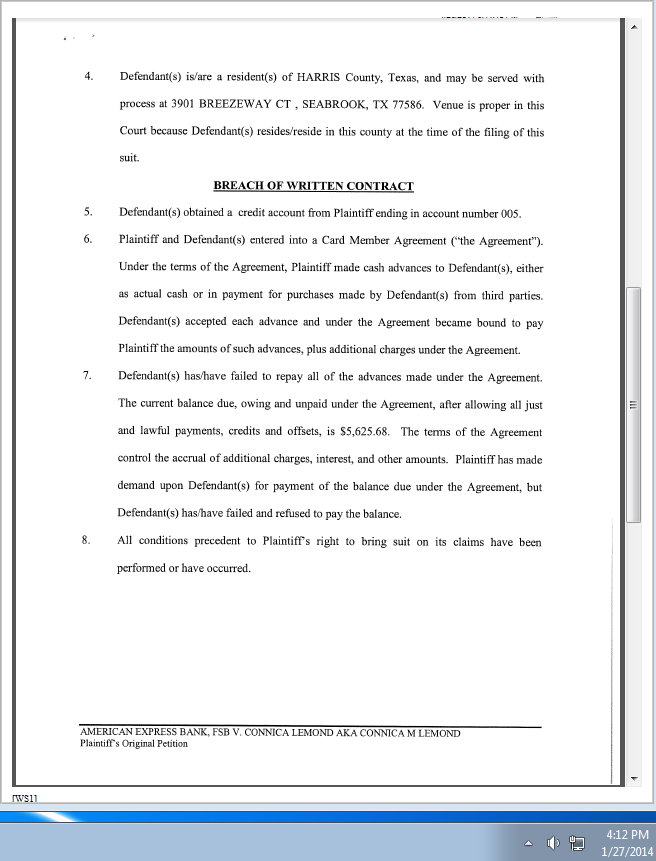
BREACH OF CONTRACT PARAGRAPH IN AMEX PETITION


BREACH OF CONTRACT PARAGRAPH IN DISCOVER BANK PETITION


TROY BOLEN SIGNATURE SAMPLE AND CONTACT INFO FROM CIVIL FILING SHEET
Troy Bolen signature samples, Bar number, and address information from Civil Case Info Sheet
in Discover Bank debt collection lawsuit
This profile page on Texas attorney Troy D. Bolen was last revised or updated on:  2/8/2014. Additional exhibits from recently filed litigation were added.

EXAMPLE OF DEBT SUIT PETITION FILED BY TROY BOLEN IN AMEX SUIT IN 2014


Tuesday, August 6, 2013

Target Credit Card Accounts in Texas Court (now owned by TD Bank)

  
TARGET CREDIT CARD DEBT SUITS
   
UPDATE: Target National Bank does not exist any more. It was closed and liquidated  March 13, 2013. Its portfolio of credit card accounts was acquired by TD BANK.


WHO ISSUED THE TARGET CHARGE CARD? 

This may sound like a silly question, but the fine print on the customer agreement will likely prove otherwise.

Credit card debt suits involving Target cards come in several varieties, with different entities as plaintiffs. Even when Target sues as original creditor, it is not Target Corporation that's doing it. The credit operations are run through an affiliated bank. While lawsuits have typically been brought by Target National Bank ("Target NB"), sometimes a closer look at the documentation will reveal that the cardmember agreement offered as a summary judgment exhibit (or at trial) identifies the card issuer as Retailers National Bank even though the title of the document makes reference to Target. The attorney for Target NA often does not come forth with proof that the two are one and the same, or that the entity named as the Plaintiff is the successor in interest of Retailers National Bank. Arguably, this constitutes a gap in the chain of ownership or raises a fact issue as to the identity of the original creditor. In addition to litigation brought by Target National Bank itself, debt suits on Target cards are also filed by TD Bank USA, N.A. as successor. The latter's home state is Delaware.


LAW FIRMS SUING ON TARGET CREDIT CARDS IN TEXAS  

Many debt collection suits on Target credit card accounts are brought by a law firm with the unwieldy name RAUSCH, STURM, ISRAEL, ENERSON & HORNIK, LLC ("RSIEH"). The name was even too long to be deemed suitable for a domain name. The debt collection firm's web address thus uses the acronym: www.rsieh.com.

RSIEH has as many as nine Texas-licensed attorneys listed below the signature line on its filings. It represents both Target National Bank and TB Bank USA, N.A. (and other creditors, such as CITIBANK, N.A.). When it sues for TB Bank, its summary judgment evidence typically includes a copy of the ASSIGNMENT AND ASSUMPTION AGREEMENT that governs the transfer of accounts. That agreement lists three Target entities as involved parties: TARGET CORPORATION as the Parent and Depositor, TARGET RECEIVABLES, LLC as a Seller, and TARGET NATIONAL BANK, as a Seller and Depositee.

RSIEH typically does not seek attorney's fees in addition to the amount of the debt and costs of suit (filing fees and cost of service of process).

TARGET CREDIT CARD AGREEMENTS AND TERMS 

Target credit card agreements are typically much shorter than other such form contracts (often only 2 pages with 3 columns each). They also differ from those of most other major card issuers in that they do not contain arbitration clauses, meaning that arbitrability is not an issue and cannot be invoked as a defense to litigation. The form agreements do, however, contain a choice of law clause stating that the agreement is governed by federal and South Dakota law.

A number of credit card issuers chose South Dakota as the relevant jurisdiction for regulatory reasons. Interest rates are not capped by usury laws in that state as long as whatever rate is charged is contractually authorized. Citibank is another major credit card issuer that located its credit card arm CITIBANK (SOUTH DAKOTA), N.A., there.

Copies of Target card agreements offered as summary judgments contain contract verbiage in fine print and are not always legible.

Target cards typically have variable interest rates for two types of balances: Purchases and Cash Advances. The APRs are shown as variable with the letter V in parenthesis. The late fee is $35.00 and a warning about this fee as a consequence of not making timely payments appears on monthly billing statements.

TARGET CREDIT CARD STATEMENTS 

In litigated cases, the account documentation submitted by Target (or on its behalf) typically reveals a key difference. Target routinely accelerates the maturity of the revolving balance on the last statement sent to the card holder. As a result, the amount shown as the minimum required payment on the last account statement ("Minimum Payment Due") matches the amount of the outstanding debt, i.e. the revolving balance. Therefore motions for summary judgment by Target containing such a final statement cannot be fought on the ground that the account documentation does not show that the amount sued for was actually due for payment in full. At best, it could be argued that contractual authorization to exercise the acceleration remedy has not been shown (if either the card agreement itself is not in the record or if there is insufficient proof of the Defendant's liability under the version attached as a summary judgment exhibit).

Unlike some other creditor (e.g. Discover Bank, Citibank) Target does not use a servicer entity to process payments. The billing statements issued for customers in Texas include payment coupons with an address for TARGET NATIONAL BANK either in Minneapolis, Minnesota or in Dallas, TX. The billing statements identify Target National Bank as an affiliate of Target Stores and requires checks to be made payable to Target National Bank.

Related topics: Cases involving Target accounts in Texas Court of Appeals