Monday, February 2, 2015

Elise Manchester (Profile of Zwicker & Associates Debt Collection Attorney)


ELISE MANCHESTER - Individual profile of debt collection attorney at major firm suing on consumer credit card debt.  

Elise D. Manchester is an attorney with the Texas branch of ZWICKER & ASSOCIATES P.C., a debt collection firm operating in more than a dozen states.

Manchester is a graduate from Baylor, where she earned her Doctor of Jurisprudence degree in 2009. She lists her practice areas as Business, Litigation: Commercial, which is interesting, given that ZWICKER is best known for suing on consumer debt on behalf of such creditors as Discover Bank and American Express. The listed areas apparently reflect the nature of her caseload at the lawfirm she was previously associated with: HARRELL PAILET & ASSOCIATES, PC. Her docket there reflected a wider range of clients, compared to the caseload at Zwicker, and greater complexity of issues.

Ms. Elise Diane Manchester's Texas Bar Card Number is 24070566. She does not use her middle name and signs herself as Elise Manchester. It appears that she does not yet sign pleadings as an attorney of record in debt collection suits filed on behalf of ZWICKER's clients in Texas.  (See image of address block and signature sample below).

Manchester is also admitted to practice in the U.S. District Court for the Northern District of Texas. She obtained her license to practice law in Texas in November 2009, the same year she graduated from law school. As of 2014, she is not licensed in any other state.

ATTORNEY MANCHESTER'S FORMER LAW FIRM AFFILIATION

Elise Manchester was previously associated with HARRELL PAILET & ASSOCIATES, PC, a Dallas law firm that also engaged in debt collection litigation, albeit with emphasis on commercial contract disputes rather than consumer debt. 

FELLOW ATTORNEYS AT THE FIRM MS. MANCHESTER IS CURRENTLY WITH  

As of 2015 Manchester's colleagues in Texas (on the law firm address block with her) are:
Troy D. Bolen, Laura L. Bedford, and Leslie L. Sun. 

LAW FIRM ADDRESS 

ZWICKER & ASSOCIATES P.C.
1 CHISOLM TRAIL, SUITE 301
ROUND ROCK TEXAS 78681
5122180488
5122180477

A previous post on this blawg provided more detailed information about ZWICKER & ASSOCIATES and its debt collection practice in Texas. One of the attorneys previously on the address block has left the firm: Audrie L. Lawton. Elise Manchester appears to be the replacement. ZWICKER currently lists four attorney's on the pleadings it files in Texas courts. 

NONLAWYER STAFF:

Holly Cocherham, Litigation Assistant

Notaries used: Mandy Backlund, Janis L Selucky, Anna Pometta-Glick  

CIVIL PROCESS SERVICE USED BY THE FIRM  

ZWICKER uses ABC Legal to serve citations and petition (suit papers) on the people the firms sues for unpaid credit card debt in Texas.

UNIFORM PLEADINGS FOR ALL ZWICKER ATTORNEYS LITIGATING IN TEXAS 
   
The Zwicker & Associates law firm uses pleadings and motion templates that are identical for all attorneys. The address block on pleadings and motions lists all attorneys involved in debt collection litigation with boxes preceding their respective names. The attorney that signs on the line provided for the signature also checks the appropriate box below by hand. 
     
TYPICAL PLEADINGS BY ZWICKER ATTORNEYS  
    
The standard pleading template has not changed. Zwicker's petition consists of three pages without any attachments in the form of affidavits or copies of account statements. They seek recovery for breach of contract, but do not seek application of the law that governs the creditor and is shown in the choice-of-law paragraph of the applicable card member agreement or customer agreement. For American Express, that is Utah, for Discover Bank, it is Delaware. 
    
RELATED PRIOR POSTS 
  
Troy Bolen Attorney Review (2013 with 2014 update) 

DOCUMENT EXCERPTS / SAMPLE PLEADINGS / IMAGES 

How Attorney Elise Manchester signs 
Leslie L. Sun - Zwicker & Associates Attorney in Texas (signature and address block from pleading)
List of Zwicker Attorneys in Texas Debt Collection Suits
as of Jan 2015 (Leslie L. Sun signature and check in box) 
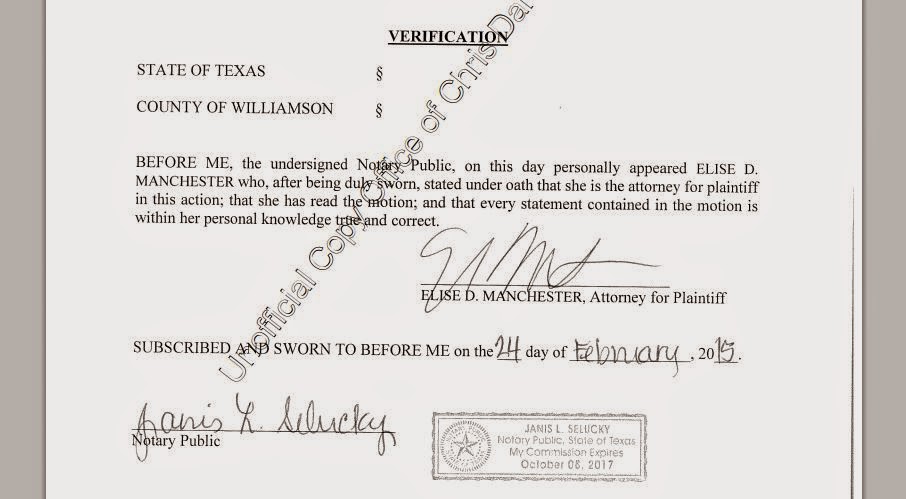
SAMPLE VERIFICATION FROM MOTION TO RETAIN CASE ON DOCKET 
(no timely service upon the defendant)


EXAMPLE OF NON-MILITARY AFFIDAVIT FILED IN SUPPORT OF DEFAULT JUDGMENT


EXAMPLE OF ZWICKER MOTION TO RETAIN TO PREVENT CASE FROM BEING DISMISSED FOR WANT OF PROSECUTION (DWOP) FILED BY ATTORNEY MANCHESTER 


Saturday, January 10, 2015

Mark Rechner - Debt Collection Attorney Profile


ABOUT MARK RECHNER 

PROFESSIONAL BIOGRAPHIC INFORMATION,
LITIGATION RECORD, AND TYPICAL PLEADINGS 

Mark Rechner, whose full name is Mark August Rechner, is a Dallas-based debt collection attorney with the lawfirm Vincent Lopez Serafino Jenevein PC. He received his law degree from Baylor University in 2007 and was admitted to practice of law by the Texas Supreme Court that same year. Attorney Rechner does not provide any details regarding his practice or specific services on the his official State Bar profile page, which was last certified 1/29/2014. Nor does Attorney Rechner's official profile feature a photo or a hotlink to his firm's website.

This attorney profile includes information obtained from court record and other sources.

LICENSE NUMBER AND NAME VARIANTS 

This attorney's name appears as MARK RECHNER on pleadings (without middle initial). The State Bar shows his attorney's complete legal name as MARK AUGUST RECHNER. There is no problem with confusion in the legal profession because there are no other Texas attorneys that share the same last name. There is, however, a person with the same name at JPMorgan, an Executive Director in Sydney Australia, who previously worked for Deutsche Bank. There are also a few other people with the same first and last name on LinkedIn, including one in Houston, albeit in the different industry. The surname "Rechner" is German in origin and means "calculator" or, in modern parlance, "computer".

STATE BAR NUMBER FOR ATTORNEY MARK A. RECHNER: 24058064

COMPLAINT HISTORY 

The State Bar of Texas (SBOT) reports no public disciplinary history for this attorney.

LAWFIRM AFFILIATION AND ADDRESS 

VINCENT LOPEZ SERAFINO JENEVEIN, P.C.
1601 Elm Street, Ste 4100
Dallas, Texas 75201
214-979-7400
214-979-7402

OTHER ATTORNEYS WITH THE SAME FIRM, CURRENT OR FORMER

Thomas M. Sellers (on the pleadings in firm address block)

Thomas Sellers, Attorney at Vincent Lopez Serafino Jenevein, PC, is also a graduate of Baylor University Law School. He earned his BA at the University of Texas in Austin in 2006.

There are other lawyers with this firm, which is active on a wider spectrum of the legal services market geared toward the corporate/business sector, but their names do not appear in consumer debt suit litigation.

STAFF AND OTHER RELATED PERSONS 

Notaries used by Mark Rechner: Amy R. Martinez; Maida Lerma; Jolene Hall; Jason T. Palguta
Legal Assistant: Amy R. Martinez

OTHER PROFESSIONAL PROFILES 

According to Attorney Mark Rechner's LinkedIn page, he has been with his current employer since 2007, i.e. eight years. He is identified as a "Law Practice Professional" with Waco, Texas as this practice area. The LinkedIn profile reports his prior employer as Vincent Moye. This Mark Rechner (there are others with the same name) has 114 connections on LinkedIn.

CREDITORS ON WHOSE BEHALF MARK RECHNER FILES LAWSUITS 

WELLS FARGO BANK NA (original debt suits and garnishment actions after judgment)

CASES IN HARRIS COUNTY (HOUSTON) 

For the time period 2010-2014 Attorney Mark Rechner is listed as attorney of record in 32 cases in Harris County Civil Courts at Law. All recent cases are either garnishment actions filed against banks or other entities believed to be holding funds owned by debtors who ended up with judgments, or cases seeking other post-judgment relief, such as turnover of assets.

For the same four-year time period, Attorney Mark Rechner is listed as attorney of record in 439 cases in Harris County District Courts, 118 of which were filed in 2014. While the majority of debt case are filed in county courts at law, the Wells Fargo collection suits handled by Rechner are filed in district courts. These are much more numerous than the county courts at law. New cases are assigned randomly. Wells Fargo debt collection suits come in four categories: DEBT, CONTRACT, BREACH OF CONTRACT, and GARNISHMENT cases. The debt, contract, and breach cases, however, are not really distinguishable because these are overlapping classifications on the district clerk's docketing system.

CASES IN FORT BEND COUNTY  
CASES IN DALLAS COUNTY 

COMMENT ON PLEADINGS FILED BY THIS TEXAS LAWYER 

Attorney Rechner's standard petition consists of four pages. Like the Texas attorneys for ZWICKER & ASSOCIATES Rechner pleads breach of contract as the sole theory. He no longer includes alternative legal theories that are equitable in nature. Such theories are incompatible with the presence of a formal written contract that control the claim and the relationship of the parties.

--> Express contract precludes equitable relief.

The case-specific content in a standard petition in credit card debt cases includes the account origination date. The underlying contract is referenced as "Wells Fargo Consumer Credit Card Customer Agreement and Disclosure Statement" (see image at the bottom of this page).

American Express also used to have wordy and unwieldy titles on its cardmember agreement, but has since replaced them with new versions that have the name of the cardholder(s) printed on Part 1. Wells Fargo, by contrast, still relies on oddly captioned generic cardmember agreements that contain neither the name of the customer, nor the account number. The account-specific credit terms are printed on a separate document. This makes sense because those terms vary among account holders based on the credit scores, spending and payment history, and other risk-related variables that the bank consideres in pricing decisions. Unlike some other debt collection attorneys, Rechner does not attach the cardmember agreement or any other exhibits to his collection suit petitions; nor does he serve any discovery requests with the initial pleading.

APPLICATIONS FOR WRIT OF GARNISHMENT 

In his garnishment applications, Attorney Rechner does not reveal what research was undertaken to determine the facts upon which the application for writ of garnishment is based. A garnishment is a separate lawsuit brought against a bank or other entity that is believed to hold assets that belong to the judgment defendant. The purpose of the action is to capture those funds in satisfaction (or partial satisfaction) of the underlying judgment. The most common type of a garnishment actions is against a bank at which the judgment debtor has a checking or savings account. The garnishment is brought against the bank, but the judgment-debtor must also be given notice, and may contest the garnishment and seek dissolution of the writ, if there are legitimate grounds for it. Some types of funds, such as social security benefits, for example, are protected and are not subject to garnishment.

SAMPLE DOCUMENTS / SNIPPETS OF PLEADINGS FILED BY ATTORNEY RECHNER 

EXCERPT FROM A WELLS FARGO PETITION FILED IN DECEMBER 2014 THAT STATES A BREACH-OF-CONTRACT CLAIM ONLY, PLUS A CLAIM FOR ATTORNEY'S FEES


EXCERPT FROM OLDER ORIGINAL PETITION FILED BY MARK RECHNER IN WELLS FARGO BANK DEBT CASE: UNJUST ENRICHMENT AND MONEY HAD AND RECEIVED THEORIES PLEADED DESPITE CLAIM BASED ON LOAN CONTRACT (BREACH OF CONTRACT).


MARK RECHNER'S LAW FIRM ADDRESS BLOCK FROM PLEADING, AND SAMPLE JOHN HANCOCK. Note: Some of the pleading are apparently signed by his colleague Tom Sellers, even though Rechner is designated as attorney in charge.

Sample signature and lawfirm address block: Mark Rechner


FEE AFFIDAVIT WITH TESTIMONY ON HOURLY RATES


EXCERPT FROM GARNISHMENT APPLICATION - AFFIDAVIT


WHAT A WELLS FARGO CREDIT CARD AGREEMENT LOOKS LIKE 


LINKS TO RELATED PAGES 

Profile of law firm: VINCENT LOPEZ SERAFINO JENEVEIN
Directory of creditors and collectors: WHO IS WHO IN DEBT COLLECTION IN TEXAS
Creditor profile: Credit Card Debt Suits by Wells Fargo Bank N. A.

EDITORIAL NOTES AND HISTORY: This profile was first posted on 1/10/2015 and has since been updated with a name of a notary public.  The SBOT and LinkedIn profile pages of Attorney Mark Rechner were last visited on 1/9/2015.


Sunday, August 24, 2014

HSBC Bank Nevada, National Association, Las Vegas, Nevada (“HSBC Nevada”) - No longer in existence


CREDIT CARD DEBT SUITS  BASED ON 
ACCOUNTS OF HSBC BANK NEVADA, N.A.

HSBC BANK NEVADA, N.A. was a national bank that has since ceased to exist. It issued various private label and co-branded cards, including Best Buy and Metris. Its portfolio also included accounts issued in the name of DIRECT MERCHANTS BANK.
 
Claims based on charged-off accounts of this nature are typically brought by debt buyers, such as NCEP, LLC; PORTFOLIO RECOVERY ASSOCIATES, LLC ("PRA"); CAVALRY SPV I, LLL (as assignee of EQUABLE ASCENT FINANCIAL, LLC); MIDLAND FUNDING, LLC; and MAIN STREET ACQUISITION CORP.
 
Attorneys for these debt buyers often do not produce a cardmember agreement to establish the contractual foundation of their claim. Other documentation is often also of poor quality. Sometimes they submit an application for a credit card, and pretend that the application is the contract, even if the application makes it clear that it may or may not be granted, and states that the cardholder agreement will be sent with the card (assuming the application is approved). In many of these debt collection cases, the documentation of the portfolio transfers is often of very dubious character also. There is frequently no specific evidence to demonstrate that the particular account on which the debt collection attorney sues was part of the portfolio to which the bill of sale or other form of assignment document pertains. One-page bills of sale typically refer to other documents (such as exhibits, schedules, and contracts) and the information contained in such other documents, but these other documents are typically not attached, and therefore are not before the court for evidentiary purposes.

HSBC BANK NEVADA, N.A.'s active credit card portfolio was acquired by Capital One Bank, National Association, McLean, Virginia and Capital One Bank (USA), National Association, Glen Allen, Virginia in a 2011 asset purchase transaction, with regulatory approval granted in 2012. Defaulted account were apparently also part of the transaction, which arguably makes Capital One a debt collector, as opposed to a creditor, under the FDCPA, when it attempts to collect on such accounts. But there may be reasonable grounds for legitimate disagreement on the matter, particularly in cases when it is not clear, or not clear initially without the benefit of discovery, what that status of the the particular account was at the time of the portfolio sale transaction.

HSBC BANK NEVADA, N.A subsequently merged with its corporate parent and its charter under the National Bank Act was surrendered to the OCC. As a result, the bank no longer exists.


EXCERPT FROM APPLICATION FOR REGULATORY APPROVAL
FOR HSBC-CAPITAL ONE DEAL FOR SALE OF CREDIT CARD BUSINESS

HSBC - CAPITAL ONE DEAL - TRANSACTION SUMMARY
(click image to enlarge)
HSBC BANK NEVADA, NATIONAL ASSOCIATION - BACKGROUND 

HSBC Nevada was chartered in 1993 under the Competitive Equality Banking Act (“CEBA”).

A CEBA bank is not a “bank” for purposes of the Bank Holding Company Act if it engages “only in credit card operations” and is restricted by statutory provisions from competing with retail banks by limiting its deposit taking and lending activities. Under CEBA, HSBC Nevada could not make any loans outside of its credit card operations, including commercial loans, farm loans, or community development loans. In addition, HSBC Nevada applied for, and received, a limited purpose designation under the CRA on February 1, 1996. A limited purpose bank is a bank that offers only a narrow product line to a regional or broader market and for which a designation of limited purpose bank is in effect.

HSBC Bank Nevada, National Association, Las Vegas, Nevada ceased to exist when it merged into HSBC Finance Corporation, Mettawa, Illinois (“HBIO”), its non-bank parent corporation incorporated under Delaware Law, pursuant to 12 U.S.C. § 215a-3. 1 As a result of the merger, HSBC Nevada’s corporate existence ended and its charter was surrendered to the OCC.


 FDIC information on HSBC-related financial institutions in the U.S.
The Bank Holding Company is HSBC HOLDINGS PLC (based in London)


Saturday, January 25, 2014

Motion for Continuance: Reset of Trial Date, Motion for Summary Judgment Hearing or Submission; and request for postponement of other court hearings


What is a continuance? What is required for a motion for continuance? Which rule applies?

CONTINUANCE AND RE-SET DEFINED 

A continuance is the legal term used to refer to a court (judge) not going forward with a hearing or trial on the day it was set to commence per prior notice and notation on the docket (the court's agenda ketp by the clerk). This may happen for a variety of reasons. It may be the judge's unilateral decision based on scheduling considerations involving other matters, or it may be requested by either party or both parties for reasons of their own.
 
In debt cases, amount of time to try a case is normally not a major issue because these types of trials are, with rare exceptions, very quick and jury trials are virtually unheard of. Many such cases are disposed of within minutes, especially when there are not live witnesses, and a business records affidavit with attachments is used instead. Some judges even give them priority on trial day if they can be taken care of in a matter of minutes.

A closely related terms is "reset". A continuance amounts to reset if a new date for the hearing or the trial is fixed at the same time the continuance is granted. The new date will be noted on the docket, and a notice will be mailed to the parties and/or their attorneys, if any, by the clerk.

Nonlegal terms that refer to the same type of action in other contexts are postponement and rescheduling.

THE RULE GOVERNING CONTINUANCES: More than one

There are actually several rules in the Texas Rules of Civil Procedure that deal with continuances. It has been proposed that the rules be reorganized and simplified. Although the Supreme Court revised serveral rules in 2013, and added new ones, a comprehensive make-over has yet to happen.

Texas Rules governing motions for continuance of trial

The most important rule for continuances of trials is rule 251. It provides for three scenarios: motion for continuance by one party, which must be supported by affidavit (or "verified", i.e. sworn to), motion for continuance by agreement of the parties;  and continuance by operation of law.

TRCP 251 titled CONTINUANCE

The rule does not completely reflect what typically happens in the courtroom. First, many continuance are done by the court on its own initiative, or upon appearance of at least one party or attorney, regardless of whether a motion for continuance is on file. Judges don't have to justify a decision to reset a case, as long as the right to a trial is not thwarted altogether.

There may be a variety of reasons for judges continuing cases, and it is particularly common in courts with a heavy caseload, such a county courts at law in large counties that handle the majority of debt collection cases.

Second, the rule does not state that an agreed continuance is automatic. The judge still retains discretion to grant the continuance or deny it and go forward with the hearing or trial. As a matter of common courtroom practice, however, the judge will  almost always grant an agreed motion for continuance as long as trial has not already been reset several times before in the same case.

County and district court judges may be more concerned with the length of time cases linger on the docket without a final decision because the Supreme Court has adopted guidelines for timely disposition, statistics are kept, and judges may be evaluated on their performance, based on such metrics, come the next election. If many very old cases remain pending, it makes them look bad. The disposition guidelines do not apply in justice court, and statistics for individual courts are typically much harder to come by.

Third, the summary judgment rule has its own provision for motions for continuance, but it closely tracks the rule that applies to trial continuance based on an alleged need of the party for additional discovery or deposition testimony.  

Finally, the set of rules that expressly address the topic of continuance do not cover another important ground for a trial reset: insufficient notice, or none at all.

MOTION FOR CONTINUANCE BASED ON LACK OF NOTICE OR INADEQUATE NOTICE OF TRIAL OR HEARING SETTING 

In order to enforce minimum required notice periods, the aggrieved party must bring its complaint to the trial court's attention. If an appeal may ensue, it would also be important to obtain a ruling on the objection.
The complaint about insufficient notice of a hearing or trial setting may be done by written objection filed with the clerk or through a motion for continuance.

There are some differences between the two forms: A motion for continuance will require a certificate of conference with the opposing counsel who set the hearing and will have to be captioned opposed or unopposed. Second, since it is a motion, it would have to be accompanied by a proposed order, and would arguably be subject to timeliness requirements applicable to motions generally. At least, the motion should be filed as promptly as possible, once the need for it becomes apparent. Third, a motion for continuance would be expected to be sworn like motions for continuance based on other grounds, at least as long as the lack of notice or insufficient notice is not apparent elsewhere on the record. To be on the safe side for purposes of appeal, the motion should be sworn ("verified") or accompanied by an affidavit setting forth the relevant facts regarding lack of (or belated) notice.

MINIMUM NOTICE REQUIREMENTS 

The minimum required notice depends on the nature of the hearing, and  -- in the case of trial settings -- whether it is the first trial setting, or a reset.

Summary judgment hearings (or hearings by submission) require a minimum of 21 days prior notice to the other party (called the non-movant); other types of motions can be set on much shorter notice: as much as a few days under the TRCP, but the local rules in a particular county, court system/division, or individual court, may require more.

For the first trial setting, the minimum notice is 45 days for contested cases. Any second or later trial setting is only subject to "reasonable" notice. Trials may be set or conducted without regard to minimum notice periods if not contested.

APPELLATE CASE LAW ON CONTINUANCES AND DENIAL THEREOF

There is plenty of case law from the courts of appeals, which typically involves denials of motions for continuance, and whether such a ruling by a trial court judge was error.

Generally, such a denial is no abuse of discretion, and not grounds for reversal of the judgment, if the motion was defective (such as  not having been sworn, or not setting forth grounds); or if there was no good cause for the continuance, i.e. need for it supported by sworn facts that establish that the substantive requirements for a continuance have been satisfied.


A typical basis, whether pretextual or well-founded, for not wanting to go forward with a trial is the claim that further discovery is needed, or that a witness is not available to testify, or wasn't available for deposition. Another common reason is a scheduling conflict of one of the attorneys, particularly a conflicting trial setting in another court.

NEED FOR ADDITIONAL EVIDENCE OR TESTIMONY AS GROUNDS FOR CONTINUANCE 

Rule 252, oddly titled "APPLICATION FOR CONTINUANCE" rather than Motion for Continuance, sets rules for a continuance based on the unavailability of testimony. This ground must be supported an affidavit that shows that the party seeking the continuance for that reason has exercised due diligence in seeking to obtain such testimony, and that the testimony is material.

TRCP 252: Form and substance for Motion for Continuance based on
need for additional discovery, testimony
The rule speaks of testimony, but it could also be a lack of documentary evidence, particularly in the summary judgment context, although the summary judgment rule has its own provisions in this regard, which are very similar.

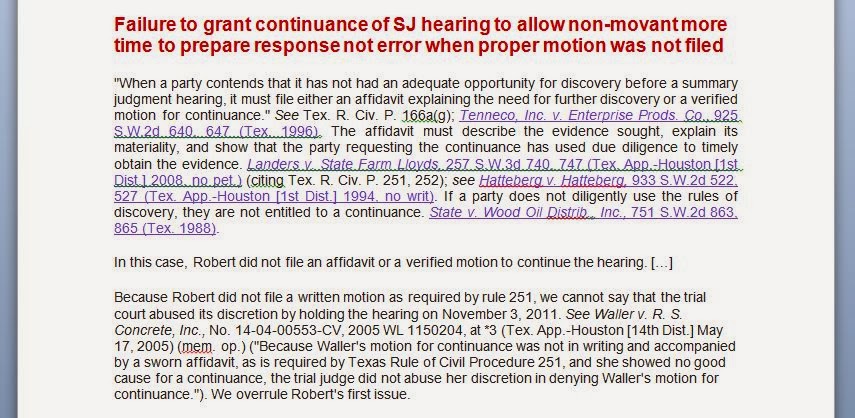
Summary Judgment Rule provisions for Continuance of Hearing
to Prepare Better Response

OTHER BASIS FOR CONTINUANCE - ABSENCE OF PARTY'S ATTORNEY 

Rule 253 states that the absence of a party's lawyer does not constitute good cause for continuance or postponement of trial, but the judge nevertheless has some discretion under such circumstances.
Rule 254 addresses the situation of an attorney serving as a legislator. In most cases the grant of a continuance requested by such attorney-legislator is mandatory if the legislature is in session.

TRIAL COURTS EXERCISE DISCRETION

As a general rule, the grant or denial of a motion for continuance is a matter on which the trial court exercises its discretion. Some judges let it be known that they will grant the first continuance as a matter of course, and that any further ones require good reason or extraordinary circumstances.

RULES GOVERNING TRIAL CONTINUANCE VERBATIM (click image for better view)

Image of the several rules governing trial continuance in Texas courts (click to enlarge)
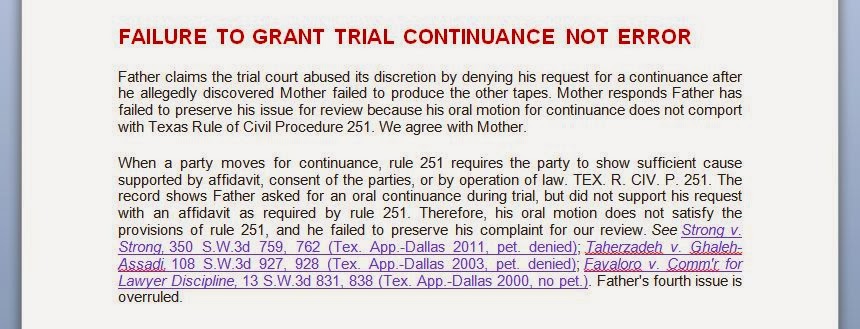
MANDAMUS PETITION FILED TO GET COURT OF APPEALS TO OVERRULE TRIAL JUDGE ON DENIAL OF MOTION FOR CONTINUANCE, BUT UNSUCCESSFUL 


Wednesday, January 22, 2014

Dan G. Young Profile of Attorney with JWY Lawfirm in Lubbock


WHO-IS-WHO AMONG THE CREDITORS’ BAR

Dan G. Young with JENKINS Lawfirm in Lubbock

INDIVIDUAL ATTORNEY PROFILE  OF DEBT COLLECTION ATTORNEY

Dan G. Young is a collection lawyer with Jenkins,Wagnon & Young, LLC

Attorney Dan G. Young has been licensed in Texas since 1983, and in Oklahoma since 2005. Unlike most other collection lawyers, Young is admitted not only to practice all courts of the State of Texas, but in federal district courts and bankruptcy courts in the multiple Districts of Texas; in the Fifth Circuit Court of Appeals; and in the U.S. Supreme Court. His law degree is from Texas Tech University (1983).  

NAME CONFUSION: SEVERAL TEXAS ATTORNEYS WITH SIMILAR NAME 

Young is a common last name. Not surprisingly, there a number of other attorneys with the same last name, and even one with the same first and last name, and a few more with the first name Daniel rather than the short version Dan. It is therefore important to include the middle name to distinguish Dan G Young from other attorneys with very similar names. The official licensing and registration records for Dan G. Young do not reveal what middle name the G stands for.  

Attorney Dan G. Young’s Texas Bar Number is 22177250

LAW FIRM AND COLLEAGUES 

Dan G. Young is a name partner at JENKINS, WAGNON & YOUNG.. Jody Jenkins and Dan G. Young sign pleadings in debt collection litigation handled by this firm. J. Mark Wagnon devotes himself to other legal matters, which consist in large part of transactional work. Wagnon does not appear as attorney of record in the firm’s collection lawsuits. Like Jenkins and Wagner, Dan G. Young was previously with McCleskey, Harriger, Brazill & Graf, L.L.P., which is true of his partners also. 

Brian Benitez (full name Brian Louis Benitez) is an associate at the firm. He too is a graduate from Texas Tech University School of Law. Benitez was licensed in 2012 and recently joint the firm.

PRACTICE AREAS

Although he is best known as a debt collection lawyer, Attorney Dan G. Young lists a number of other areas of practice on this State Bar profile:  Bankruptcy, Business, Consumer, Creditor-Debtor, Insurance, Labor-Employment, Litigation: Commercial, Real Estate, Other, Finance

ADDITIONAL BIOGRAPHIC INFORMATION 

According to his bio on his firm’s website, Dan G. Young was born in Lubbock in 1957, earned his college degree in his home town in 1979, and also went to law school there, earning his JD from Texas Tech University School of Law  in 1983, where he was also on the law review. He was licensed that same year. Young has chosen collection work as his niche in the legal field. He is a member of the National Association of Retail Collection Attorneys  and the American Collectors Association.

FOR WHICH CREDITORS DOES DAN G. YOUNG LITIGATE?

A search on the Harris County District Clerk's websites reveals  Dan G Young as attorney of record in 437 cases. Recent clients include CONVERGING CAPITAL CORPORATION, SIMMONS FIRST NATIONAL BANK, CACH LLC, EQUABLE ASCENT FINANCIAL LLC, GLOBAL ACCEPTANCE CREDIT COMPANY.

APPELLATE RECORD IN TEXAS

Dan G. Young has a much more extensive appellate track record than most other debt collection attorneys in Texas. He is listed as attorney in 30 cases, although there are few in recent years.  One of the appeals resulting in a noteworthy opinion involved a debt collection case brought on behalf of Hudson & Keyse, L.L.C. on an assigned Chase Manhattan Bank credit card debt that was appealed to the Fourteenth Court of Appeals in Houston. Many appeals in debt collection matters get dismissed for various reasons, such as nonpayment of fees, defective appellant’s brief or none, and lack of jurisdiction due to untimely filing of notice of appeal, or for other reasons.  

TYPICAL PETITION IN DEBT SUIT 

Notwithstanding his appellate law credentials, the pleadings filed by Dan G. Young are rudimentary. Like all other debt collection firms, litigation templates are used and suit papers for individual cases are generated with document production software that inserts a few pieces of variable data into the e-template for pleadings, motions, and other documents. While the typical original petition contains a fact section, it may not even feature a separate paragraph on the legal theory of recovery. See sample of fact section: 


ATTORNEY FEE AFFIDAVITS 

Both Jody Jenkins and Dan G Young seek attorneys fees in debt suits. The typical amount claimed as reasonable, regardless of county in which the suit is filed, is $1,500. See excerpt from sample fee affidavit: 


LAWFIRM ADDRESS AND CONTACT DETAILS FOR DAN G. YOUNG

Dan G. Young
JENKINS, WAGNON & YOUNG, P.C.
P.O. BOX 420
Lubbock, Texas 79408-0420
Phone: 806-796-7322
Fax: (806) 771-8755


Thursday, December 19, 2013

Comment on Labeau v. GE Capital Retail Bank - Deemed admissions used against bank customer


Current rules give unfair advantage to mass-litigation attorneys targeting Texas consumers

Labeau v. GE Retail Bank formerly GE Money Bank

CASE NOTE AND COMMENT  ON USE OF DEEMED ADMISSIONS AGAINST DEBTORS WITHOUT LAWYERS 

This case has an important lesson, and a sad one: Don't try to help your spouse with litigation (unless you are a lawyer).

Husband was sued on a credit card, but did not get himself together to file his own paperwork, or thought the wife would do a better job being his advocate in addition to mounting her own defense. They were both named as defendants.

Creditor, GE Capital Retail Bank (formerly GEMB), filed motion for summary judgment based on deemed admissions, which was granted over the objection of the debtor's spouse. The Fort Worth Court of Appeals affirmed on appeal, pointing out the incompetence of the defense under the current rules governing litigation.

Some of these rules are bad rules, and the Supreme Court, and Texas Legislature (to the extent that's required), should change them. Why are they bad? Because they are out of sync with reality and lend themselves to abuse and deception, on a massive scale.

Unauthorized practice of law: Can't afford a lawyer. Out of luck. Family member can't help you. Is not allowed to help you!

The official purposes of the Unauthorized Practice of Law Committee (UPLC), and the law under which it operates, is to protect the public from substandard legal representation. But many people can't get a lawyer, good or otherwise, because they can't afford one. In the case of debtors, that's why they are in default in the first instance.

The rule that prohibits family members from helping family members in court punishes what the law otherwise recognizes as a duty (at least to some extent), namely that spouses take care of each other, not to mention a moral obligation and the right thing to do.

While trial judges condone many other procedural and evidentiary errors if there is no objection (you have to be an attorney, or be well-versed in law to make the right one), trial judges do enforce the rule that family members are not allowed to advocate on behalf of one of their own. They enforce that rule, while remaining silent on many others unless a competent lawyer raises the issue, such as pleading deficiencies, hearsay exceptions, and objections to incompetent or otherwise defective affidavits. This does not mean they are being mean. Some may very well stop non-lawyers in their tracks in good faith because what they are doing may also subject them to the possibility of criminal prosecution, though that's a stretch. Be that as it may, family members will typically not be allowed to speak for other family members in court (except as witnesses), and may not sign court-filed papers on their behalf. It's a big no-no, and courts of appeals have harped on it time and again.

This case is  no exception. Spouse, rather than defendant, signed motion for continuance and did not ask for withdrawal of deemed admissions. At least, this time the panel opinion did not go so far as to suggest that the spouse may have committed a crime.

Deemed admission: Perversion of a tool for lawyers to streamline litigation 

Deemed admissions result from failure to answer requests for admissions. The original purpose of that rule that authorizes Requests for Admissions is to allow litigants to reduce the number of issue for trial by disposing of those that are not really contested or not worth arguing about.

But requests for admissions are these days mostly used for an entirely different purpose: To trap unrepresented litigants who are known to be unlikely to respond. After all, they get these requests from an attorney suing them, -- an attorney who may even have stated in a letter or in the pleadings themselves that any information will be used for debt collection purposes. Sounds like another well-known phrase: Anything you say may be used against you. the Miranda warning. This one is known to the public from myriad cop and crime shows on TV. So why would average unsophisticated telly-watching folk who find themselves the target of a lawsuit respond  to request for information when they have just been warned that everything they say will be used against them?

What the lay defendants don't know or appreciate is how their failure to respond will be used against them, and that judgment can be entered on deemed admissions even if default judgment cannot be entered after they have filed an answer (or written a letter to the judge).

A modest proposal: Abolish the deemed admissions rule, and replace it with a rule authorizing the filing of stipulations signed by both parties or their attorneys.

The Texas Supreme Court should abolish or change the deemed admissions rule because it was being intentionally misused by attorneys engaging in mass-litigation against individuals most of whom will not hire legal counsel. Debt collection attorneys know how to exploit the current rules and use them for purposes for which they were not intended. Additionally, the rule allows them the get Defendants to admit (by doing nothing) facts that even the debt collection attorney knows to be false, or does not care if they are false.

Modest changes to benefit the lawyerless masses, but only in JP and family courts so far

The Supreme Court has recently promulgated new rules for justice court. Among those is a rule that allows family members to act on behalf of defendants in debt suits filed in those courts, though it requires the judge's permission, and the "representation" is limited. The operative word is "assisted".


Additionally, the Supreme Court has taken note that large numbers of people try to get divorced without a lawyer, many no doubt because they cannot afford one. The highest court, over the vociferous objections of the Family bar, thus promulgated pro se forms to help those unrepresented litigants.


The rules of procedure for county and district court should also be amended to make them more user-friendly, rather than giving an unfair advantage to debt collectors engaging in mass litigation. The debt collectors' tactics can be effectively countered only by those defendants who can afford to mount a defense with counsel, or become legally savvy extremely quickly. It only takes a little over 50 days to end up with deemed admissions; and only 30 if they are served under rule 21a. A typical pro se litigant would not know that, and most probably won't trust the debt collection attorney telling him or her as much. And a month is hardly enough for even a college-educated lay person to become legally savvy.

Even a three-year law school education, followed by bar exam passage, does not make freshly licensed attorneys ready for litigation. If left without supervision, they will predictable make numerous mistakes. How can the general public be expected to know how deemed admission operate and how to undo the damage once the relentless operation of the rule has inflicted it?

Here is the tale of LaBeau, as told by the court of appeals: 

LaBeau did not respond to the motion for summary judgment, but his wife attached to the June 5, 2012 motion for continuance (which bore only her signature) a document entitled "Facts to be Admitted or Denied." She admitted making the agreement with Lowe's Home Improvement, stated that Lowe's "third partied" the agreement with GE Capital, and denied the amounts due and owing. She also claimed she had sent two checks to Lowe's, one for $1,350 and one for $1,800, and that she had attempted to resolve the matter in good faith.
Even if the motion for continuance could be construed as a motion to withdraw the deemed admissions, it was filed by LaBeau's wife rather than LaBeau.[3] See Tex. R. Civ. P. 7. There is nothing in the record from LaBeau asking the trial court to withdraw the deemed admissions or otherwise responding to the motion for summary judgment.[4] See Unifund CCR Partners v. Weaver, 262 S.W.3d 796, 797-98 (Tex. 2008). Accordingly, we conclude and hold that the trial court did not err by granting summary judgment, and we overrule LaBeau's second issue.
Decision 

Having overruled both of LaBeau's issues, the Forth Worth Court of Appeals, in an opinion by Chief Justice Terrie Livingston, affirmed the trial court's judgment and ordered LaBeau to pay the costs of the appeal.

Comment 

The decision of the Second Court of Appeals is not wrong under existing law. It is just not right. It is not right because the rules under which the appeal was decided subvert, rather than promote, the merits-based resolution of cases. But the problem is the nature of the rules themselves that permit non-merits based adjudication of cases brought against unsophisticated defendants based on deemed admissions. The remedy is their amendment by the Texas Supreme Court, -- which is the relevant rule-making "agency" with respect to rules of procedure and evidence.

Case info and link to appellate docket sheet and on-line opinion on the court's website  

Michael LaBeau v. GE Capital Retail Bank f/k/a GE Money Bank, No. 02-12-00284-CV (Tex.App. -- Fort Worth, July 16, 2012) (Opinion by Chief Justice Terrie Livingston) (click docket number).


(Click image to enlarge it)


GE Capital Retail Bank formerly known as GEMB, Appellee, was represented by Joseph Marse O'Bell, a ZWICKER AND ASSOCIATES attorney handling debt collection cases in Texas for multiple creditors.


Sunday, December 15, 2013

Sufficiency of the Pleadings: Was the bank's debt claim properly stated in plaintiff's petition?


HAS THE CREDITOR SUING ON AN ACCOUNT PLEADED PROPERLY? 

Fair Notice Standard applies to pleadings in Texas Courts

The quality and specificity of pleadings filed by debt collection attorneys varies considerably; but even at the lower end of the spectrum, a pleading will probably pass muster in most circumstances because the pleading rules in state court are more relaxed, compared to federal court. This is true for plaintiffs as well as defendants.

Texas courts apply the fair notice standard to pleadings by the plaintiff, and do not require the defendant to admit or deny specific factual allegations in the numbered paragraphs of the Plaintiff's petition.

Nor is the defendant required to provide specific facts supporting affirmative defenses when filing an answer. The identification of the relevant defense(s) by name is generally sufficient. Rule 94 lists defenses that must be pleaded expressly, and Rule 93 specifies which matters require verified (sworn) answer.

But see -- > Requests for admissions are sometimes embedded in the pleadings, which is not proper under the rules governing pleadings and discovery, and can create confusion, but is standard practice for many collection law firms. They are rarely scolded for it.

The Bank's petition mentioned credit card account and default. Was the cause of action properly identified? 

While it was not one of the main issues in the case, the Texarkana Court of Appeals, in Tully v Citibank, addressed the issue of pleading sufficiency with respect to breach of contract. Although Citibank's attorney had not expressly pleaded breach of contract as a cause of action in the trial court, the appellate court held that it had nevertheless satisfied the fair notice standard, which applies to trial court pleadings in Texas courts.

The higher court noted that Citibank had stated in its petition that the suit was based on a credit card debt. More specifically, Citibank alleged that Tully "defaulted in making the payments required by the terms of the Card Agreement. Due to Defendant's breach of the terms of the agreement....". The "cardmember agreement" is indisputably a type of contract, and the allegation of "default" amounts to an allegation of "breach" under a contract governing extension of credit and repayment of amounts loaned. Construing the petition liberally, the court concluded that it gave fair notice that Citibank was asserting a cause of action for breach of contract. The Tully v. Citibank case stands for the proposition that a suit for collection for a credit card debt is a breach of contract suit, and is cited for this legal point, even by federal bankruptcy courts. See In re Tran, 369 B.R. 312, 317 (S.D. Tex. 2007), aff'g 351 B.R. 440, 445 (Bankr. S.D. Tex. 2006)
Under Texas law, collection of the amount due under a credit card agreement is treated as a claim for breach of a written contract. Tully v. Citibank (South Dakota), N.A., 173 S.W.3d 212, 215-220 (Tex.App.-Texarkana 2005). Thus, Texas law provides that eCast's claim is one based on a writing, therefore, to be entitled to prima facie evidentiary effect, eCast's claim must include the writing under Rule 3001(c).
Challenging the other party's pleadings with Special Exceptions  

In Texas, pleading deficiencies may be attacked through a motion by another name: Special Exceptions. The rule governing this procedure, which essentially involves a motion for an order requiring the opponent to re-plead, is rule 91 of the Texas Rules of Civil Procedure (TRCP 91). It must be read in conjunction with Rule 90, which addresses waiver of such defects in form.


Normally, it is not worth mounting this type of challenge because it requires a hearing, and the payoff, even in the best-case scenario will be meager. The debt collection case cannot be resolved favorably for the defendant based solely on special exception without the plaintiff being given an opportunity to amend and thereby correct the error. Only if an attempt at amendment would be futile, can the trial court dismiss a petition on special exceptions and close the case.

A motion for summary judgment, by contrast, can seek a final disposition. Either party can file such a motion, and when the plaintiff files one, the defendant may consider countering it with a motion for summary judgment of his or her own. Also see -- > No evidence motion for summary judgment by the defendant.

In contrast to special exceptions, a summary judgment motion does not afford the non-movant a safe harbor, or second chance, after the motion has been heard and granted (except a motion for reconsideration or a motion for a new trial, which applies generally).

Pleading sufficiency review in the default judgment context 

Sometimes, however, a defective pleading can become a controlling issue; particularly in the context of an appeal from a default judgment. Texas courts have held that the examination of the pleading as a basis for a judgment under such circumstances is more rigorous. The caselaw on this issue is supported by rule 90, which essentially says that all complaints of pleading deficiencies are waived if not made the subject of special exceptions except that the rule does not apply against a party against whom a default judgment is rendered. See TRCP 90.

This makes sense. After all, in the default judgment context, the defendant did not (by definition) appear and was not in a position to challenge the plaintiff's pleading or assert any objections.

Case in point from the Beaumont Court of Appeals 

In 2012 the Ninth Court of Appeals, sitting in Beaumont, handed down an interesting opinion on the subject of pleading sufficiency when presented with the issue after default judgment was rendered against a consumer in a case in which the plaintiff had sued two. Hankston v. Equable Ascent Financial, 382 S.W.3d 631 (Tex.App.- Beaumont - 2012).

Applying the more exacting standard applicable to review of default judgments, the court held, in an opinion written by Justice David Gaultney, that the debt buyer's pleadings did not support the various theories that the creditor's attorney urged on appeal.

Petition did not sufficiently allege elements of account-suit theories 

As for the theory of open and stated account, the petition did not include an allegation that the defendant had agreed that the balance alleged as due was correct, in addition to equivocating on how much was due by conceding that the pleaded-for amount may not reflect all payments made.

Even though an affidavit was attached to the pleading, it did not qualify as a sworn account because the affidavit did not state that the "claim is, within the knowledge of affiant, just and true...." See Tex.R. Civ. P. 185, and therefor did not meet the minimum requirements of a sworn account suit under Rule 185. Nor did the petition contain any allegation that the account was "for goods, wares and merchandise," for material furnished, for personal services rendered, or for labor done or furnished. See Tex.R. Civ. P. 185.

As for the quantum meruit claim, there was no allegation that the plaintiff provided valuable services or materials. The court also noted that a quantum meruit claim is not available when there is an express contract, as was also alleged in the petition. -- > Express contract renders recovery in quantum meruit unavailable.

But the breach of contract claim was defective too, because the plaintiff tried to impose liability on two defendants, but the body of the petition referred only to one, and did not say which one opened the account or signed the contract. Nor did it even identify the original creditor, which is an additional proof requirement for a plaintiff suing as an assignee.

RELATED TOPICS AND BLOG POSTS

Theories of recovery in Texas debt collection suits
Breach of contract as the proper theory to collect a credit card debt (Tully v. Citibank)
Account suit theories: Open account, account stated, and sworn account
Challenging default judgments after the fact: Different methods of attack 
Post-judgment motion vs. restricted appeal: Caveats 


Saturday, December 14, 2013

Credit Union loses on appeal: Hooper v. Generations Community FCU (Tex.App. 2013) (case note) (San Antonio)


Hooper vs. Generations Community FCU (Tex.App. 2013)  

CREDIT UNION FAILED TO PROVE ELEMENTS OF BREACH OF CONTRACT CLAIM 

This is a collection case in which a debtor ultimately prevailed because the financial institution failed to prove its cause of action. The trial court had not held the plaintiff to its burden of proof, but the San Antonio Court of Appeals did, when it reviewed what had transpired in the court below, and overturned the trial court's judgment in June 2013.

Explaining in their opinion why judgment for the credit union had to be reversed, three justices on the San Antonio Court of Appeals, all women, correctly state that a cause of action for collection of a credit card debt is a breach of contract claim, recite the essential elements of such claim, and show that the credit union had simply not proven all of those elements at trial. It lost, as it should, because the credit union's attorney had done a poor job presenting its case. As was true of Citibank when it moved for summary judgment with a dubious motion against cardholder Jack Tully in one of the first precedent-setting Texas credit card debt collection case in recent history.  

WHY DID CITIBANK LOSE IN TULLY? 

In Tully v. Citibank (Citibank v. Tully in the trial court) Citibank's attorney had a summary judgment in his client's favor reversed because two of his theories - sworn account and quantum meruit - were not legally viable for collection of a credit card debt, while the third theory, breach of contract, which was the correct theory, given the nature of the debt failed because Citibank had not proven the contractual authorization for finance charges.

The summary judgment record in Tully contained a Cardmember Agreement from Citibank, but it did not contain the interest rate disclosure information, which was presumably set forth in separate document ("card carrier") mailed with the card cards which reflected different interest rates for different categories of borrowers,  reflecting different borrower profiles, creditworthiness, and risk levels (-- > risk-based pricing based on borrower characteristics vs. market-based pricing).

The Texarkana Court of Appeals accordingly reversed the summary judgment for Citibank and sent the case back to the trial court.

APPEAL FROM SUMMARY JUDGMENT VS. BENCH TRIAL 

In Hooper, a panel of the San Antonio Court of Appeals reviewed the propriety of judgment for the creditor entered after a bench trial. Even though the standard of review on appeal from such a judgment differs from the standard applicable to summary judgments, the substantive elements that the plaintiff has to prove are the same.

As plaintiff, the creditor has to prove (1) that a valid contract existed, (2) that the plaintiff performed or tendered performance, (3) that the defendant breached the terms of the contract, and (4) that the plaintiff suffered damages as a result of the defendant's breach.

Other intermediate courts of appeals in Texas do not disagree with the recitation of these essential elements of a breach of contract claim; nor do the even disagree with the requirement that specific contract terms must be proven for a viable breach-of-contract claim (rather than merely the abstract fact that there was some kind of contract between creditor and borrower).

But panels of justices of certain other courts of appeal (in Houston, Dallas, and Waco) have let financial institutions win without proving the underlying contract even though such a contract is always required under state and/or federal law governing credit cards and issuers of such cards. How so? -- By other means.

See --> Account Stated: an old theory turned to new use to allow creditors to win without having to prove up the loan contract.

WHY WAS THE JUDGMENT FOR THE CREDIT UNION REVERSED?

The court of appeals' opinion in Hooper makes clear that the credit union lost because its attorney had done a poor job presenting its case at trial. It had not actually proven up the agreement referenced in the application for credit, and had not shown what the terms were that formed the basis for the allegation that Hooper breached the contract. Since the element of breach of credit agreement could only be shown with reference to the specific contractual obligation governing repayment in installments, the absence of the agreement was also fatal to the third element of a viable breach of contract cause of action, breach by nonperformance.

Holding that the evidence was legally insufficient to support the trial court's judgment, the San Antonio appellate court explains that the creditor cannot prove breach without establishing what obligations were subject to breach, i.e. the terms of the underlying loan contract.


The court sums up the deficiency in the evidence as follows:

Although there was some evidence that Hooper obtained a credit card from the Credit Union and that he used the credit card, there was no evidence establishing Hooper's specific obligations under the terms of an agreement. For example, there was no evidence regarding Hooper's obligation to repay the balance and interest on the account, including when his payments were due, where his payments were to be made, and what would transpire if he failed to make a payment in accordance with the terms of an agreement. Nor was there evidence indicating Hooper failed to comply with a particular term of an agreement, or otherwise failed to perform his obligations under an agreement. We conclude the record discloses the complete absence of evidence of the third element of the Credit Union's breach of contract claim, i.e., that Hooper breached the terms of an agreement with the Credit Union. In the absence of evidence that Hooper failed or refused to do something he promised to do under an agreement, the Credit Union failed to prove its breach of contract claim.

TULLY AND HOOPER COMPARED 

Both Tully v. Citibank and Hooper v. Generations Community Federal Credit Union involved insufficient proof of the terms of the underlying contract. In Tully it was lack of evidence that the interest rates on the account statements were contractually authorized because the Cardmember Agreement that Citibank attached to its motion did not actually contain the finance terms; in Hooper it was the absence of evidence of the repayment terms that the customer was alleged to have breached because the credit union never proved up the Credit Line Account Agreement and Disclosure that contained the terms under which the customer was to be held liable.

Because the element of breach by nonperformance can only be established with reference to the underlying contractual obligations, the absence of the terms document also proved fatal to the third element of the credit union's breach of contract claim. Because the credit union had not met its burden of proof at trial, the San Antonio reversed and rendered judgment for the Defendant.

CITES FOR THESE APPELLATE OPINIONS IN SUCCESSFUL APPEALS BY DEBTORS 

Jack TULLY v CITIBANK (SOUTH DAKOTA), N.A., 173 S.W.3d 212 (Tex.App.-Texarkana 2005, no pet.)(case note)
Bret Wayne HOOPER v. GENERATIONS COMMUNITY FEDERAL CREDIT UNION,
No. 04-12-00080-CV (Tex.App. - San Antonio, June 23, 2013, no pet.)

HOW CITED 

A credit card issued by a financial institution is a special contract that does not create the sort of debtor-creditor relationship to bring a claim within the scope of Rule 185. See Bird, 994 S.W.2d at 282; see also Sherman Acquisition II LP v. Garcia, 229 S.W.3d 802, 807 (Tex.App.-Waco 2007, no pet.); Tully v. Citibank (South Dakota), N.A., 173 S.W.3d 212, 216 (Tex.App.-Texarkana 2005, no pet.).

Hooper v. Generations Cmty. Fed. Credit Union, No. 04-12-00080-CV, 2013 WL 2645111, at *3 (Tex. App.-San Antonio June 12, 2013, no pet.) (mem. op.) (reversing judgment for creditor where cardholder agreement was not offered into evidence and there was no evidence establishing debtor's specific obligations under an agreement).


Last revised: 12/8/2018