Saturday, December 7, 2013

What is a Citation in a lawsuit on a debt in Texas?


"GREETINGS" of the unwelcome kind: Being served with a lawsuit papers: Citation and Petition 

The Meaning of the word Citation in the debt-collection context 

The word CITATION has other meanings, too, but in the debt collection context, the citation is the document that gives formal notice to the defendant that he or she has been sued. In federal court, and in other states, it is called summons, but debt suits are not filed in federal court.

TERMINOLOGY: TEXAS VS. OTHER FEDERAL COURT AND OTHER STATES

In Texas the word summons is used to, but most commonly for a call to jury duty. The papers served with the citation are also denominated differently. In Texas state courts they are called PETITION, and ORIGINAL PETITION, which in federal courts (including federal courts in Texas) they opening salvo in a civil action takes the form a COMPLAINT, served with SUMMONS, or a request to waive issuance and service of summons.

THE CITATION IN A CIVIL CASE IN TEXAS 

The citation is a document separate from the pleading itself, and is prepared and issued by the clerk of the court, not by the attorney for the plaintiff. It will tell the Defendant about the deadline to answer the lawsuit and contain a warning about the prospect of a default judgment if the Defendant fails to answer. The plaintiff's petition will be attached. It will normally be titled "Plaintiff's Original Petition", or some variant thereof. Additionally, discovery requests may also be attached, or even included withing the body of the petition. -- > Embedded discovery requests. If discovery in served with the petition, the titled of the petition will typically refers to it, e.g.: Plaintiff's Original Petition and Requests for Admissions.

There are very specific requirements regarding the contents of the citation, the manner of service upon the defendant, and the certification by the process server or officer that such was done. The latter is called the "return of service". If the defendant could not found, the citation will be returned also, with information on the unsucessful service attempts. The fact that service of process was not successful may be noted on the docket with the strange but descriptive word "NONSERVICE" or "UNSERVICE" or "NONEXECUTION".

The plaintiff may then request reissuance of citation (alias citation) to try again, perhaps at a new address if the original one was incorrect or a work address. An order for substituted service under Rule 106(b) may also be requested.

ALTERNATIVES TO SERVICE OF CITATION IN PERSON

Under Rule 106(b), the service is often made by attaching the lawsuit papers to the front door or gate with contemporaneous mailing by certified and regular mail to the same address. When this method is used, the defendant does not have to be encountered in person and the process server or law enforcement officer will not be in a position to testify about having handed the papers to the defendant. But, if the instructions on the order for Rule 106 service were meticulously followed, that does not matter. -- > Sufficiency of substituted service by alternative methods

THE HARSH CONSEQUENCES OF NOT ANSWERING

If the defendant was served, but does not answer as instructed by the citation, the plaintiff may move for a no-answer default judgment. The effect of a default judgment is no different from that of a regular judgment, but it may be easier to challenge for irregularities in the manner it was obtained. There are likely to be more errors because the lawsuit was not subjected to the adversarial process in which errors could have been complained of, and corrected. Courts and clerks are supposed to make sure that all requirements are met, some even have default judgment check-list, but nothing is guaranteed. -- > Requirements for default judgment; -- > Challenging a default judgment based on belated notice.

ATTACKING A DEFAULT JUDGMENT ON GROUNDS OF DEFECTIVE SERVICE OR NONSERVICE 

Compliance with rules of service and the relevant surrounding facts regarding service typically become issues when the defendant eventually hires a lawyer and challenges a default judgment. The method to do so is by bill-of-review petition. If rendered recently, other means to attack the default judgment may also be available. -- > Post-judgment motion; -- > Motion to set aside default judgment; -- > Appeal from final judgment; -- > Restricted appeal.

In an appeal, it may even be possible to argue that the petition was defective and does not support the default judgment; rather than the service of citation. -- > Insufficient pleadings and default judgment.

Defendants are supposed to be given notice of a default judgment promptly after it is signed (to Defendant's last known address), but if the address for service under Rule 106 was bad in the first instance, the notice of judgment will likely have gone to a bad address too. Such notice is not even required to be sent by certified mail, and it does not include an actual copy of the judgment. -- > Sample notice of judgment.

SAMPLE DOCUMENTS 

Return of Citation (2014) - Proof of Service by Declaration under penalties of perjury
by Civil Process Server in lieu of affidavit or sworn & notarized return 


RELATED TOPICS AND BLOG POSTS 

Initiation of lawsuit by Original Petition, followed by service of process on the defendant
Service of lawsuit papers in person, by certified mail, and by alternative methods
What to do about a default judgment
Insufficient pleadings as a basis to challenge a default judgment
No-answer default judgment vs. post-answer default judgment


U.S. Bank National Association ND ("US Bank NA ND") Credit Cards


U.S. Bank, National Association, ND is a North Dakota based bank that is part of a family of financial services firms with similar names. It is an issuer of credit cards, which include private label cards. 

Defaulted accounts are sold to debt buyers such as  CACH, LLC and Converging Capital LLC, which sue on such accounts in Texas. Among the attorneys handling such accounts are Richard E. Clark; Jody D. Jenkins, and Dan G. Young


EXCERPTS FROM A US BANK NA CARD MEMBER AGREEMENT (2008)

Choice of Law Clause: North Dakota


Reservation of Rights clause with respect to future amendments of terms


Arbitration Provisions 


Default provision - Defined events of default: The obvious one (nonpayment) and some rather vague and subjective ones


Delinquency Interest: Contractual authorization of penalty pricing 


ADDRESSES incl. PAYMENT ADDRESS FOR US BANK CARDS: 

U.S. Bank
P.O. Box 790408
St. Louis, MO 63179-0408

U.S. Bank National Association ND
P. O. Box 2066
Milwaukee, WI 53201-2066

OCC LISTING FOR US BANK AND SIMILARLY-NAMED NATIONAL BANKS 


OTHER US BANK COMPANIES (per privacy policy statement in CMA from 2008)


Friday, December 6, 2013

Wells Fargo Bank lawsuits on credit cards in Texas courts

ORIGINAL CREDITOR PROFILE: 

WELLS FARGO BANK, N.A. 

Wells Fargo Bank, N.A. is a major national bank headquartered in Sioux Falls, South Dakota. It is a prolific litigator in Texas courts. In Harris County, for example, a party search on the district clerk’s website yields more than 3000 cases filed in the county's civil district courts. A large proportion of these, however, are foreclosure cases, and some are garnishment cases that are docketed separately even though they arise from a previous lawsuit. 
This post will focus on credit card debt suit involving cards issued by Wells Fargo Bank, N.A. (“Wells Fargo” or “WFBNA”). It should be noted, however, that Wells Fargo also sues on Personal Loan Agreements, and that those lawsuits have a number of distinct characteristics. For one, the underlying contract and TILA disclosures look different. As is true of other major banks, there are other entities with similar sounding names. See FDIC listing below.    
WELLS FARGO COLLECTS ITS OWN DEBT
Like Discover Bank and American Express, Wells Fargo sues as original creditor to collect money owed on defaulted credit card accounts (rather than selling them off to debt buyers, a practice Chase Bank USA, N.A. is known for). Wells Fargo utilizes one major lawfirm to sue customers in Texas: VINCENT LOPEZ SERAFINO JENEVEIN, P.C. ("VINCENT"). Mark Rechner and Thomas Sellers are the attorneys on the pleadings.
WELLS FARGO CREDIT CARD AGREEMENTS
Wells Fargo cardmember agreements (which the bank calls customer agreements) are extremely verbose. A pro se litigant who appealed an adverse judgment recently complained that she could not make sense of it even though she had a college degree and other people of similar level of education could not understand it either. Card agreements, of course, are written by lawyers for other lawyers, especially the select number of lawyers known as judges. After all, banks want to make sure they win if they are sued by aggravated customers, not to mention hordes of them being rounded up for a class action. Cardmember agreements are carefully drafted, so as to give as much leverage to the creditor, but to also hold up in count. 
Wells Fargo, of course, might disagree, and point to the section of the contract that even offers translated versions in various languages as proof that it is very customer-oriented. -- > Bank documents in Spanish and other foreign languages
That said, once a WFB cardmember agreement becomes an exhibit in litigation, it offers a convenience factor that somewhat compensates for the excessive length: the sections are numbered, thus making it easier to reference them, if necessary to support an argument by the defense. Other CMAs, but contrast, are much harder to deal with, and are often not even legible because the font of the fine print is too small, and the quality of the reproduction poor. Chase and HSBC argreements are notorious for this problem. 
Wells Fargo Cardmember Agreement: Two Parts
A standard Wells Fargo credit card contract actually consists of the multiple parts: The cardmember agreement proper, which has the unwieldy title "CONSUMER CREDIT CARD CUSTOMER AGREEMENT & DISCLOSURE STATEMENT VISA® OR MASTERCARD®" (“Customer Agreement”), and an additional credit terms document that contains TILA disclosures and is referred to as "Important Terms Of Your Credit Card Account" (“Terms Document”), which is found on the enclosed letter/card carrier. A third component is also mentioned: any subsequent disclosures, but, depending on the age of the account by the time it went into default, there may not have been any such supplemental change notices. All accounts must have the additional Terms Document, however, because that document contains the credit terms that federal law requires to be set forth in writing when the account is opened, and the Wells Fargo customer agreements do not contain all of the material terms. -- > Truth in Lending Act (TILA) Disclosures 
The division of the contract into two components makes sense. The Customer Agreement is generic and covers a large segment of the customer base (possibly even all of them at a particular point in time), while the Terms Document will vary across the population of customers as it will reflect differential pricing (higher or lower interest rates and other terms) for individual segments reflecting different cardholders' creditworthiness and credit utilization patterns. The industry calls this risk-based pricing, but risk-management is not the only reason. Banks want to maximize profits by charging interest rates as high as the market (customers) will bear.   
What happened with the Terms Document? (TILA Disclosures)
The first paragraph of the Customer Agreement incorporates the Terms Document by reference, but the Terms Document itself is typically omitted when Wells Fargo moves for summary judgment. Counsel for the Defendant may thus want to point out to the court that the plaintiff has failed to prove up the essential terms of the contract, and cite the Williams v. Unifund case in support. The argument may not always carry the day, but it is legally sound under existing case law, and worth making. 
Choice of law: SD
Although Wells Fargo Bank is associated with the West Coast, the contractual choice of law in its Customer Agreements is South Dakota. WFBNA moved its headquarters from SAN FRANCISCO, CA to SIOUX FALLS, SD in 2004. Other Wells Fargo entities are located elsewhere, including one in Texas. See FDIC list at the bottom of this page. The reason major national banks choose South Dakota is the favorable legal climate there: No limits on interest rates that may be contracted for. Citicorp, based in New York, did the same thing, and is running its credit card operation out of South Dakota through Citibank, N.A., and previously Citibank (South Dakota) N.A..  
The Wells Fargo choice-of-law paragraph states as follows: 

This Agreement and your account, as well as our rights and duties and your rights and duties regarding this Agreement and your account, will be governed by and interpreted in accordance with the laws of the United States and, to the extent applicable, the law of the State of South Dakota, regardless of where you reside or use your account at any time.
Arbitration clauses 
Wells Fargo credit card agreements contain arbitration provisions for arbitration under the FAA, though South Dakota law is also mentioned. Under the terms of the arbitration agreement, either the customer or the bank may submit a dispute to binding arbitration at any time notwithstanding that a lawsuit or other proceeding has been previously commenced. 
This clause allows WFBNA to opt for arbitration when the customer answers the debt suit with a counterclaim; or to quash a lawsuit when sued by a consumer independently, but it also allows the cardholder to assert the arbitration provisions as a defense in a debt collection suit brought by the bank against him or her.  -- > Invoking arbitration agreement whensued for credit card debt
This is what a typical arb agreement looks like:


Billing Disputes
Disputes about charges on account statements are handled through Wells Fargo Card Service with a PO address in Des Moines, Iowa.
Payments, however, must be sent to a different address for the same entity in Los Angeles, California.
 
TYPICAL ORIGINAL PETITION IN A WELLS FARGO SUIT ON CREDIT CARD ACCOUNT

In Texas, debt collection suits involving Wells Fargo credit card accounts are filed by VINCENT LOPEZ SERAFINO JENEVEIN, P.C., a lawfirm based in Dallas.
The standard VINCENT pleading typically ignores the choice-of-law issue, and invokes theories of recovery which are not even viable for collection of a credit card debt (which requires written credit terms under federal and state laws regulating the banking sector). 
  
Those theories are unjust enrichment and money had and received, but Wells Fargo's attorney does not move for summary judgment on those theories. Therefore; it is not worth complaining about them.  -- > equitable theories; -- > express contract preclusion of equitable claims; -- > special exceptions to challenge the opponent's pleadings


Legal fees in addition to the amount claimed as due on the account 
Attorney’s fees are typically also requested in petitions filed by VINCENT, based on a Texas statute, rather than a South Dakota one. The amount sought in the trial courts is typically moderate (less than $1,000), but much higher contingent attorney’s fees are requested should the consumer unsuccessfully appeal an adverse judgment ($5000 for each level of appeal). -- > Comparison of attorney fees claims in debt collection suits 

SUMMARY JUDGMENT MOTIONS FILED IN WELLS FARGO CREDIT CARD ACTIONS

WFBNA attorney Mark Rechner of VINCENT LOPEZ SERAFINO JENEVEIN, P.C., typically moves for summary judgment with an affidavit of a Wells Fargo representative located in Iowa (e.g., Jessica Rogers, Melissa J. Blair,Mandy E.L. Wagner); a copy of a CONSUMER CREDIT CARD CUSTOMER AGREEMENT & DISCLOSURES STATEMENT (see description above); and a few monthly account statements. There is no bill of sale as they appear in suits by assignees such as Midland Funding, LLC or CACH, LLC because WFBNA sues itself as original creditor on defaulted accounts (although there are exceptions). -- > Lawsuits by assignees on Wells Fargo bank debt 
The affidavit, which also functions as a business records affidavit, will normally recite the date of account creation, but the Customer Agreement will typically be of much more recent vintage (e.g., 2010). Typically, the TILA Disclosure document (the Terms Document as discussed above) will not be attached as a summary judgment exhibit even though the Customer Agreement states that it is part of the customer's contract with Wells Fargo Bank and is referenced numerous times in the small print.   
Unlike final account statements from Target NB, Capital One, and Citibank, the last Wells Fargo account statement will typically not reflect acceleration of maturity; i.e. it will show an amount due on a date a few weeks after the end of the current billing cycle that is significantly less than the amount of the revolving balance (or it may show chargeoff without prior acceleration of maturity and zero balance). Additionally, the last statement will show how much of the minimum payment amount represents the past-due amount.
If the last monthly statement is deemed admissible for the truth of what is expressly set forth on it (based on the business records affidavit), it would not support the proposition that payment was due in full. If the affiant testifies otherwise, the conflict in the evidence should preclude summary judgment, in addition to raising an issue of credibility. Wells Fargo's counsel may argue in reply that the card agreement authorizes acceleration (with reference to paragraph 25 titled "DEFAULT / IMMEDIATE REPAYMENT OF BALANCE IN FULL"), but even if the contractual basis for this lender remedy is established, the conflict in the evidence should still preclude resolution of the case by summary disposition. The last statement would only support a claim for the past-due portion of the minimum payment amount as damages caused by breach consisting in cessation of monthly payments by the cardholder. 
Additionally, if there is no showing of acceleration of maturity prior to the lawsuit, defendant's counsel may assert that the presentment requirement has not been satisfied for attorney fee purposes under Chapter 38 of the Civil Practice and Remedies Code. This issue should be raised in the answer (or amended pleading) in the form of a specific denial that Plaintiff has met the conditions precedent for fee recovery.

LINKS TO PROFILES OF OTHER MAJOR CARD ISSUERS AS PLAINTIFFS

FIA Card Services N.A. suing on Bank of America credit cards 

FINANCIAL INSTITUTION ENTITY INFORMATION FROM OCC AND FDIC 

Wells Fargo entities listed on FDIC web site
Wells Fargo Bank, National Association: Institutional History
Wells Fargo Bank listing on the Comptroller's National Bank List
OCC website (November 2013 version)


Thursday, December 5, 2013

The Williams v. Unifund case: Significance


In Williams v. Unifund CCR Partners Assignee of CitiBank the First Court of Appeal, in an opinion by Justice Evelyn Keyes, held that Citibank assignee who sued on a credit card had not met the requirements of proof for breach of contract because it had not produced the underlying cardmember agreement from Citibank or any other document establishing the terms that governed the account, and the monthly account statements showed variation in the interest rate and corresponding accrual amounts for individual billing cycles.

THE WILLIAMS V. UNIFUND CASE (2008 opinion on proof requirements for credit card debt suit)  

This is a credit card case in which the consumer lost on Unifund's motion for summary judgment in the trial court, and then appealed. The appeal was assigned to the First Court of Appeals (Houston), which held that the assignee of Citibank was not entitled to summary judgment on its breach of contract case because it had not produced the cardmember agreement, nor any other documentary evidence of the terms that governed the account.

The interest rate printed on the Citibank account statements varied (--> variable APR), and the assignee claimed additional interest after chargeoff and sale of the account by the original creditor.

SIGNIFICANCE

This case is most usefully cited for the proposition that it is not enough for a creditor to establish the fact that some sort of contract existed; it must instead prove the terms of that contract.

The panel opinion does not mention that the interest rate was required to be set forth in writing pursuant to federal law (TILA & Regulation Z), but cites an old case from Texas for the proposition that the interest rate is a material term in a loan contract, and must therefore be proven when asserting a breach of contract claim involving such a type of debt. (Claims for debt may also arise from other sources, such performance of services).

The opinion also mentions alternative theories (sworn account and quantum meruit) and overrules the consumer's limitations defense.

The award of attorney's fees to Citibank's assignee was also reversed because Unifund was no longer the prevailing party, a requirement for fee recovery under Chapter 38 of the Civil Practice and Remedies Code. The fee claim, by an attorney associated with Hull & Associates, was high for a case of this nature. James Hull and his associates routinely claim much higher amounts as reasonable and necessary that other debt collection attorneys, including those that also litigate in other major cities.
-- > Amounts of fees in debt collection cases.

The court also rejected the sworn account theory as nonviable for collection of cc debt based on the substantive element of such suit: underlying sales transaction(s)

The defendant's SoL defense was overruled as the debt claim was found not to have been time-barred based on the date of the last payment and the date the suit was filed.

The appellate opinion in Williams v. Unifund was written by Justice Evelyn Keyes. It overturned a summary judgment for the debt buyer granted by Judge Lynn Bradshall-Hull, who was then a county court-at-law judge, and later became a District Judge in Harris County.

CAVEAT: This was an appeal from a summary judgment, not a bench trial.

CASE CITES: MSJ ON BREACH OF CONTRACT CLAIM WITH AND WITHOUT CREDIT CARD AGREEMENT

Compare Williams v. Unifund CCR Partners, 264 S.W.3d 231, 236 (Tex. App.-Houston [1st Dist.] 2008, no pet.) (reversing summary judgment because there was no document produced showing terms of credit card agreement), with Rogers v. Unifund CCR Partners Assignee of Citibank, No. 01-10-01146-CV, 2012 Tex. App. LEXIS 3027, at *14 (Tex. App.-Houston [1st Dist.] Apr. 19, 2012, pet. denied) (mem. op.) (affirming summary judgment based on Unifund's evidence of credit card agreement, although not original agreement, that reflected agreement's terms and cardholder's acceptance of those terms by his continued use of credit card).  


Monday, December 2, 2013

AG Enforcement Actions against Debt Collectors in Texas


Enforcement Actions by the Consumer Division of the Texas Attorney General's Office against debt collectors violating state law. 

ATTORNEY GENERAL LITIGATION AND WORK PRODUCT

The AG's pleadings and motions are of far superior quality than those of most debt collection attorneys, and -- frankly -- consumer defense attorneys also. This reflects both the quality of their lawyers (assistant attorney generals do most of the work at the ground level though their superior are listed above their names on all pleadings) and the institutionalized memory and experience, not to mention the ready availability of prior legal work products and briefing, not merely litigation forms and templates.

The AG's civil litigation activities are concentrated in certain areas - such as regulatory/administrative law, sovereign immunity, public employment disputes. Much of the litigation work of the AG's office (General Litigation Division) consists of defending lawsuits against government entities and state officials or public employees sued in their official capacity (or for conduct while on duty or connected to their work, such as Section 1983 actions alleging constitutional violations). Leaving aside the child support enforcement program, which is also housed in the Office of Attorney General, plaintiff's litigation by the OAG is the exception, rather than the rule. But the standards of the legal work are equally high.

There are a few examples where the Consumer Protection Division of the Attorney General's Office (OAG) has sued debt collectors for questionable practices. These actions are formally brought in the name of the State of Texas acting by and through its Attorney General [currently] Greg Abbot, but an assistant attorney general signs the pleadings and handles the litigation. 

Two deserve mention: State of Texas v. Onwuteaka  and  State of Texas v. Midland et al

STATE OF TEXAS v. MIDLAND FUNDING LLC, MIDLAND CREDIT MANAGEMENT, INC., and ENCORE CAPITAL GROUP, INC..

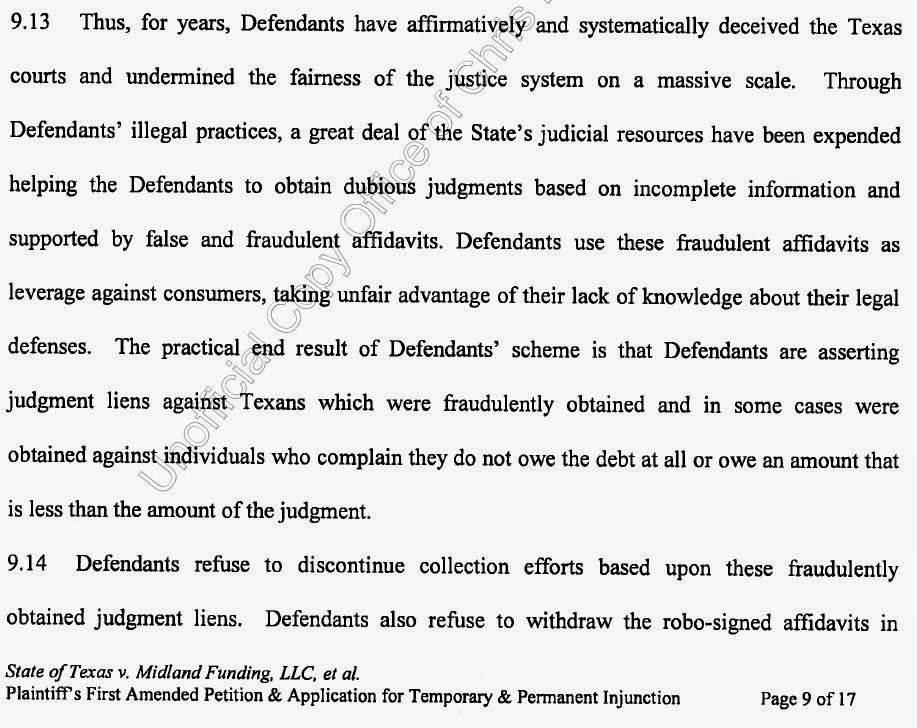
This enforcement action was filed July 8, 2011 in Harris County District Court over robo-signed affidavits in massive numbers of Midland debt collection suits filed across the State of Texas in recent years. 


Excerpt from amended pleading filed by Texas AG against Midland Funding LLC et al
over robosigning

The AG's lawsuit resulted in an Agreed Final Judgment and Assurance of Voluntary Compliance half a year later after several rounds of amended pleadings. The Defendants agreed to pay a half-million dollar fine and to shape up with respect to affidavit production and account documentation. Affected consumers got a discount on the amounts of the questionable judgments against them, but weren't precluded by the settlement with the Attorney General (State of Texas) from invoking other remedies on an individual basis. (The obvious one would be a bill of review proceeding in the court that signed the (default) judgment).

STATE OF TEXAS v. SAMARA PORTFOLIO MANAGEMENT LLC; LAW OFFICE OF JOSEPH ONWUTEAKA, PC; and JOSEPH O. ONWUTEAKA, individually.

This enforcement action was brought by the Consumer Protection Division of the AG's Office to stop Attorney Onwuteaka from suing borrowers of high-interest loans in Justice of the Peace Patronella's court in Downtown Houston even though they do not live in Harris County. -- > Mandatory venue violation.
  
In addition to penalties of monetary character, the Attorney General also seeks injunctive relief as he did in the action against Midland and its corporate parent and servicer. 


State of Texas through its Attorney General vs Samara Portfolio Management
Enforcement action under DTPA and Texas Debt Collection Act

Samara Portfolio Management LLC is a debt purchaser that is actually owned by Attorney Joseph Onwuteaka and his wife. He basically hires himself to collect the accounts that he buys up and owns through his LLC (Limited Liability Company).  


CASE STYLE: State of Texas v Samara Portfolio Management, LLC et al; Cause No. 2013-35721 in the 80th Judicial District Court of Texas (Harris County)(click link for May 16, 2015 update on status of litigation and record of debt collection attorney Joe Onwuteaka.


Saturday, November 30, 2013

Venue violations - What remedies when consumer gets sued in the wrong county & court?


What if a consumer is sued on a credit card debt where he does not live? There will likely be relief available: Motion to transfer venue and/or motion to dismiss the improperly filed suit; and possibly a cause of action under fair debt collection laws. This post focuses on the latter, the FDCPA in particular.

FEDERAL & STATE VENUE RULES FOR DEBT SUITS

Mandatory venue under federal law: Cardholder must be sued in county of residence

Under the FDCPA, a consumer must be sued in the county in which he or she lives or where the loan contract was signed. In credit card cases, the consumer typically signs no contract (except perhaps if the card is issued by a credit union); therefore there will typically only be one applicable venue, which would be mandatory, i.e leaving the debt collection attorney no choice in the matter. Another exception, involving location of real estate, is not applicable either, because consumer credit card debt is not a mortgage, and typically not secured at all, at least not in Texas.

If the consumer gets sued elsewhere, he or she may have a case under the fair debt collection laws in addition to being entitled to transfer of venue under the Texas Rules of Civil Procedure.  -- > Motion to Transfer of Venue under  TRCP.

The venue restriction on debt suits imposed by the FDCPA is found at Section 1692i(a)(2) of Title 15 of the United States Code, cited as 15 U.S.C. § 1692i(a)(2).

Mandatory venue under Texas law: Credit card debt suit must be filed in county where cardholder resides
The Texas Civil Practice and Remedies specifies where civil lawsuit may or must be brought. "May be brought" is called permissive venue and "must be brought" goes under the rubric of "mandatory venue". For consumer debt, the rules mirror the federal venue rule: the lawsuit against the consumer seeking collection of debt must be filed either where the contract was signed (if there is a signed contract) or where the consumer lives.

Texas Civil Practice & Remedies Codes also has strict rule for venue 

Venue for consumer credit cases is governed by Section 15.035(b) of the Civ. Prac. & Rem Code, which mandates that venue is proper in either the county of the consumer's residence or the county in which the consumer signed the contract. The CPRC also expressly states that this provision cannot by waived by the consumer.

Enforcement of venue provision against debt collector with a record of massive violations 

The Texas Attorney General recently brought an enforcement action against an attorney for routinely suing debtors in Justice Court court in Downtown Houston (JP Court of Harris County Precinct 1 Place 2) even though they lived outside the county and had no connection to Harris County. The civil action was filed by the Consumer Protection Division in the public interest and seeks a permanent injunction and hefty monetary penalities to be paid to the State of Texas. As of November 2013, it is still pending in Harris County District Court: State of Texas vs. Samara Portfolio Management LLC; Law Office of Joseph Onwuteaka, PC, and Joseph O. Onwuteaka, individually.

Case Style on complaint filed by AG: State of Texas v. Samara Portfolio Management LCL
TDCA Enforcement Action (above) and factual allegations section (below)


VENUE VIOLATION BY DEBT COLLECTION ATTORNEYS AS AN FDCPA CLAIM 

Under the FDCPA, unless a debt collector is suing to enforce an interest in real property, it must bring any action on a debt against a consumer in the judicial district where the consumer signed the contract at issue or in the judicial district where the consumer resided when the suit was filed. 15 U.S.C. §1692i(a)(2).
Note that the federal judicial district is not coextensive with a county (a political subdivision of the state), wherefore caselaw should be researched to determine whether a venue violation can be asserted in good faith in a particular case, such as when the defendant is sued in the wrong JP court precinct within a county.
Lawsuits on behalf of corporations are mostly filed by attorneys because corporate officers who are not attorneys are not permitted to sue and sign pleadings as agents of corporate entities unless they bring the lawsuit in justice court. -- > Can a corporate entity appear in court without lawyer?

To assert a venue-violation claim against an attorney under the FDCPA, it must be shown that the attorney meets the federal definition of debt collector. The FDCPA covers attorneys, but not all attorneys under all circumstances in which a questionable or clearly prohibited act occurred (such as a violation of the federal venue rule). An attorney only faces liability under the FDCPA for such act if he or she meets the statutory definition of "debt collector". The key element of that definition is the "regularity" of the debt collection activitities. -- > When can attorneys be sued for FDCPA violations?

The FDCPA has one-year statute of limitations. Therefore, a remedy may no longer be available under the FDCPA even if a violation could easily be proven and even if the attorney meets the statutory definition. In those instance where the claim of unfair debt collection is time-barred under federal law, it may be worth considering the TDCA as an alternative.

RELATED TOPICS RELATED TO FAIR DEBT COLLECTION COMPLIANCE: 

When are collection attorneys subject to liability under the FDCPA?
What is a covered debt under the FDCPA?
Texas Debt Collection and federal Fair Debt Collection Practices Act: Compare and Contrast
Texas AG civil injunction suits to enforce compliance with state fair debt collection statute


Friday, November 29, 2013

Do debt collection attorneys have to comply with the FDCPA? Are they covered?


FDCPA When do attorneys face liability under the federal Fair Debt Collection Practices Act?

Can collection attorneys be sued under the FDCPA if they engage in deceptive or otherwise prohibited conduct?  

In principle, yes, but not always. The debt at issue must be a consumer debt and the attorney must meet the definition of debt collector that is set forth in the act. A single debt collection suit would not make the filing attorney a debt collector (under the FDCPA) because the statute says that it applies only to those who engage in debt collection on a regular basis.

WHO IS A DEBT COLLECTOR UNDER THE FDCPA? and WHEN DOES THIS APPLY TO COLLECTION ATTORNEYS?  

Attorneys qualify as debt collectors for purposes of the FDCPA when they regularly engage in consumer debt collection, such as litigation on behalf of a creditor client that is a national bank or other financial institution, or an assignee of an original creditor.

Numbers matter

A person may “regularly” collect debts even if debt collection is not the principal purpose of his business. If the volume of a person’s debt collection services is great enough, it is irrelevant that these services only amount to a small fraction of his total business activity. Whether a party "regularly" attempts to collect debts is determined, of course, by the volume or frequency of its debt-collection activities.

What is 'regular'?

But there is no clear-cut rule or yardstick that can be used to determine what amounts to regular, so the status issue may have to be litigated in the particular case, unless the attorney's correspondence expressly states that the attorney is a debt collector on its paperwork (correspondence and pleadings) or concedes the issue in the course of an FDCPA action. In a complaint filed in federal court, specific allegations must be set forth in the initial pleading, including those pertinent to the essential elements of a cause of action, and the defendant must admit or deny each allegation in his answer.

Status definition not vague

At some point the definition of “debt collector” in 15 U.S.C. § 1692a(6) was challenged as unconstitutionally vague, but the Fifth Circuit Court of Appeals decided that it was not, pointing out that it was a statute that regulates economic activty and provides for civil penalties rather than jail, and that courts have managed with the statutory definition for a long time since FDCPA was enacted with no major problems in making the necessary determinations as to debt collector status under the Act on a case-by-case basis.

When the federal act is not available

Note that the FDCPA has a state law counterpart, the Texas Debt Collection Add (TDCA). The TDCA (also abbreviated DCA with the T for Texas omitted) uses a different definition of those covered by it, which includes original creditors, and differs in other significant respects. -- > Suing under the Texas Debt Collection Act.

STATUTORY DEFINITION OF DEBT COLLECTOR UNDER FDCPA


LEADING CASE FOR LAWYERS AS FDCPA DEFENDANTS

Heintz v. Jenkins, 514 U.S. 291, 292 (1995) (litigating lawyers are not exempt from the FDCPA if they otherwise qualify as debt collectors)

RELATED FAIR DEBT COLLECTION TOPICS

Consumer's counterclaim under federal and state fair debt collection laws
Federal vs state regulation of debt collectors: FDCPA and Texas Debt Collection Act
Differences between FDCPA and TDCA: Who is covered, what type of debt, and what conduct provides grounds for relief?
What is a consumer debt under federal fair debt collection practices law?
Mandatory venue violations: Consumer sued in the wrong county and wrong court 


What is consumer debt under the Fair Debt Collection Practices Act (FDCPA)?


THERE IS DEBT AND THERE IS DEBT ...

NOT ALL DEBT IS ALIKE UNDER CONSUMER PROTECTION LAWS THAT GOVERN DEBT COLLECTION AND DEBT COLLECTORS   

Debt collection activities are regulated by the federal debt collection practices act, which contains a list of no-nos that constitute violations, but are actionable under the FDCPA only if the debt sought to be collected is a consumer debt as opposed to a business debt. Other limitations also apply.-- > Who is a debt collector under the FDCPA?

If the debt is a business debt, no private remedy is available under the FDCPA. But see  -- > Texas DTPA and Texas Debt Collection Act.

American Express, for example will insist, either as a term of granting credit in the first instance, or by way of notice to card holders later, that certain types of credit or charge cards it issues are business cards and may only be used for business purposes even if the cardmember is an individual operating a sole proprietorship, which is not a distinct legal entity under Texas law.

American Express is known for issuing cards in the names of both business and owner even if the business is merely an assumed name (aka DBA for "doing business as") of an individual, i.e. a natural person as opposed to corporate entity (such as a PC, a PLLC, a LLC, or a INC). The apparent reason for this is to take the account out of the scope of the FDCPA and out of other consumer protection laws employing the same or a similar definition that also exclude business debt.

So what qualifies as consumer debt?

FDCPA DEFINITION OF CONSUMER DEBT 

The FDCPA defines a “debt” as follows:
[A]ny obligation or alleged obligation of a consumer to pay money arising out of a transaction in which the money, property, insurance, or services which are the subject of the transaction are primarily for personal, family, or household purposes, whether or not such obligation has been reduced to judgment.
15 U.S.C. § 1692a(5) (2000). U.S.C. stands for United States Code, with the number preceding it referring to the Title, and the number behind it to the relevant Section within the Title. The FDCPA is part of the federal Consumer Protection Act.

Definition of debt for purposes of FDCPA liability
HOW IS THE FDCPA CITED? 

General cite for federal law protecting consumers against unscrupulous collection actions:

Fair Debt Collection Practices Act 15 U.S.C. § 1692, et seq.

TOPICS AND ISSUE IN (UN)FAIR DEBT COLLECTION 

Can attorneys be sued for violations of the FDCPA? 
Who is a debt collector under the federal FDCPA?
Federal FDCPA and TDCA compared
Enforcement of fair debt collection practices by the Texas Attorney General Consumer Protection Division


Friday, November 22, 2013

Default Judgment: Appeal, Post-Judgment Motion, and Bill of Review


Default judgment entered. Judgment granted for Plaintiff. -- Now what?  


ATTACKING DEFAULT JUDGMENTS AND OTHER JUDGMENTS 

This article discusses, in general terms, what options may be available to the consumer once a judgment has been entered for the creditor. It focuses on legal remedies to attack the judgment, not on efforts to settle the case in order to avoid enforcement in the form of execution or garnishment, topics left for another day. 

Also see more recent article on --> TRAPs and PITFALLS in pro se appeals and --> Sample Briefs 
  
APPEALS, BILL OF REVIEW, and POST-JUDGMENT MOTIONS 
  
It makes sense to discuss appeals and bill of review together, at least in an article that provides a general overview because the purpose of appeal and bill of review are the same: to attack an adverse judgment. 
  
They are nevertheless two rather different vehicles, and come into play under different circumstances.   
  
The bill of review procedure applies in the trial court and may be available for as long as four years after the judgment was signed (and sometimes even potentially longer when the defendant was unaware that the judgment even existed). The timeframe for appeals, by contrast, is much shorter. More on appellate deadlines below.   

A bill-of-review proceeding is initiated to attack a default judgment while an appeal may be brought to challenge a variety of judgments: a default judgment; a summary judgment; or a judgment entered after trial on the merits.
  
A bill-of-review petition is filed in the trial court that granted the judgment. An appeal, by contrast, is taken to the court of appeals in whose geographic jurisdiction the county or district court is located, though the notice of appeal must be filed in the trial court. (Appeals from justice court, also called JP Court, are another matter; they go to county court and have their own set of rules).  

Both bill of review and appeals - ordinary appeal and restricted appeal -  have specific requirements that must be satisfied. If the judgment was entered recently (within the last 30 days), it may be possible to attack the judgment by post-judgment motion in the trial court, such as a motion for new trial or a motion to set aside the default judgment; or a motion to modify the judgment.

All such post-judgment motions have to filed within 30 days counting from the date the judgment was signed by the judge (which may differ from the hearing or trial date). It may be necessary to obtain a copy of the judgment from the clerk to be sure of the correct date. An extension may be available if the defendant did not become aware of the judgment until some point later, but the time frame under the rule that extends post-judgment deadlines under special circumstances is also restricted. -- > Late notice of judgment and motion under Rule 306a.  

DEADLINES THAT REALLY KILL 

The timing rule for post-judgment motions is very harsh. Such motions must be filed within 30 days or the plenary power of the trial court will automatically expire, meaning that the judge could no longer set aside the judgment even if inclined to do so. Sometimes judges set aside and alter judgment only to have the second judgment declared void by a higher court. 
  
The deadline for appeals is also 30 days, but the rules for appeals are more lenient in two respects: 

First, a tardy would-be appellant may qualify for a 15-day extension to file the notice of appeal; second, in the case of a default judgment, the consumer may be able to bring a restricted appeal up to six months after the judgment was entered if he or she did not file a post-judgment motion or a timely notice of appeal to initiate a regular appeal. As the name suggests, a restricted appeal is more limited in other respects. It also requires a different notice of appeal. 

But the road to the court of appeals has booby traps too. In an appeal from a bench trial, findings of facts are needed in most cases, and the request for those is due before the notice of appeal itself is due: 20 days from the date of the judgment. -- > Findings of Facts and Conclusions of Law. And if the trial court is tardy in issuing findings, the prospective appellant has the burden to file a reminder called a past-due notice. 

TYPES OF APPEALS

The fourteen intermediate courts of appeals in Texas hear and decide various categories of appeals from county and district courts, not all of which are relevant to debt collection litigation. Among those that pertinent are the following: (1) appeals from final summary judgments; (2) appeals from final judgments entered after a bench trial (almost never a jury trial in collection cases); (3) direct (regular) appeals from default judgments; (4) restricted appeals from default judgments after the deadline for a regular appeal has passed. (Mandamus proceedings, which like an appeal by a different name and different rules and standards need not concern us here). 

Typically, the urge, need, or desire to appeal arises after a final judgment has been entered against the Defendant. Appeals during the pendency of a lawsuit are exceedingly rare in debt litigation. That category of appeal is called interlocutory, and must be specifically authorized by statute. The circumstances that give rise to a right to an appeal before a final judgment seldom occur in debt collection suits, but there are exceptions, as there are to almost any rule and generalization:   

IMMEDIATE APPEALS WHILE A LAWSUIT IS PENDING 

Interlocutory appeals are not a regular feature of debt collection litigation. But there are two possible exceptions: immediate appeals relating to arbitration (denial of motion to compel arbitration); and appeal of an adverse ruling on a contest to personal jurisdiction through what is called "special appearance" under Rule 120a. The latter scenario rarely occurs because consumers in debt collection suits must be sued in the county in which they reside, not merely in the state in which they live.

If a cardholder is sued in the wrong county, the remedy is a motion for transfer of venue (and a possible unfair debt collection claim based on the mandatory venue violation). Because of potential legal liability, however, debt collectors have good reason to make sure they don’t see in the wrong court. Collectors who flout the rule even risk enforcement action by consumer protection authorities. Example: Texas AG's action against Joseph Onwuteaka and his debt collection firm over mandatory venue violations: State of Texas v. Samara Portfolio Management LLC in Harris County District Court. 

As for personal jurisdiction issues involving foreign defendants, they are much more common in commercial litigation against companies and their directors and/or owners, not consumers.

The most common forms of appeal in debt litigation are (1) ordinary appeal from a final judgment -- either a summary judgment in favor of the creditor or a judgment entered after a bench trial -- and (2) restricted appeal, which is a special form of appeal that affords a remedy for default judgments under certain conditions. Sometimes, it is the creditor that appeals when the consumer prevails in the trial court. 

BILL OF REVIEW VS. APPEAL

A bill of review proceeding is a method to attack a judgment that is no longer appealable because it has become final and the deadlines for regular and restricted appeal have passed. Unlike appeals, a bill of review is filed in the trial court in which the judgment was rendered. As such, it looks more like a regular lawsuit initiated by petition (though it must be sworn). 

The bill-of-review case may be assigned a new cause number just as all other freshly filed civil suits; or it may be given the original cause number with an extension added (a hyphen plus an additional digit or letter). Regardless of how a particular county or clerk denominates the bill-of-review case, its purpose is to persuade the trial judge to set aside the final judgment in the earlier case, and thereby -- essentially -- revive that lawsuit. If the bill of review is granted, the effect will be that the parties are returned to the position they were in before the judgment was granted. This means that the case is re-opened, and will have to be tried or disposed of in some other fashion. To complicate matter further, in a bill-of-review proceeding the judgment debtor who was the defendant in the collection suit is now the petitioner (plaintiff) and the creditor is the defendant. If the case is reopened, the parties sometimes revert to their original designations. As a further wrinkle gets added when the judgment was assigned to a new owner. Suffice it say, to reopen a default-judgment case by bill of review can be a rather daunting proposition. 

An appeal, by contrast, involves a proceeding in a higher court that seeks to convince the higher court that the trial judge erred, or that there was some other problem, such as a defect in service (which the trial court judge may not have noticed and may not have been made aware of). There may be variety of outcomes: reversal and remand to the trial court; reversal and rendition of judgment in the appellant's favor; affirmance of the trial court's judgment, and partial reversal. Sometimes the courts of appeals correct a minor matter, such as deleting a word or item or adjusting the interest rate, and characterize the disposition as "affirming the judgment as reformed". 

TAKING AN APPEAL: NO EASY TASK

There are many requirements for a successful appeal, and many procedural traps along the way. It is almost impossible for a pro se litigant to be successful on appeal, though not unheard of either. Most pro se appeals in debt suits are either dismissed or denied, and even those brought with attorneys often fail, for a variety of reasons. -- > appellate decisions in debt litigation 

Dismissal is the virtually guaranteed outcome if the appellant does not pay the appellate filing fee ($205 as of 2018) or does not pay for the clerk's record (cost depends on number of pages needed for the appeal). Appeals from judgments resulting from bench trials normally also require a reporter’s record (cost depends on length measured in words spoken and transcribed; with fees charged per page). The reporter’s record should be much shorter, and cheaper, compared to other civil cases involving comparable dollar amounts in damages because little or no oral testimony is typically presented, as most if not all of the evidence is in the form of documents submitted with a business records affidavit.  

Other forms of noncompliance can also entail dismissal, such as failing to file the required appellate docketing statement. Unrepresented litigants typically do not know how to draft an appellate brief, and often violate multiple rules of form. 

They will typically be given another chance (ordered) to submit a compliant brief by a specified deadline, but a fundamental lack of familiarity with the appellate process cannot be remedied within a matter of weeks; not to mention presenting a strong argument on the merits, supported by relevant legal authority (case law). If an argument on appeal is not supported with citations (to relevant published opinions in earlier cases and to the record in the case before the court), the argument is waived, and the justices will often not even consider it. 

The panel hearing the case will often overlook defects in form that remain in the resubmitted pro se brief, but will very likely rule against the unrepresented appellant on the merits, often based on failure to preserve error in the trial court, such as not making objections at all, or not giving a ruling on them. 

Most pro se appeals thus fail, assuming they even reach decision the decision stage. -- > Common error on appeal 

That said, default judgment are easier to attack than decisions on the merits, especially when the defendant was not (properly) served with process ( -- > Defect in service of citation) or was not given notice of the trial or hearing. One of the most critical issues is the date the defendant becomes aware that a default judgment was entered and/or hires an attorney who can assess the case and see if there is a viable basis to attack it. 

The clerk of the court will typically mail notice that a judgment was entered to the defendant's last known address, but that may not be the correct one. If the defendant does not take action promptly, it may be too late to undo the judgment, unless the requirements for a bill of review are satisfied. 

A bill of review, however, is an equitable remedy, and as such leaves a lot of discretion to the judge to grant or deny it, depending on the reason that led to the default judgment and whose fault it was. An additional complicating factor is that oftentimes the judge hearing the bill of review will be the same that signed the judgment that is being attacked. If the judge made an error, it can be a delicate matter asking the same judge to correct it since the bill of review plaintiff would have to convince the judge of some wrongdoing or an oversight the last time around. In an appeal, by contrast, it is three justices on a higher court that review the actions of the judge in the court below, and they do it on a daily basis for a living. 


Last revisions 12/8/2018